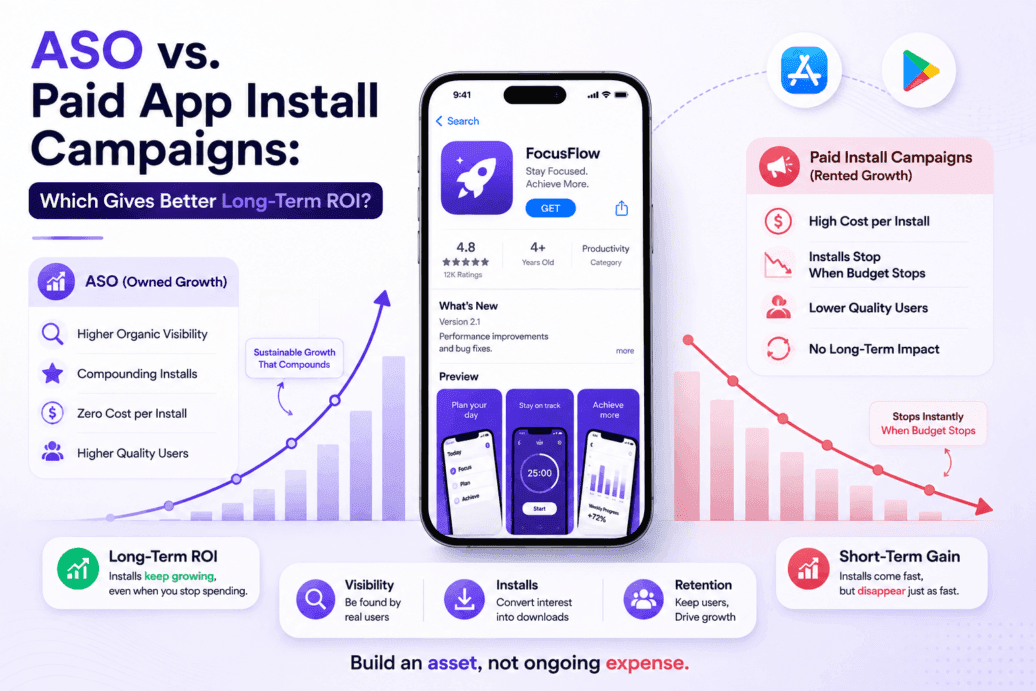
ASO vs. Paid App Install Campaigns: Which Gives Better Long-Term ROI?
Algomindz SEO Team · August 23, 2026 · 10 min read
Key takeaways
- ASO and paid install campaigns buy fundamentally different things: ASO earns installs you keep, while paid campaigns rent installs that stop the moment the budget does.
- Organic installs earned through ASO carry no per-install cost once the optimization work is done, whereas paid install costs keep climbing as competition and privacy-driven targeting changes tighten.
- ASO typically takes three to six months to compound, so it rarely replaces paid campaigns in a launch window, but it tends to outperform them well after the same spend has stopped.
- Organic app users convert to paying users at roughly three times the rate of paid installs and retain better early on, because they arrived by searching with real intent.
This is the actual shape of the ASO versus paid install decision, and it’s worth working through properly rather than defaulting to whichever one produces a more satisfying dashboard in week one.
The Real Difference: Owning Installs vs Renting Them
Every app growth channel falls into one of two categories, and which one you’re funding changes what you should expect from it.
Paid app install campaigns, whether through Apple Search Ads, Google App Campaigns, or social ad networks, are rented visibility. You pay for placement, that placement generates installs for as long as the budget keeps flowing, and the moment it stops, so does the traffic. Nothing about a paid campaign carries forward into next month on its own.
ASO is an owned asset. A keyword ranking you’ve earned, a conversion-optimized product page, an accumulated base of positive reviews, all of it keeps generating organic installs without a new payment every time someone searches. The optimization work you did four months ago doesn’t stop working just because this month’s budget didn’t include another round of it. It keeps compounding, the same way a well-ranked webpage keeps earning organic search traffic long after the content was published.
The Data: ASO’s Return Compounds, Paid Campaigns Reset
This isn’t just a comforting story, the actual performance data backs it up clearly.
Because organic installs earned through App Store Optimization carry no per-install cost once the underlying optimization work is done, industry analysis describes ASO as having the strongest long-term ROI of any app growth channel, since the marginal cost of each additional organic install is effectively zero. For a well-optimized app, ASO alone typically accounts for 30% to 60% of total installs, a substantial share of total growth that isn’t costing anything per install once the work is in place.
The quality difference matters just as much as the cost difference. Research from data.ai found that organic installs convert into paying users at roughly three times the rate of paid installs, and separate analysis found organic users showing 15% to 25% higher Day-1 retention than users acquired through paid channels. The underlying reason makes intuitive sense: someone who found your app by actively searching for what it does has already expressed genuine intent, while someone served a paid ad while scrolling something unrelated hasn’t necessarily expressed any intent at all yet. That gap in intent shows up directly in whether they stick around.
There’s a genuine cost-reduction effect too. Businesses investing seriously in ASO have been able to reduce their blended user acquisition costs by up to 60%, since a stronger, better-converting product page doesn’t just win more organic installs, it also improves the conversion rate of every paid click landing on that same page, making the paid budget itself more efficient at the same time.
Why the Cost of Renting Users Keeps Climbing
The case for ASO gets stronger every year for a simple reason: paid app install costs keep rising, and they show no sign of reversing.
Current benchmarks put the global average cost per install at around $2.24 on iOS and $1.12 on Android, and that number climbs considerably higher in competitive regions, reaching roughly $3.40 on iOS and $1.85 on Android in Europe. Channel choice matters too, current data puts TikTok Ads as one of the cheaper acquisition channels at around $2.45 per install, while influencer marketing runs closer to $4.20, and those figures shift constantly as ad networks adjust pricing and competition for inventory changes. A meaningful part of the overall increase traces back to privacy changes like Apple’s App Tracking Transparency framework, which made precise ad targeting harder and pushed campaigns toward broader, less efficient audiences to hit the same install volume. The pattern is structurally identical to what’s happened with paid advertising on the open web: as more apps compete for the same limited ad inventory, and as targeting gets less precise, the price of every install climbs, regardless of how well any individual campaign is run. ASO doesn’t carry this same structural cost inflation, because its value comes from optimization work you’ve already done, not from an auction you have to keep winning every single day.
What Compounding Actually Looks Like in Practice
The idea of ASO “compounding” is easy to state and harder to picture, so it helps to see it in concrete terms. Based on a conservative modeling framework from SplitMetrics, a solid round of ASO improvements, better keyword targeting alongside stronger screenshots and metadata, might add roughly 8% more organic installs while also lifting product page conversion rate by around 10%. Those two gains don’t just add together, they multiply, since more people finding your listing and a higher share of them converting compound into a meaningfully larger result than either improvement would produce alone. Now extend that same improved listing across every month going forward, still earning that lift without a repeat payment, while a paid campaign covering the same three-month window produced installs only for exactly as long as the money was flowing and produced nothing at all in month four without another round of spend.
What This Means for Bangladeshi App Developers Specifically
The core economics here apply everywhere, but the opportunity is sharper in a market like Bangladesh’s growing app ecosystem, where relatively few local developers have invested seriously in structured ASO yet. Most local competition for app store visibility either hasn’t optimized their listings at all or is relying entirely on paid installs to manufacture short-term download spikes, often around a launch, without any lasting organic foundation underneath. A Bangladeshi app that does the ASO work properly is competing for organic visibility in a considerably less crowded field locally than the same effort would face in a saturated market like the US, while still facing real competition from global apps with far larger paid budgets. That combination, real local opportunity paired with the same cost pressure everywhere else, makes ASO an even higher-leverage investment here than the global averages alone suggest.
There’s also a currency dimension worth naming plainly. Paid install costs, like most digital advertising, are typically billed in US dollars through platforms like Apple Search Ads and Google Ads. For a Bangladeshi developer, that means a rising global CPI trend isn’t just an abstract industry statistic, it’s a cost that fluctuates with exchange rates and eats into a marketing budget that was likely set in local currency terms. ASO work, by contrast, is a one-time or ongoing service cost rather than a per-install auction price, which makes it considerably easier to budget for predictably over a full year rather than watching a paid campaign’s efficiency erode as global ad prices shift.
When Paid Install Campaigns Are Still the Right Call
None of this makes paid app install campaigns a poor decision, it makes them the wrong tool for a job they were never meant to do alone. Paid campaigns remain the right call for generating visibility and download volume in the earliest days after launch, when an app has no organic ranking history at all and needs some initial traction before ASO improvements even have installs to work with. They’re also genuinely useful for testing messaging, audience segments, and creative approaches quickly, generating real data about what resonates before committing months of ASO effort in a specific direction. And there’s a real, well-documented interaction between the two channels worth knowing: research from Yodel Mobile found that paid app install campaigns can boost organic ASO performance by up to 148%, since a burst of paid installs sends the store’s ranking algorithm a strong volume and engagement signal that can lift organic visibility at the same time.
The mistake isn’t running paid campaigns, it’s running them indefinitely as the only growth channel while never building the ASO foundation that would make every one of those paid clicks convert better and eventually reduce how much paid spend is needed at all. The strongest app growth strategies use paid campaigns exactly where they’re strongest, fast, testable, immediate, while letting ASO quietly build the compounding organic foundation that keeps generating installs long after any single paid campaign has ended.
The Bottom Line
Paid app install campaigns will always win the race for the first thirty days, in the same way paid web advertising always wins the first month against SEO. ASO wins every month after that, for as long as the underlying optimization work is maintained, without paying an ever-rising per-install price all over again. The app businesses treating ASO as a real, ongoing investment rather than an afterthought to their paid budget aren’t just saving money over time, they’re building an asset that keeps converting better, retaining longer, and costing less per install than the channel that has to be paid for every single day just to keep functioning.
Want an app growth strategy that combines ASO with the surrounding SEO and AEO work that drives discovery beyond the app store itself? Talk to our team about a long-term approach to app visibility, or explore our full portfolio of case studies to see the results behind this kind of strategy.
Want more of our work in your Google results?
Frequently asked questions
Yes, based on consistent industry data. Once the core optimization work is done, organic installs earned through ASO carry no additional per-install cost, while paid campaigns require ongoing spend that has been climbing steadily due to rising competition and privacy-driven targeting changes.
Comments
No comments yet. Be the first to share your thoughts.