
Why Having a Great App Isn’t Enough If Nobody Can Find It
Pujan Kumar Saha · August 21, 2026 · 12 min read
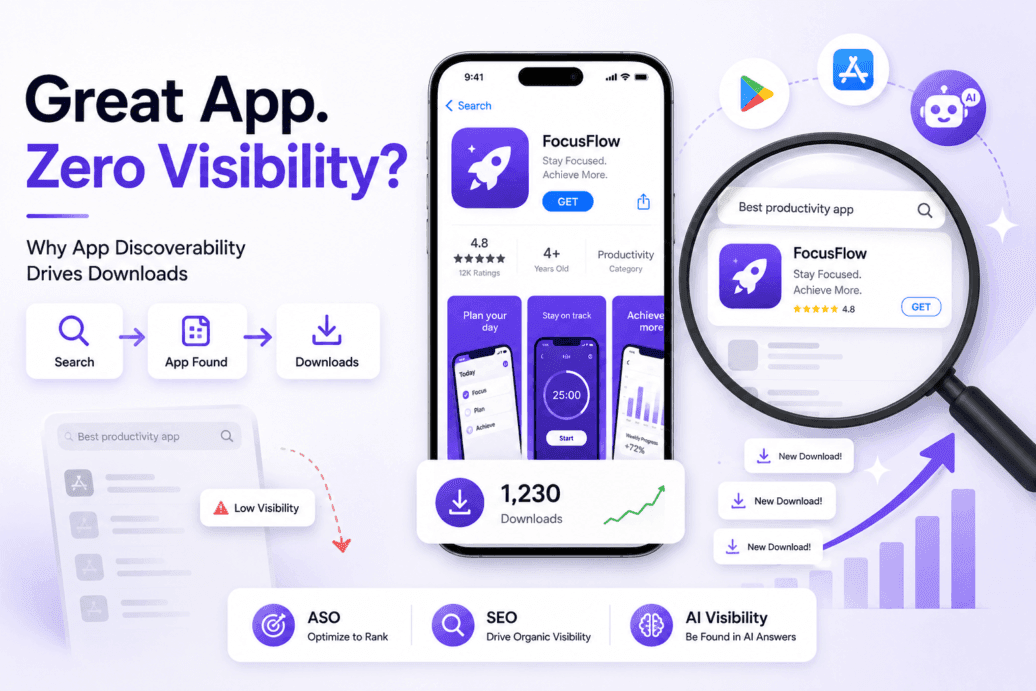
Key takeaways
- A well-built app that ranks on page eight of an app store search is functionally invisible, because almost nobody scrolls that far to find it.
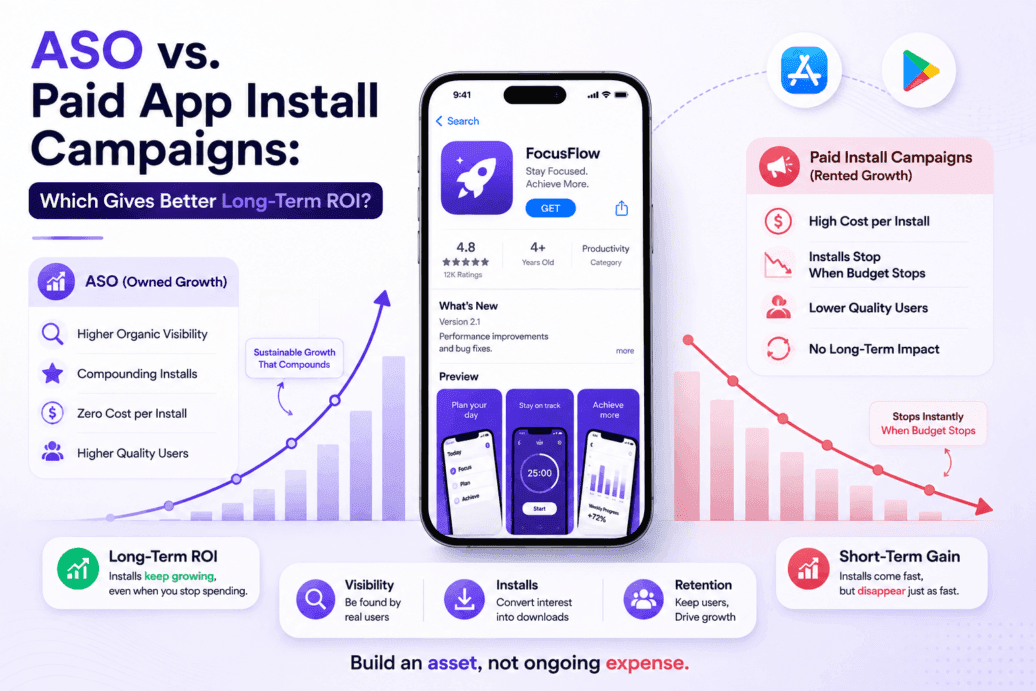
- Paid install campaigns do not fix a discoverability problem; they mask it, because installs stop the moment spending stops and the underlying store ranking never improved.
- App Store Optimization covers the fundamentals most founders skip: keyword-targeted titles and subtitles, tested screenshots, review management, and a listing written for how people actually search.
- AI assistants are becoming a genuine app discovery channel, which means an app needs a findable web presence and content, not just a store listing.
Just like a great website with no SEO behind it quietly fails to reach the customers it was built for, a great app with no discoverability strategy behind it fails the exact same way, for the exact same underlying reason. Quality was never the bottleneck. Being found was.
The App Store Is Bigger and Noisier Than Most Founders Realize
It helps to see the actual scale of what a new app is launching into. Combined, the Apple App Store and Google Play now host somewhere north of five million apps, and that number keeps climbing fast. Roughly 3,700 new apps are submitted to the Apple App Store every single day, and Google Play adds another 1,200 to 1,250 daily. Your app isn’t just one of five million. It’s one of thousands added on the very same day it launched, all competing for the same limited amount of user attention, screen space, and search visibility.
This is why the phrase “build it and they will come” simply doesn’t hold up in a mobile app context anymore, if it ever really did. Somewhere in that flood of daily submissions are apps just as well-built as yours, and most of them will never be found by more than a handful of people, not because they’re bad, but because nobody structured them to be discoverable in the first place.
The Funnel Nobody Talks About
Founders tend to think about app success in a single number, downloads, the same way website owners used to think about success purely in terms of traffic. In both cases, that single number hides several distinct stages, each with its own drop-off, and each one worth understanding on its own.
Visibility comes first, and it’s the stage most apps fail at before anything else even has a chance to matter. An app has to actually appear when someone searches a relevant term, browses a category, or gets served a recommendation. Research on app discovery consistently finds that somewhere between 58% and 70% of all app downloads originate from a search inside the store itself, with the number running even higher, up to 70%, for non-gaming apps specifically. If your app doesn’t surface in that search, the rest of the funnel never gets a chance to happen. On iOS specifically, search accounts for roughly 65% of discovery, with browsing making up about 18%, referrals around 12%, and paid ads trailing behind at roughly 5%, a clear signal that organic search visibility inside the store matters more than almost any other single channel.
Once someone actually sees your app’s listing, the next stage is whether they tap through to view it, and then whether that view converts into an actual install. Industry benchmarks put the average tap-through-to-install rate at around 33% on iOS and 28% on Google Play, meaning even among people who already saw your listing and were interested enough to open it, roughly two out of three still walk away without installing. This is where your screenshots, your app icon, your description, and your ratings either close the deal or lose it, often within a few seconds of someone’s attention.
Finally, and this is the stage that determines whether any of the above was actually worth it, comes retention. Getting downloaded and getting used are two different outcomes, and an app that’s optimized purely to win the download without giving real thought to the first-use experience often sees a large share of new installs disappear within days. Visibility gets someone to your door. Everything after that determines whether they stay.
Why “Just Run Ads” Doesn’t Actually Fix This
The instinctive response to poor visibility is often to throw a paid user acquisition budget at the problem, and while paid campaigns can genuinely work as a short-term lever, they don’t solve the underlying discoverability gap, they just rent a temporary workaround for it. The average cost per install has climbed past $3.50 on iOS and $1.20 on Google Play industry-wide, and like most paid channels, that cost tends to rise over time as more apps compete for the same limited ad inventory, not fall. The moment the ad budget stops, so does the flow of new installs it was generating, and the app is right back to relying on whatever organic discoverability it actually has, which, if none of the underlying work was ever done, is usually very little. This is the same owned-versus-rented dynamic we’ve covered in detail in our piece on why SEO functions as a long-term investment, and it applies to app discoverability just as directly as it applies to a website.
What Actually Makes an App Discoverable: The Basics of ASO
App Store Optimization, often shortened to ASO, is genuinely the closest mobile equivalent to SEO that exists, and the comparison isn’t just a loose metaphor, the underlying mechanics are strikingly similar. A few fundamentals matter most.
Keyword placement in your app’s title and subtitle carries real weight, since these are the fields store algorithms weigh most heavily when deciding which searches your app should appear for. An app named something clever but disconnected from what it actually does is quietly invisible to the exact searches that would otherwise find it.
Your screenshots and icon do more work than most founders expect, because users make a judgment about whether to tap through in a matter of seconds, long before they read a single word of your description. Custom, purpose-built product pages have been shown to lift conversion rates by 20 to 35% compared to a generic default listing, a meaningful difference for the exact same underlying app.
Ratings and reviews function as both a trust signal to users and a ranking signal to the store’s own algorithm. A handful of critical early reviews left unanswered can quietly suppress an otherwise strong app’s visibility, while a steady stream of positive, recent reviews signals to the algorithm that people are genuinely satisfied, which tends to be rewarded with better placement.
None of this is a one-time setup. Competitors update their own listings, seasonal search terms shift, and the algorithms themselves change. Treating ASO as something you configure once at launch and never revisit is one of the most common reasons an app’s visibility quietly declines over time even without anything obviously going wrong.
The Part Most App Founders Completely Miss
Here’s the gap that catches even founders who’ve done real ASO work: optimizing your listing only helps with people who are already inside the app store, actively searching for something like what you built. A large share of your actual potential users haven’t gotten there yet, because they don’t know an app is the answer to their problem, they’re still describing that problem in a regular Google search.
Someone typing “how do I track my daily expenses without a spreadsheet” or “easiest way to send money to family in Bangladesh” is expressing exactly the need your app might solve, but they’re doing it on the open web, not inside an app store, and no amount of app store keyword optimization reaches them there. This is where a proper marketing website and real content strategy around your app become genuinely necessary rather than optional polish. A well-optimized landing page and supporting content, built around the actual problems your app solves rather than just your app’s name, captures this much larger audience of people who are problem-aware but not yet app-aware, and guides them toward a download through a deep link rather than leaving that entire audience undiscovered. This is standard SEO strategy work, applied to a product that happens to live in an app store instead of purely on the web, and it’s frequently the single most underused growth lever available to app founders who’ve already done their ASO homework.
AI Assistants Are Becoming an App Discovery Channel Too
The discovery landscape is shifting again, and it’s worth getting ahead of rather than reacting to later. A growing number of people now ask an AI assistant directly, “what’s a good app for tracking expenses” or “is there an app that helps with X”, before ever opening an app store search bar themselves. Whichever app gets named in that AI-generated answer has a real head start, and whichever one doesn’t may never even make it onto the user’s shortlist. This is a direct extension of the same principle behind Answer Engine Optimization, structuring your app’s web presence, its content, its reviews, its documented use cases, clearly enough that AI systems can confidently recommend it when someone asks. App discoverability in 2026 no longer starts and ends inside the store itself.
Why This Matters Even More in Bangladesh Right Now
Bangladesh’s app ecosystem has grown quickly, from mobile financial services and ride-sharing to food delivery and education, and that growth is only accelerating as smartphone adoption and mobile data access continue expanding across the country. That growth cuts both ways for a new local app. On one hand, there’s a large and rapidly growing audience of smartphone users actively searching for solutions to everyday problems. On the other, a Bangladeshi app now has to compete for visibility not just against other local apps, but against global competitors with far larger marketing budgets and years of accumulated app store authority. Just as most Bangladeshi businesses haven’t invested seriously in SEO for their websites yet, most local app developers haven’t invested in structured ASO or the surrounding content strategy either, which means the app that actually does this work properly has a real, currently open opportunity to stand out in a way that will get considerably harder once more local competitors catch on.
A Practical Starting Checklist
- Research the actual keywords your target users search for, both inside the app store and on the open web, rather than assuming you already know the terminology they use.
- Invest real effort into your app store listing’s visuals, since screenshots and icon are judged in seconds, long before anyone reads your description.
- Build a genuine review and ratings strategy, including responding to negative reviews, rather than treating ratings as something outside your control.
- Create a real marketing website with content built around the problems your app solves, not just a bare landing page with a download button, to capture the much larger audience still searching for solutions rather than apps by name.
- Structure your app’s web presence for AI-assisted discovery, since a growing share of recommendations now happen inside a chat conversation before a user ever opens an app store.
- Treat both ASO and the surrounding content strategy as ongoing work, not a one-time launch task, since competitors, algorithms, and search behavior all keep shifting after launch.
The Bottom Line
An app doesn’t fail because it wasn’t good enough nearly as often as founders assume. It fails because being genuinely discoverable, inside the app store, on the open web, and increasingly inside AI-generated answers, takes deliberate, ongoing work that most teams pour into building the product and never quite get around to. The app that wins isn’t always the best one. It’s the one that shows up when someone, somewhere, is already looking for exactly what it does.
Want your app’s discoverability strategy to cover the app store listing, the surrounding website, and AI-assisted discovery all at once? Talk to our team about a combined SEO and AEO approach built for how people actually find apps today, or explore our full portfolio of case studies to see the results behind this approach.
Want more of our work in your Google results?
Frequently asked questions
ASO, App Store Optimization, focuses specifically on improving an app’s visibility and conversion rate inside app stores like the Apple App Store and Google Play. SEO focuses on visibility across the open web through search engines like Google. The underlying principles, keyword relevance, user trust signals, and ongoing optimization, are strikingly similar, but the technical execution and ranking factors differ between the two.
Comments
No comments yet. Be the first to share your thoughts.