Bangla, Banglish or English? Keyword Research for How Bangladesh Really Searches
Pujan Kumar Saha · October 24, 2026 · 10 min read · Updated October 24, 2026
Key takeaways
- People in Bangladesh search Google in Bangla script, Banglish and English, often the same person on the same day, so keyword research has to collect all three versions of every search.
- Google handles over 97% of searches in Bangladesh while under 0.1% of websites are written in Bengali, which leaves many Bangla and Banglish searches with very little competition.
- Keyword tools under-count Banglish because spellings vary; Google Autocomplete and a regex filter in Search Console show the demand a site already receives.
- Build one page per intent, usually in English with Banglish phrasing in headings and FAQs, and add Bangla-script pages only when your own data proves the demand.
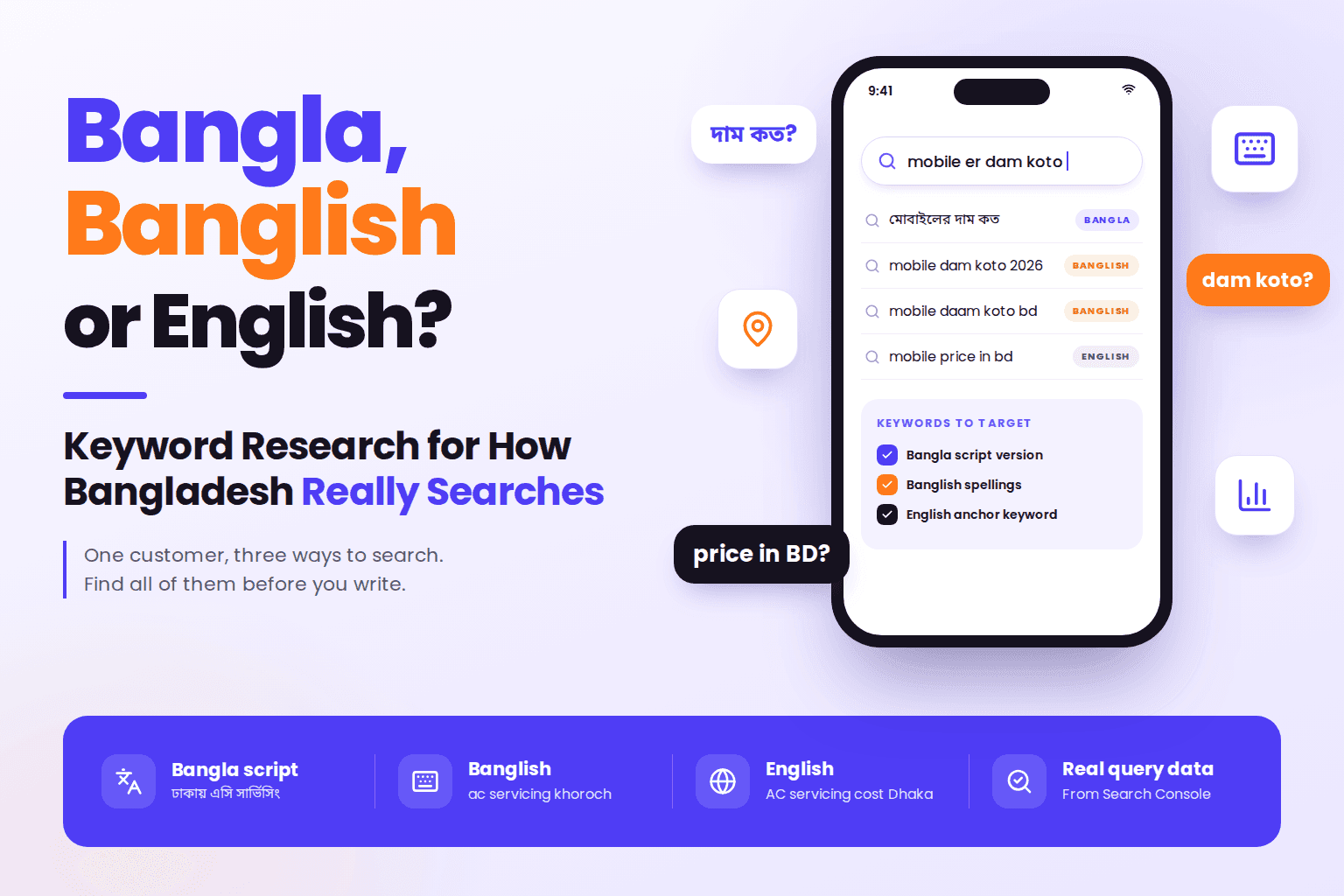
The short answer: people in Bangladesh search Google in all three. English leads for brands, products and business services. Bangla script shows up for local, everyday and spoken-style questions. Banglish, Bangla typed in English letters like "mobile er dam koto", fills the space in between. Good keyword research in Bangladesh collects all three versions of every search, then builds one strong page for each intent instead of one page for each script.
The language question comes up in almost every first call I have with a Bangladeshi business. Owners ask whether they need a Bangla website, whether Banglish keywords are "real", and why keyword tools show zero searches for phrases their customers type every day. This guide answers those questions with the data that exists, shows the four-step method we use, and is honest about where the numbers run out.
How Bangladesh Searches in 2026: The Numbers
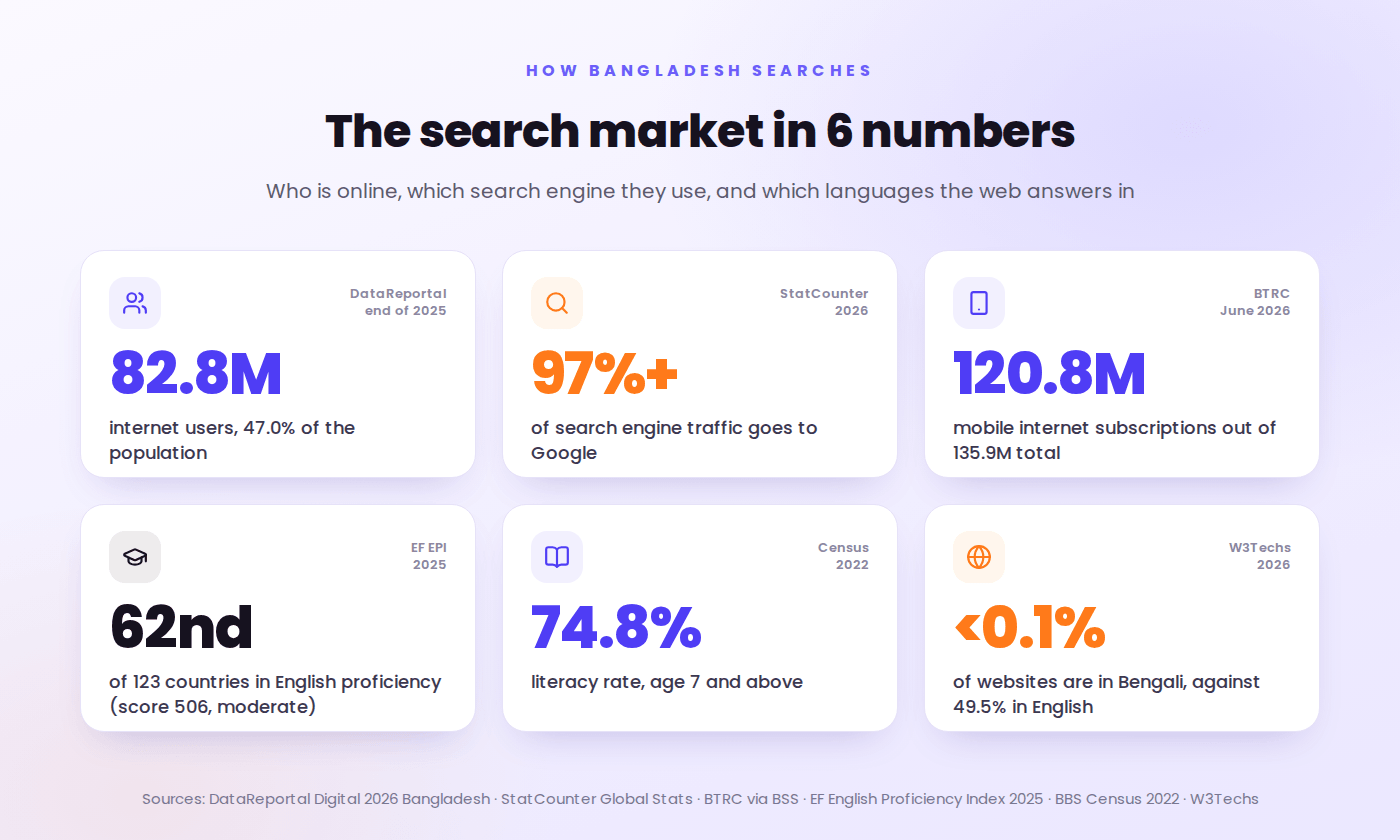
Start with the size of the audience. DataReportal counted 82.8 million internet users in Bangladesh at the end of 2025, 47.0% of the population. The regulator BTRC counts connections rather than people, and it reported 135.94 million internet subscriptions in June 2026, 120.84 million of them mobile. Either way, this is a phone-first market.
Search is close to a one-company story. StatCounter's 2026 figures put Google above 97% of search engine traffic in the country, so keyword research here really means researching Google.
The language data tells the real story. Bangladesh ranks 62nd of 123 countries in the EF English Proficiency Index 2025, with a "moderate" score of 506 that drops from 527 in Dhaka to 426 in Sylhet. Literacy reached 74.8% in the 2022 census. Yet W3Techs finds that under 0.1% of websites are written in Bengali, against 49.5% in English. Millions of people think in Bangla, and very little of the web answers them in it.
Bangla, Banglish and English: What Each Looks Like in Search
I describe the three forms to clients as three keyboards, not three audiences. The same person often uses all of them in one day, depending on the phone, the keyboard setting and what they are looking for.
| Form | Example search | Who uses it, and for what |
|---|---|---|
| Bangla script | ঢাকায় এসি সার্ভিসিং খরচ | Older users, voice search and Bangla keyboards. Local services, health, religion, news, government information |
| Banglish | ac servicing khoroch dhaka | Younger mobile users typing fast on an English keyboard. Prices, how-to questions, comparisons |
| English | AC servicing cost in Dhaka | Office users, B2B buyers, students, brand searches. Products, business services, technical topics |
The last column comes from what we see in clients' Search Console data, so treat it as a pattern rather than a measured share.
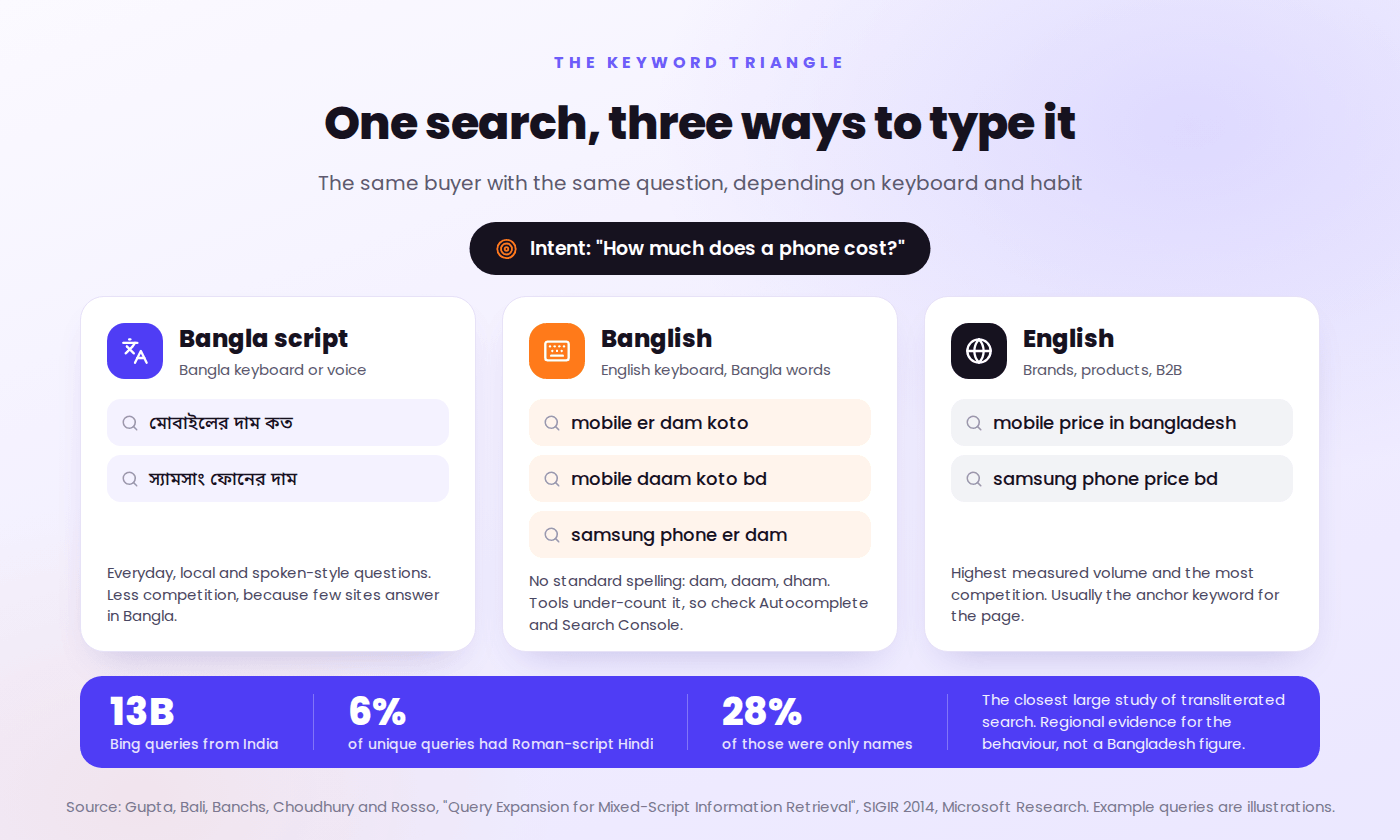
Two things make Banglish messy. There is no standard spelling, so দাম can be typed dam, daam or dham, and কত can be koto or kto. And phonetic keyboards such as Avro on desktop and Ridmik on Android let people type Banglish and get Bangla script out. The same customer may produce either form depending on one setting they changed years ago.
Why Banglish Keywords Are the Hidden Layer
Banglish is hard to measure, which is exactly why it gets missed. No published study of Bangladeshi search logs tells us what share of queries are Banglish. The closest large-scale evidence comes from next door. Microsoft researchers analysed a Bing log of 13 billion queries from India and found that 6% of unique queries contained Hindi words typed in Roman letters. Only 28% of those were plain names of people, places or organisations. The rest were real questions, song lyrics and phrases.
Bangla and Hindi are different languages, so I would not copy that 6% onto Bangladesh. What the study shows is the behaviour: when people type on English keyboards but think in their own language, transliterated searches become a steady slice of demand, made of long, specific and oddly spelled queries.
Those queries tend to have little competition, because almost no business writes for them. A page that clearly answers "laptop er dam koto", in English with the Banglish phrasing used where a customer would use it, can pick up searches that bigger competitors never target.
Which Language Should You Target? It Depends on Your Buyer
The right mix depends on who buys from you. This is the split we start from when we plan keyword research for a new client.
| Business type | Language focus | Example searches |
|---|---|---|
| F-commerce and D2C brands | English and Banglish first, Bangla script for product questions | panjabi price in bd, panjabi dam koto |
| Local services: clinics, coaching centres, restaurants | Bangla script and Banglish first, English for "near me" and brand searches | dentist dhanmondi, দাঁতের ডাক্তার ধানমন্ডি |
| Banks, insurers and telcos | English first, Bangla script for help and how-to questions | home loan interest rate, একাউন্ট খোলার নিয়ম |
| B2B, IT and exporters | English, with country-specific variants | garment manufacturer bangladesh |
Local businesses usually see the most Bangla-script demand, because people describe a problem the way they would say it out loud. Our guide to local SEO in Bangladesh covers the Google Maps side of that. If you are unsure where you fit, start with English plus Banglish. That covers most commercial searches, and a few months of Search Console data will tell you whether Bangla-script demand justifies more.
How to Do Keyword Research in Bangladesh, Step by Step
This is the process we use. You need a Google account, access to Google Search Console and, ideally, one paid tool such as Ahrefs or Semrush.
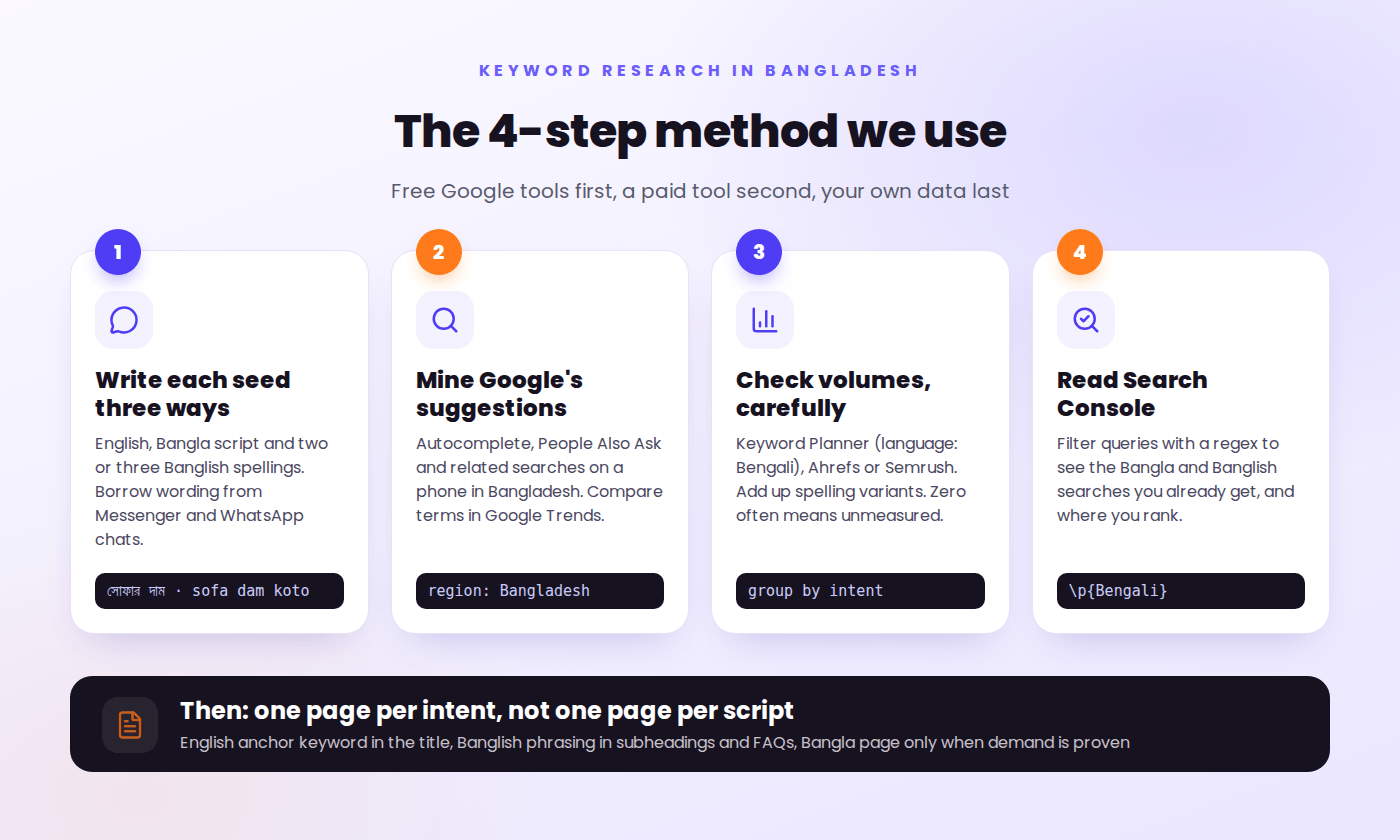
Step 1: Write every seed keyword three ways
List the 10 to 20 things customers buy from you or ask you about. For each one, write the English version, the Bangla-script version and two or three Banglish spellings. "Sofa price" becomes "sofa price in Bangladesh", "সোফার দাম", "sofar dam" and "sofa dam koto". Then ask your sales and customer-service staff how customers phrase things in Messenger and WhatsApp chats. Those chats are the best free Banglish keyword list you will ever get.
Step 2: Mine Google's own suggestions
Type each seed into Google on a phone in Bangladesh and note what Autocomplete suggests, then check People Also Ask and the related searches at the bottom of the page. Do it for all three forms. Autocomplete is built from real searches, so a Banglish suggestion appearing at all tells you people type it. Google Trends helps too: compare an English term with its Bangla twin, set the region to Bangladesh and look at interest over 12 months and by division.
Step 3: Check volumes, then trust them a little less
Google Keyword Planner lets you target Bengali as an ad language and Bangladesh as a location, and Ahrefs and Semrush both have Bangladesh databases. Use them for English and Bangla-script terms. For Banglish, expect zero or tiny numbers. Tools merge similar spellings, round small volumes down and miss many transliterated phrases, so "no data" usually means "not measured", not "nobody searches". Add up the variants of one intent and judge the group, not each spelling.
Step 4: Read your own Search Console queries
Your own data beats any tool. In the Search Console Performance report, add a query filter, choose Custom (regex) and enter \p{Bengali} to see only queries that contain Bangla script. The filter uses Google's RE2 syntax, which supports Unicode script classes like this one. For Banglish, filter for common words such as \b(koto|dam|daam|kivabe|kothay)\b. The report shows which pages already get each kind of search and at what position. This is often the first time an owner sees Bangla and Banglish demand they were already ranking for by accident.
Turning Bangla and Banglish Keywords Into Pages
Once your lists are grouped by intent, map each intent to one page. The most common mistake I see is three thin pages, one per script, for the same question. They split links and clicks, and none of them ranks well.
For most businesses, one English page per intent works best. Put the English keyword in the title and H1, answer the question in the first paragraph, and fold Banglish phrasings into subheadings and FAQs where a customer would actually say them. Write prices in taka, use local place names and keep sentences short.
Build a separate Bangla-script page only when your data shows real Bangla demand and you can write it properly. Machine translation reads badly, and customers notice. Google has said it judges a page's language from its visible content, not the lang attribute, so a half-translated page does not count as Bangla. If you run both versions, connect them with hreflang (en-BD and bn-BD). Our content writing team writes both.
We used the same intent-first mapping on Rangs eMart's category and brand pages, where keyword rankings grew 650% in six months.
Common Keyword Research Mistakes in Bangladesh
- Trusting tool volumes for Banglish. Zero in a tool is not zero in real life. Check Autocomplete and Search Console before dropping a phrase.
- Stuffing misspellings. Writing "dam, daam, dham" in one paragraph reads like spam. Use the most common variant once, in a natural place, and let Google connect the rest.
- Copying Indian keyword lists. Hindi-English mixes and Indian place names do not match how Bangladeshis search, even for the same product.
- Dropping "bd" and "bangladesh". Many commercial searches end with "price in bd", "bangladesh" or "dhaka". Keep those modifiers in your lists and headings.
- Using Bangla URLs without a plan. Bangla characters in a URL turn into long percent-encoded strings when people share the link. Keep slugs in English.
Bangla, Banglish and AI Search
AI answers add one more reason to get this right. Google brought AI Overviews to India in English and Hindi in August 2024. When I checked Google's announcements for this post, I could not find Bengali in the officially listed AI Overview languages, so Bangla-script searches may still get classic results more often than English ones. That can change at any time.
Chat assistants such as ChatGPT, Gemini and Perplexity already understand Banglish and Bangla questions, and they often answer from English pages. Clear, direct answers with local facts, taka prices and a named author make a page easier to quote in any of the three languages. That is the core of answer engine optimization, and it overlaps almost completely with good keyword research.
Want to know which languages your customers really search in? Our SEO team can pull the Bangla, Banglish and English demand for your business from your own Search Console data. Get in touch, or see the results we have delivered in our case studies.
Want more of our work in your Google results?
Frequently asked questions
No. Most businesses rank well with English pages that use local wording, taka prices and natural Banglish phrasing in headings and FAQs. Add Bangla-script pages when Search Console shows meaningful Bangla queries for your topics and you can write them properly, not through machine translation.
Comments
No comments yet. Be the first to share your thoughts.