
UBIN, Trade License and Return Policy: The Trust Layer Every Bangladeshi E-commerce Website Needs
Pujan Kumar Saha · · 10 min read · Updated
Key takeaways
- The Ministry of Commerce 2021 Digital Commerce Operation Guidelines and the DBID rules, as reported, ask online sellers to show their DBID (UBIN) and at least one business identifier such as a trade license, TIN or VAT number.
- Refund, return, replacement and delivery terms are reported to be required in Bangla, with delivery windows of 5 days in-city and 10 days otherwise.
- Address, phone and email have no specific rule in the sources checked, but are strong trust signals for buyers, Google and AI assistants.
- Put identifiers in footer text, keep policies on their own pages, and match Organization and return policy markup to the visible content. This is not legal advice.
The short answer: a Bangladeshi online store should show its Digital Business Identification number (DBID, earlier called UBIN), its trade license number, a return and refund policy and delivery terms written in Bangla, and a real address, phone and email. The Ministry of Commerce's 2021 Digital Commerce Operation Guidelines and the later DBID rules point to most of this. It also tells Google and AI assistants the shop is real. This is not legal advice.
Every week I see shops with good products and a missing trust layer: no trade license number anywhere, a return policy that says "terms apply", and an address that is just "Dhaka". Buyers hesitate, Google and AI assistants have nothing to verify, and the owner blames the ad budget. This guide lists what the published rules say, what is only good practice, and where each item should sit on your website.
What Rules Apply to Bangladeshi Online Stores?
The Ministry of Commerce issued the Digital Commerce Operation Guidelines on 4 July 2021, as The Daily Star's overview of the guidelines explains, mainly to protect buyers. Bangladesh Bank issued a separate circular on 30 June 2021 about settling payments in e-commerce, which a Dhaka law firm's note on the circular summarises. A later Digital Business Identification (DBID) scheme added the ID number.
I could not open the official gazette text from this environment, so every requirement below comes from news reports and law-firm summaries of it, and I name the source each time. Commentators also disagree on how binding the guidelines are, and the ministry can change them. Check the current text with the Ministry of Commerce or a lawyer before you rely on any line here.
UBIN and DBID: What Is the Unique Business ID?
You will see two names. Coverage in 2021, such as Dhaka Tribune's report on mandatory UBIN registration, called it the Unique Business Identification Number. Later reports call the same scheme the Digital Business Identification, DBID. The sources do not say outright that they are one scheme, so treat UBIN and DBID as the same ID unless the portal tells you otherwise.
What the reports say about it:
- It must be shown. The guideline made it mandatory for online businesses to display the registered DBID number on their website or social media page, according to The Daily Star.
- Registration is free. E-commerce traders register at the DBID portal, dbid.gov.bd, Prothom Alo reported.
- Existing sellers had a deadline. They were to apply within 90 days of the guideline's publication, per The Daily Star; Dhaka Tribune's headline described it as two months, so the sources differ.
- Many applications failed. The Financial Express ran the headline "Over 85pc applicant e-com firms fail to get digital ID certification", and an earlier piece said only 393 e-commerce companies got a DBID in five months.
What it means for you: apply now if you have not, because incomplete documents are the usual stumbling block, and paste the number into your footer once you have it. Sources differ on who issues the certificate (one says the Registrar of Joint Stock Companies and Firms, RJSC), so follow whatever the portal currently says.
Trade License, TIN and VAT: What Should the Website Show?
The 2021 guideline asks sellers to hold at least one of a trade license, VAT registration, TIN, UBID or a personal retail account number, and to display it. That is how The Business Standard's analysis of the guideline and Dhaka Tribune's report on the draft describe it. A trade license comes from the City Corporation or other local authority for the premises or registered office, a law-firm guide notes.
The sources conflict on one point: whether a trade license is always needed next to a DBID. One guide says a DBID application can proceed without one, but that this does not remove the need for any license or sector permit your actual trade requires. So I tell clients to get the trade license anyway if they sell from a fixed address.
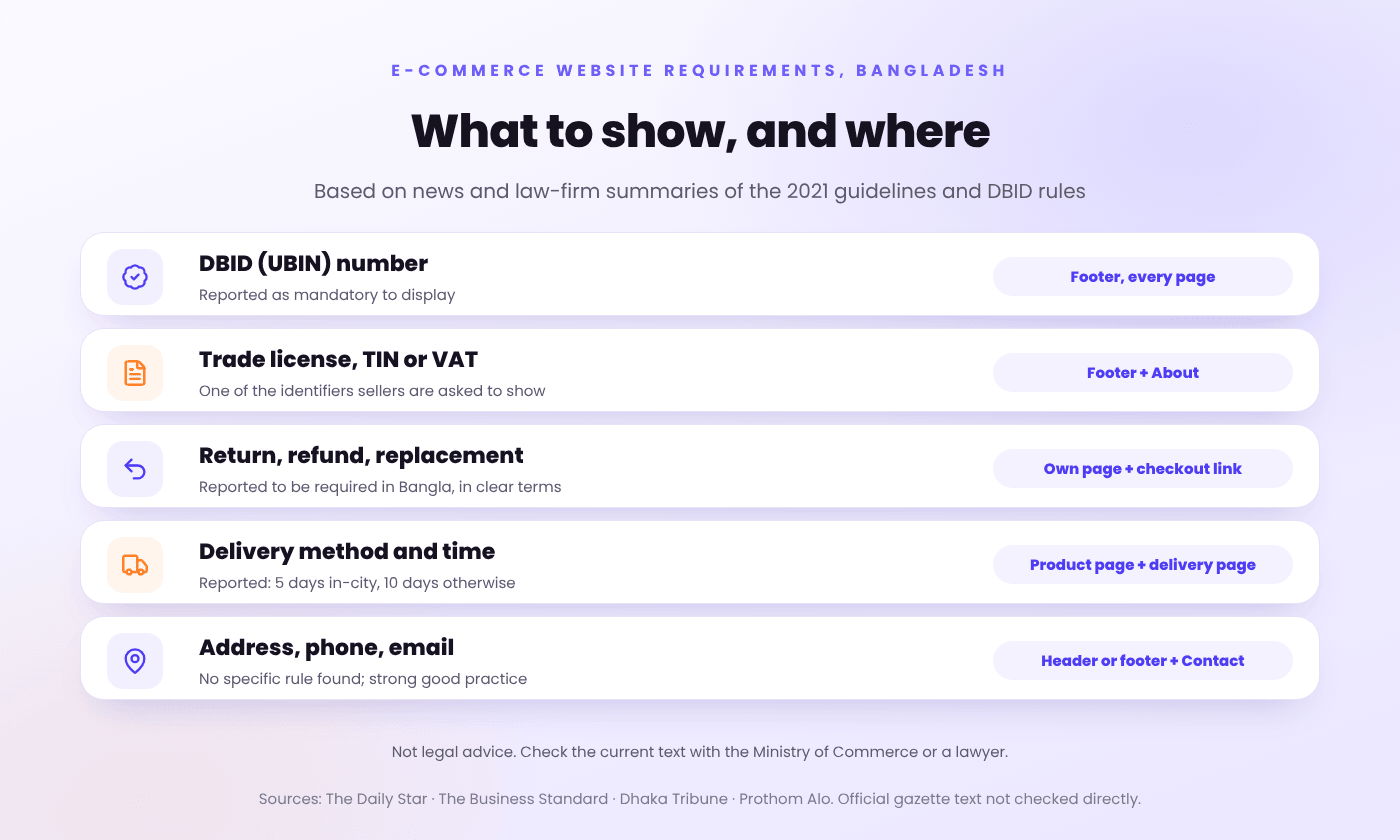
| Item | What the sources say | Where it goes on the site |
|---|---|---|
| DBID (UBIN) | Mandatory to display on website or social page | Footer on every page |
| Trade license number | One of several identifiers sellers are asked to show | Footer and About page |
| TIN or VAT number | Same list of identifiers; use what applies to you | Footer, checkout invoice |
| Return, refund and replacement terms | Must be listed in Bangla, clearly | Own page, linked from product pages and checkout |
| Delivery method and time | Must be stated; reported limits of 5 days in-city and 10 days otherwise | Product page and delivery page |
| Address, phone, email | No specific rule found in these sources; strong good practice | Header or footer, Contact page |
What it means: put the identifiers in the footer so they appear sitewide, in plain text, not inside an image. Text is what Google and AI assistants can read.
What Must a Return and Refund Policy Say?
The guideline asks sellers to publish refund, return and replacement terms, the delivery method, delivery time and other conditions in Bangla, in a clear format, as The Business Standard's report on the five-day delivery rule sets out. A policy that says only "terms and conditions apply" does not meet that.
Write the page so a buyer could act on it without calling you:
- How many days after delivery a customer can ask for a return or exchange, and which products are excluded (underwear, opened cosmetics, sale items, and so on).
- The condition the product must be in, and who pays the return courier fee.
- How and when refunds are paid: bKash, Nagad, card or bank, and how many working days.
- Who to contact, with a phone number and an email, and what proof you need (photo, invoice number).
Keep a Bangla version as the main text and an English version beside it. If you also run Facebook sales, paste the same wording on the page, so your promises do not change by channel.
Delivery Time and Refund Deadlines: What Do Reports Say?
The same coverage reports a delivery window of five days when buyer and seller are in the same city and ten days otherwise, and a full refund through the original payment method within ten days if a prepaid order is delayed. One law-firm summary argues the periods should be counted in working days, which shows the wording leaves room for doubt.
Another report says that if a seller cannot supply the product for reasons beyond its control, it must tell the buyer within 48 hours of full payment and refund within 72 hours. Bangladesh Bank's version says refund charges fall on the platform, not the customer. Banks and payment gateways such as SSLCommerz often take longer than 72 hours to settle, so write your own refund promise in working days and keep it honest.
What it means: state a delivery time per zone on the product page (inside Dhaka, outside Dhaka) and make sure your courier, whether Pathao, Steadfast or your own riders, can actually hit it. I covered the checkout side of this in how to design a cash-on-delivery checkout for Bangladesh.
Which Contact Details and Seller Information Should You Show?
I did not find a clause in these sources that names the seller's physical address, phone or email as a requirement, and one law-firm guide only recommends showing phone and email prominently. I would show them anyway, because a buyer deciding whether to send advance money looks for exactly this.
- Registered business name and the trade name customers know you by.
- A full street address a courier could find, not just the district, plus a Google Map link if you have a showroom.
- A working phone number and WhatsApp, and a monitored email on your own domain, not a free webmail address.
- Opening hours, and a clear note if you are online only.
Use the identical name, address and phone on your website, Google Business Profile and Facebook page. Mismatches are one reason why Google struggles to match a business to a single place; the directory list I put together explains the citation side.
How Do These Pages Help Google and AI Assistants Trust You?
Google's Search Quality Rater Guidelines treat trust as the most important part of E-E-A-T, and they expect shops to show who is responsible for the site and how to reach them. The guidelines are for human raters, not a ranking switch, but they show what Google wants to be able to verify. You can read them in Google's published rater guidelines.
Google also supports structured data for your return rules. Its documentation on merchant return policy markup lets you describe return windows and fees in a machine-readable way, and Organization markup lets you state your name, address and contact points. Both need the visible page content to match.
| Trust element | What a person sees | What Google or an AI assistant can read |
|---|---|---|
| DBID, license, TIN in footer | A real registered business | Text that can be matched with Organization schema |
| Return policy page | A way out if something goes wrong | Return policy markup and a quotable page |
| Delivery page | Clear zones, charges and times | Answers for "how long does delivery take" |
| Contact and map | Someone to call | Name, address and phone consistent with your Business Profile |
For AI answers like ChatGPT and Gemini, the same logic applies: they quote pages that state facts plainly. Our guide to strategies that help AI search quote your pages goes deeper, and a shop that hides its policies gives them nothing to quote.
Where Should the Trust Pages Live on the Site?
Build them once, link them everywhere. A practical structure for a WooCommerce, Shopify or custom store:
- Footer on every page: DBID, trade license number, TIN or VAT where applicable, address, phone, email.
- Pages for Returns and Refunds, Delivery, Terms and Conditions, Privacy Policy, About and Contact, each in Bangla with an English version.
- A one-line return and delivery summary on every product page, linking to the full page.
- A short policy reminder and link at checkout, next to the Place Order button.
- Organization schema and return policy markup that match the visible text.
If your store is still a Facebook page, weighing a Facebook page against your own website is the first decision. When you build the site, our team's e-commerce website development service includes these pages in the first release. Each page must be server-rendered, plain text and visible on a phone.
Common Mistakes Bangladeshi Stores Make
- Numbers as images. A scanned license in the footer cannot be read by search engines. Use text, and link the certificate if you want.
- English-only policies. The guideline asks for Bangla, and most of your buyers read it faster.
- Policy promises you cannot keep. "7-day refund" with a 3-week process invites complaints and reports.
- Different details on every channel. Website, Facebook and Google Business Profile should match word for word.
- Copying another shop's policy. It often names their courier and rules, not yours.
The guidelines also reportedly allow penalties, including action against marketplaces that do not comply. Compliance is cheaper than recovering from a ban, and better trust on the page also lifts conversions. See also the wider e-commerce SEO playbook for Bangladeshi stores for what to do after the basics.
Want these pages built into your store and marked up so Google and AI assistants can read them? Book a trust-layer review with us, or see how other online stores did it first.
Want more of our work in your Google results?
Frequently asked questions
Reports from The Daily Star and Dhaka Tribune say the Digital Commerce Operation Guidelines and the DBID rules require online businesses to register and show their DBID number on their website or social page. Registration is reported to be free on dbid.gov.bd. Confirm the current rule with the Ministry of Commerce, because this is not legal advice.
Related articles
86.8% Pay Cash on Delivery: Checkout Design for Bangladesh (bKash, Nagad, Deposit-on-Delivery)
Read article
Bangladesh Isn't Mobile-Only: About Half of Web Traffic Is Still Desktop
Read article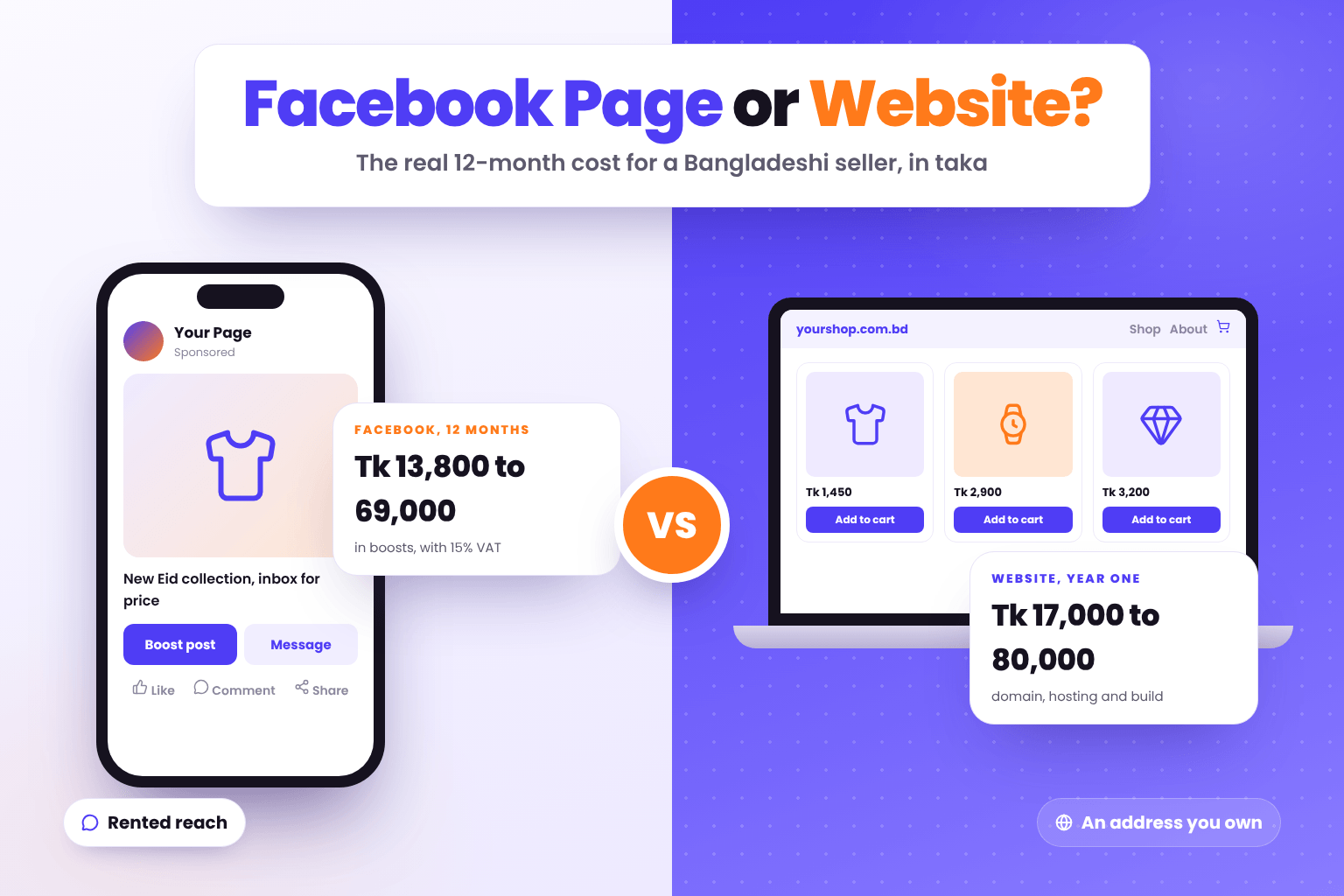
Comments
No comments yet. Be the first to share your thoughts.