
86.8% Pay Cash on Delivery: Checkout Design for Bangladesh (bKash, Nagad, Deposit-on-Delivery)
Pujan Kumar Saha · · 9 min read · Updated
Key takeaways
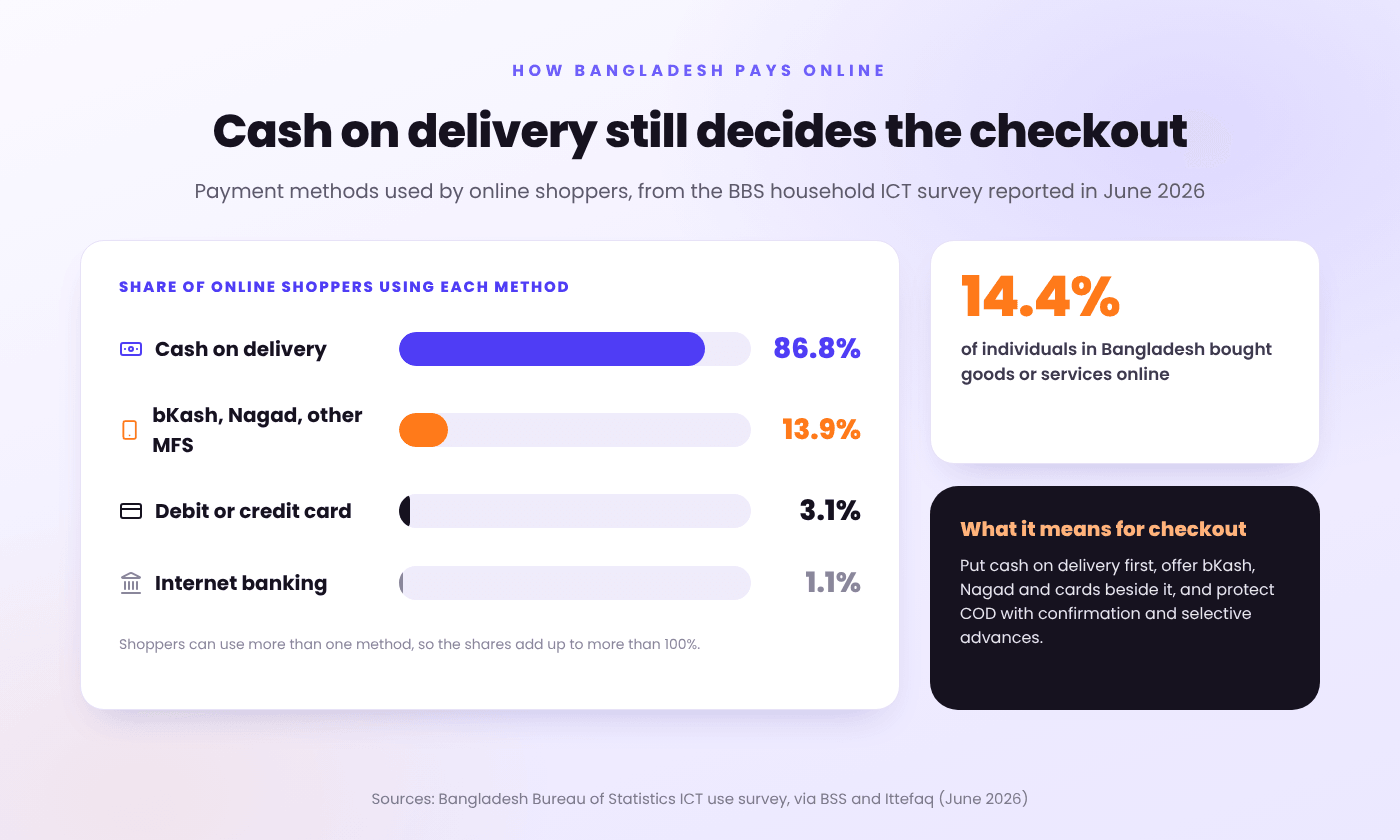
- A 2026 BBS survey found 86.8% of Bangladesh's online shoppers use cash on delivery, against 13.9% for mobile money and 3.1% for cards, so checkout should put COD first.
- Show delivery charges for inside and outside Dhaka in the cart, since surprise extra costs are the top checkout-related reason shoppers abandon.
- Cut fake orders with SMS or WhatsApp confirmation and a small bKash or Nagad delivery-charge advance on higher-risk orders, not by removing cash on delivery.
- Build address fields around district, area or thana and a landmark, accept 11-digit mobile numbers, and make postcodes and email optional.
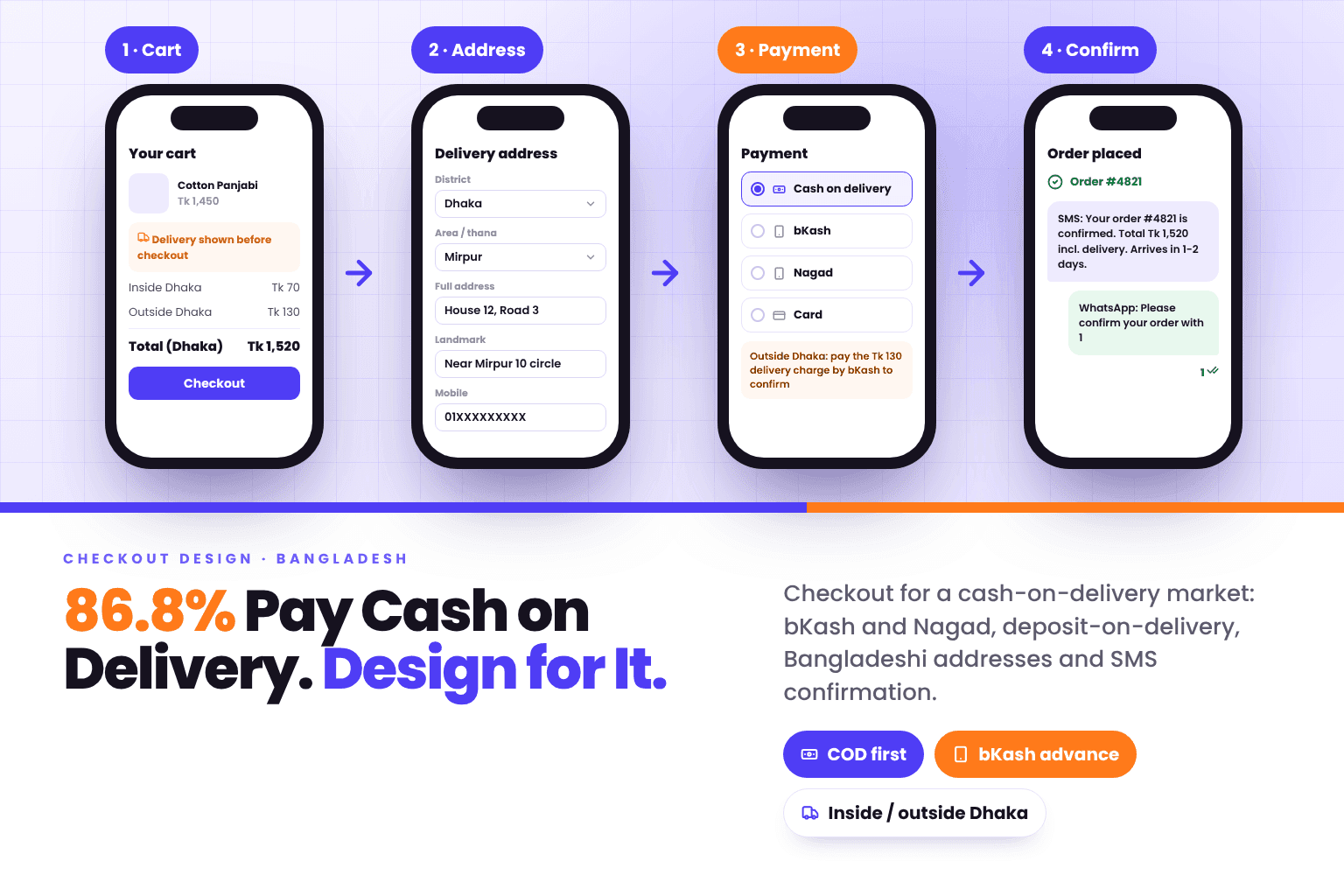
The short answer: in Bangladesh, 86.8% of online shoppers pay cash on delivery, so a good checkout keeps COD front and centre and protects you around it. Show delivery charges for inside and outside Dhaka before checkout, use address and phone fields built for Bangladeshi addresses, offer bKash, Nagad and cards as options, ask for a small advance only where risk is high, and confirm every order by SMS or WhatsApp.
Most checkout advice online is written for markets where everyone pays by card. Copy it in Dhaka and you get a slick page that loses orders, attracts fake ones and confuses customers about delivery costs. I have looked at a lot of Bangladeshi store checkouts this year, from Facebook sellers moving to their own sites to established brands, and the same few problems come up again and again. This guide covers the checkout flow that works in a cash-on-delivery market, step by step.
How Bangladesh Pays Online in 2026
The clearest recent data comes from the Bangladesh Bureau of Statistics' household survey on ICT use, reported in June 2026. It found that 14.4% of individuals bought goods or services online, and cash on delivery was used by 86.8% of online shoppers. Mobile money such as bKash and Nagad was used by 13.9%, cards by 3.1% and internet banking by 1.1%, according to Ittefaq's report on the same survey. Shoppers can use more than one method, so the shares add up to more than 100%.
Two things follow for your checkout. First, cash on delivery is not a fallback option to hide at the bottom of the page. For most of your buyers it is the reason they feel safe ordering at all.
Second, digital payment is growing but small. Offer bKash, Nagad and cards because some customers want them, especially repeat buyers and people in Dhaka, but do not design the whole page around them.
Why Checkout Design Matters More in a COD Market
Checkouts lose people everywhere. Baymard Institute's research puts the average cart abandonment rate at about 70%, with unexpected extra costs such as delivery fees the top checkout-related reason. That is global data, but surprise delivery charges are exactly what Bangladeshi shoppers complain about too.
A cash-on-delivery market adds a second cost: orders that are placed but never paid for. Pathao says fake cash-on-delivery orders are the most common type of courier fraud Bangladeshi sellers face, and that they spike during campaigns and sales. Every refused parcel costs you packaging, the courier's delivery charge and often a return charge, plus stock tied up for a week.
How much a refused parcel costs depends on your courier contract. Steadfast's terms say it does not charge for returned parcels, while other couriers bill a return fee, so read your own agreement before deciding how strict to be.
So a Bangladeshi checkout has two jobs. It must make ordering easy and honest for real customers, and it must quietly filter out the orders that will never be accepted. The steps below do both.
Checkout Design in Bangladesh: The Flow That Works
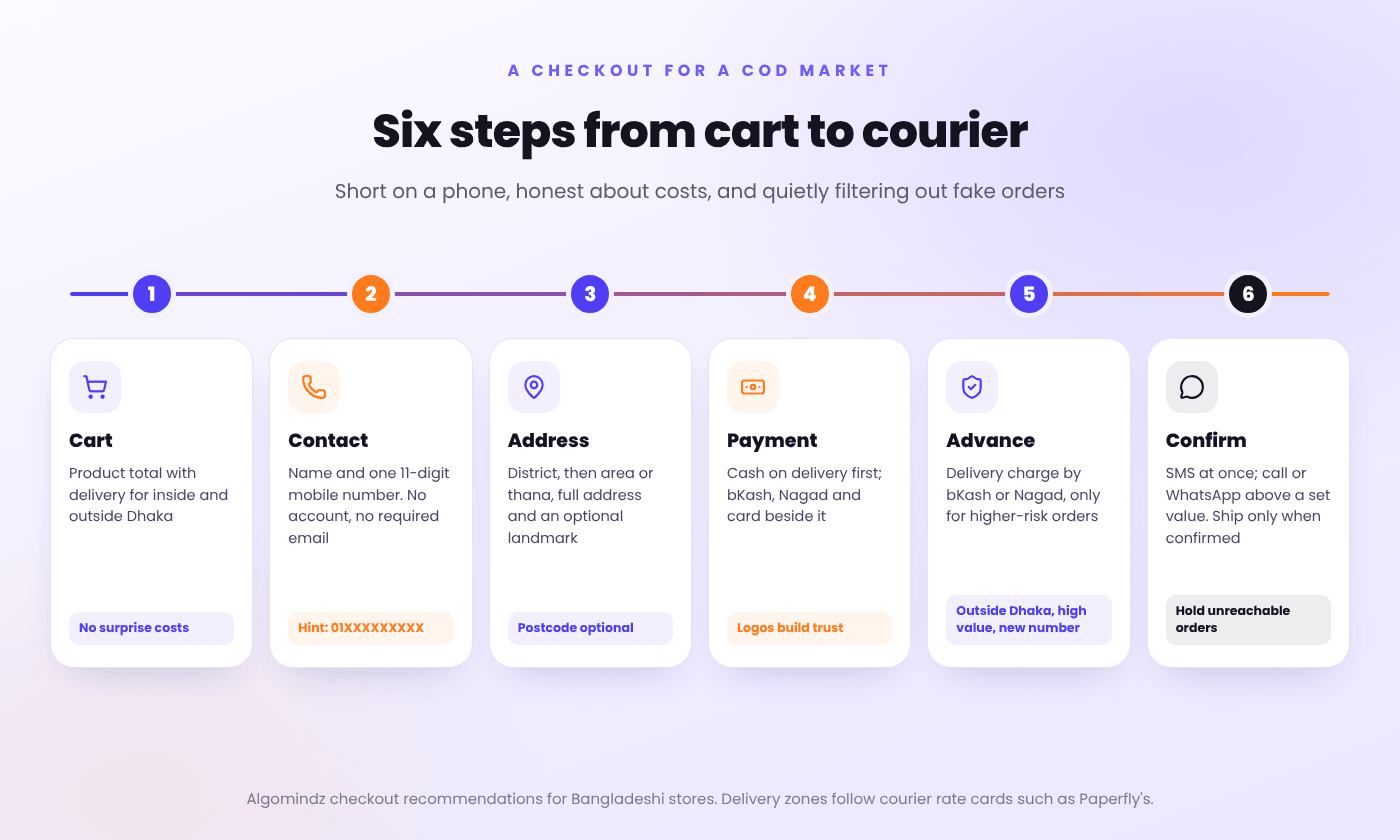
This is the order of steps we recommend for most local stores. It keeps the form short on a phone and puts the trust signals where people hesitate.
| Step | What the shopper sees | Why it matters here |
|---|---|---|
| 1. Cart | Product total plus delivery charge for inside and outside Dhaka | No surprise costs at the last step |
| 2. Contact | Name and an 11-digit mobile number, no account required | The phone number is how the order gets confirmed and delivered |
| 3. Address | District, then area or thana, then full address with a landmark | Couriers deliver by area and landmark, not postcode |
| 4. Payment | Cash on delivery first; bKash, Nagad and card as options | Matches how 86.8% of shoppers pay |
| 5. Advance (when needed) | Delivery charge paid by bKash or Nagad for higher-risk orders | Filters fake orders without blocking real ones |
| 6. Confirmation | Order number on screen, then SMS or WhatsApp | Confirms the customer is real and reachable |
Keep Cash on Delivery, but Ask for a Small Advance When It Makes Sense
Removing cash on delivery to stop fake orders usually costs more than the fake orders do, because most real customers leave too. The better approach is a small advance on the orders most likely to fail.
The common version is "deposit on delivery charge": the customer pays only the delivery fee in advance by bKash or Nagad, and the product price on delivery. A real buyer rarely minds paying a delivery charge of around Tk 70 to Tk 130 upfront. Someone placing a prank order usually disappears at this step.
Ask for it selectively, not from everyone. Good triggers are delivery outside Dhaka, high-value orders, first orders from a new number, and numbers with refused parcels in your courier's fraud check. Show the rule clearly on the payment step, for example "Orders outside Dhaka: pay the Tk 130 delivery charge by bKash to confirm".
Keep advances small. Under the Digital Commerce Operation Guidelines 2021, reports at the time said larger advances needed Bangladesh Bank-approved escrow. Check the current rules before asking customers for more than the delivery charge.
Adding bKash, Nagad and Card Payments
For online payment, most small and mid-sized stores use a payment aggregator such as SSLCommerz, which bundles cards, bKash, Nagad, Rocket and internet banking behind one integration. Larger stores sometimes add bKash's and Nagad's own merchant payment gateways directly for lower fees and a smoother wallet flow. aamarPay, ShurjoPay and Portwallet are other local options to compare.
Whichever you choose, design the payment step around trust. Show the bKash, Nagad, Visa and Mastercard logos, say plainly that cash on delivery is available, and explain what happens next for each option. A small incentive helps move willing buyers online, such as free delivery or a modest discount for paying in advance by bKash or Nagad, as long as it is clearly worded and honoured. If a customer pays online, confirm the payment on screen immediately, because many will screenshot it in case anything goes wrong.
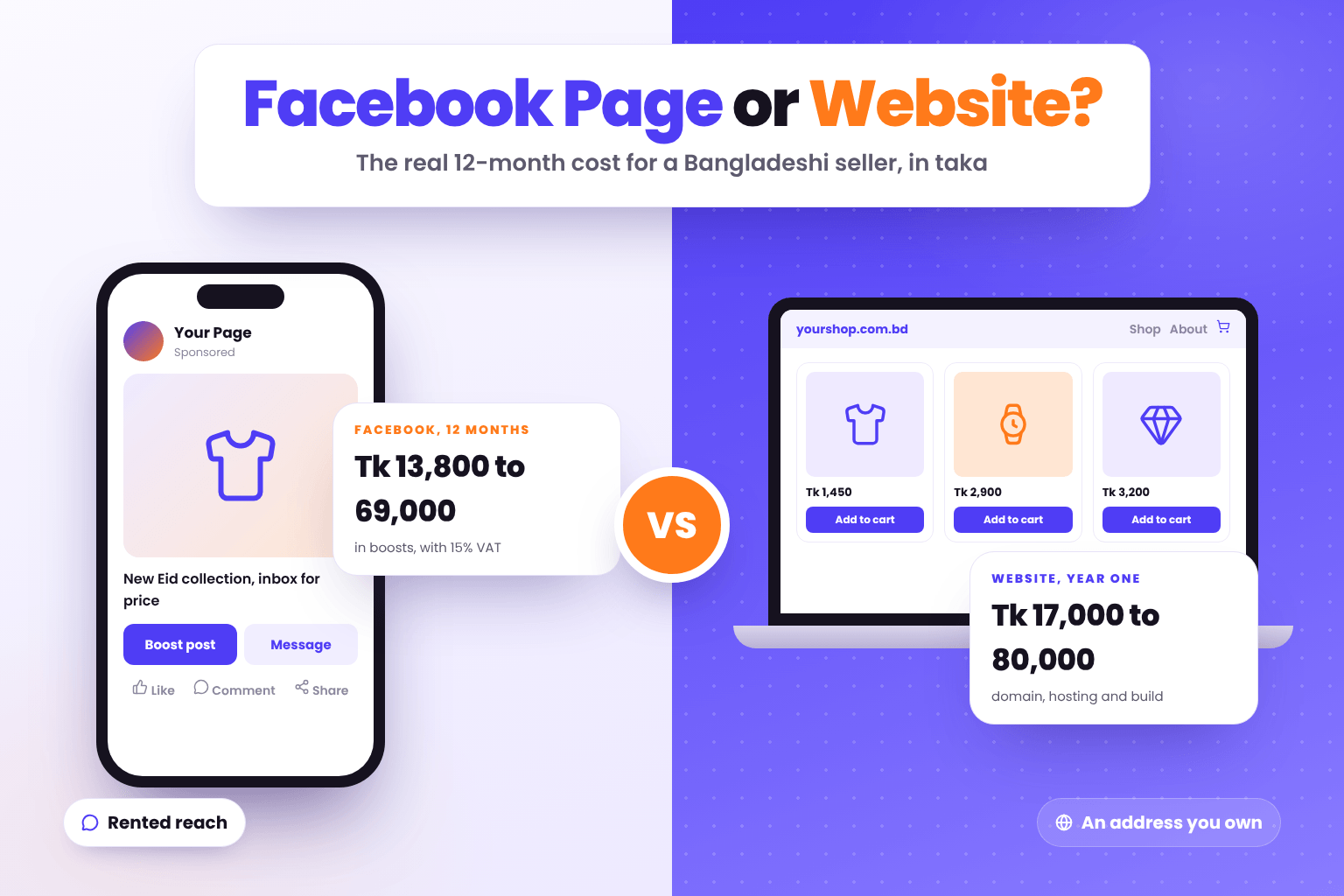
Gateways usually need a working website with clear terms, privacy and refund policy pages before they approve you, so publish those pages first. Fees vary by provider and payment method, so get current quotes in writing. If you are still deciding whether a website is worth it, our comparison of Facebook page and website costs for sellers runs the numbers.
Address and Phone Fields That Fit Bangladeshi Addresses
Many international checkout templates fail here. They demand a postcode, a state and a "street address line 2", and they reject phone numbers in local formats.
Build the address step the way couriers actually deliver. Start with a district dropdown, then an area or thana dropdown that changes with the district, then one free-text field for the full address. Add a separate optional "landmark" field, such as "beside Bashundhara City" or "opposite Uttara Sector 7 mosque", because riders use it constantly. Make the postcode optional or remove it.
For the phone, accept an 11-digit number starting with 01, with or without +88, and normalise it in the background. Show the format as a hint ("01XXXXXXXXX") rather than an error after the fact. Ask for one number, not two, and do not force an email address: many buyers do not check email, and the order will be confirmed by phone anyway.
Let people type in Bangla or English. A customer writing their address in Bangla should not see an error message.
Show Delivery Charges Inside and Outside Dhaka Up Front
The single most common checkout complaint I hear is a surprise delivery fee on the final step. Show it in the cart, and on product pages if you can.
Courier rate cards make this easy to set up. Paperfly, for example, lists Tk 70 for same-city delivery, Tk 110 for suburbs and Tk 130 for the rest of Bangladesh, plus a per-kilogram charge above 1 kg. Pathao, Steadfast, RedX and others use similar zones. Use your own negotiated rates, rounded into two or three simple zones customers understand: inside Dhaka, Dhaka suburbs and outside Dhaka.
If you offer free delivery above a threshold, show the progress in the cart: "Add Tk 350 more for free delivery inside Dhaka". It raises order value and turns the delivery fee into a goal instead of a penalty. State delivery times next to the charges too, such as one to two days inside Dhaka and two to four days outside.
Confirm Every Order by SMS or WhatsApp
Confirmation is your cheapest fraud filter and your best trust signal at the same time. Send an SMS within a minute of the order with the order number, total amount including delivery, and expected delivery date. For orders above a value you choose, follow up with a short call or a WhatsApp message asking the customer to confirm.
WhatsApp works especially well because customers can reply with a location pin, a better landmark or a change of time. Use a WhatsApp Business number shown on your site, not a staff member's personal number, so the history stays with the business.
Only hand the parcel to the courier once the order is confirmed. If a customer cannot be reached after two attempts, hold the order rather than shipping it. That one rule prevents a large share of refused deliveries, and it costs nothing to set up.
Measure What Your Checkout Is Costing You
You cannot fix what you do not measure. Track four numbers every month.
- Checkout drop-off by step. In GA4, set up a funnel from cart to order confirmation and see which step loses the most people.
- Delivery success rate. Delivered orders divided by shipped orders, from your courier dashboard. Watch it by area and by payment method.
- Advance uptake. Of the orders asked for a delivery-charge advance, how many paid? If very few did, your rule may be too broad.
- Cost per refused order. Delivery, return and packaging costs together, so you can judge whether a stricter rule is worth it.
Change one thing at a time and compare a month before and after. A checkout is never finished; it gets tuned. For the traffic side of the store, our guide to SEO for Bangladeshi online stores covers product and category pages, and we build checkouts like the one above as part of our e-commerce website development for local stores.
Losing orders between the cart and the courier? Send us your checkout link and we will point out where shoppers drop off and where fake orders slip through, or see the stores we have worked with in our e-commerce results.
Want more of our work in your Google results?
Frequently asked questions
Yes, for almost every store. A 2026 government survey found 86.8% of online shoppers in Bangladesh use cash on delivery. Removing it usually loses more real customers than it saves in fake orders, so keep it and add protections such as confirmation calls and selective advances.
Comments
No comments yet. Be the first to share your thoughts.