 ASO case study
How MyBL reached #1 on 13 of 22 app store searches
In three months, we took Banglalink's MyBL app to #1 on 13 of 22 tracked app store search terms, ahead of every competing operator app.
- Client
- MyBL
- Country
- Bangladesh
- Services
- ASO
- Project period
- 3-month campaign
- 13/22
- Tracked terms at #1
- 15/22
- Terms in the top 5
- 20/22
- Terms ranked, up from 1
- 4.75
- Store rating, highest of five operator apps
A loved app that people could only find by name.
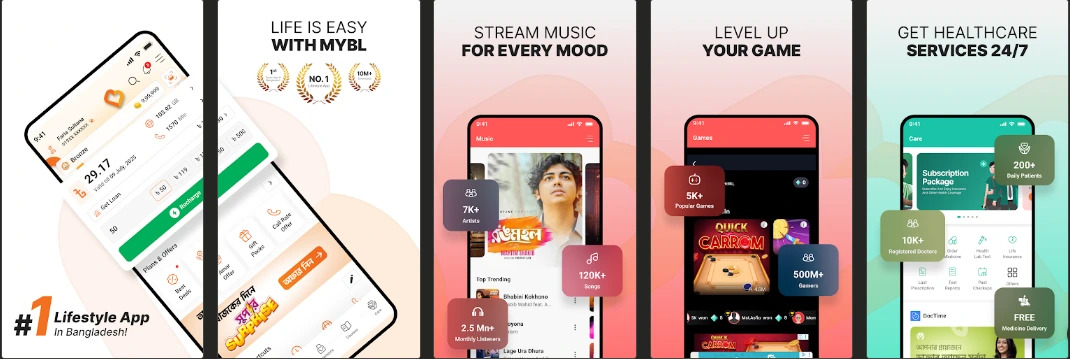
MyBL (My Banglalink) is the self-care and lifestyle super app of Banglalink, one of Bangladesh's leading mobile operators. Live since 2014, it combines account self-care with entertainment, health, learning, payments and travel for prepaid and postpaid users across the country.
The app already had strong ratings and a #1 position in the Lifestyle category, but its store listing was not built to be found for the services people actually search for. It competes with four other operator self-care apps, two of them with far larger rating volumes, so organic store discovery was the main lever for growth rather than paid installs alone. Google Play is its primary acquisition channel, alongside the Apple App Store.
We ran a five-phase ASO program: a technical and listing audit, search demand research, competitor and market analysis, metadata optimization, and a full rewrite of the store description.
What kept MyBL out of the search results.
An underused title
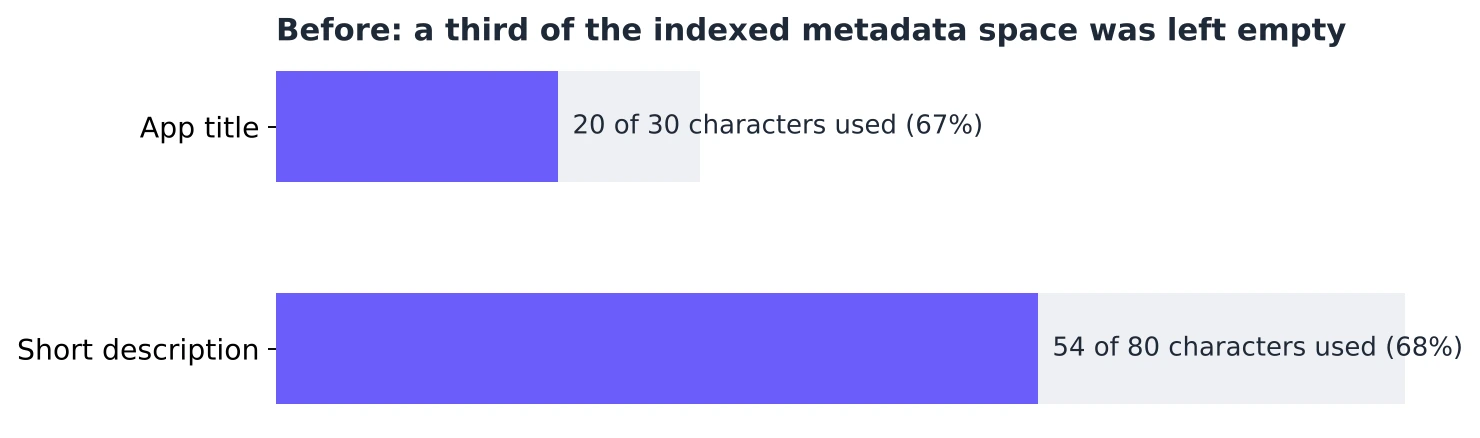
The app name used 20 of its 30 available characters, carrying the brand and nothing about what the app does.
A thin short description
Only 54 of 80 characters, and a brand statement rather than a summary of services. Google Play indexes this field, so the unused space was lost ranking potential.
A description built for announcement, not discovery
The long description read as a launch note. Its most repeated words were generic, and the services users search for most appeared once or not at all.
Brand-dependent visibility in a crowded field
At baseline, MyBL had a recorded ranking on only 1 of the 22 search terms we later tracked. Competitor 1 already led on listing health and held far more ratings, so MyBL needed relevance, not volume, to win the search results.
Five linked phases, every change traced to a measured gap.
We ran the program as five linked phases, so every change to the listing traced back to a measured gap or a demand signal. Audit gaps set the research brief, and the research and competitor data shaped every line of new copy.
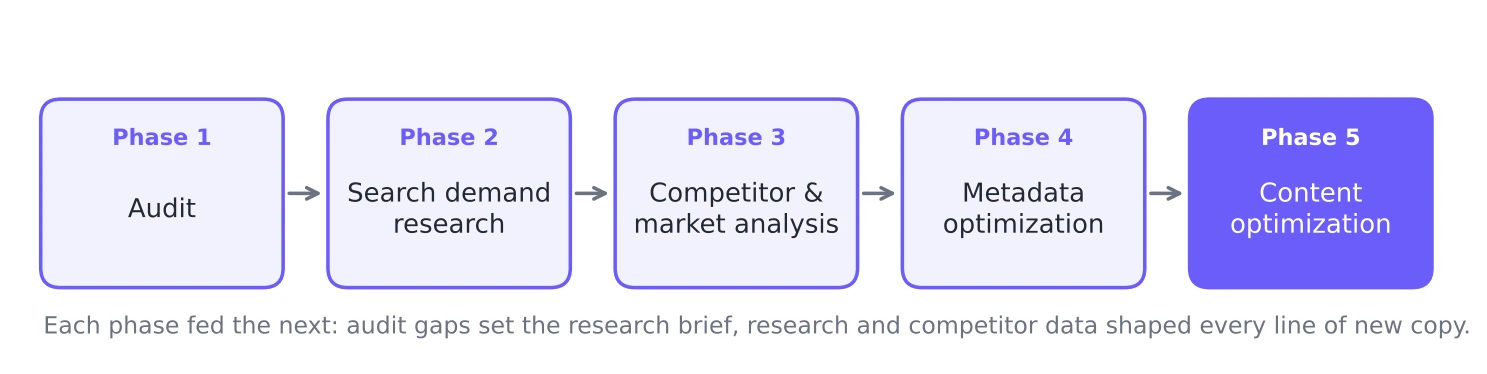
- Phase 1
ASO and technical audit
Scored texts, visuals and app details against four competitors, producing a prioritized gap list.
- Phase 2
Search demand research
Mapped what users search for across every service MyBL offers into an intent-clustered semantic core.
- Phase 3
Competitor and market analysis
Compared app strength, ratings, category position and rating velocity to write a positioning brief.
- Phase 4
Metadata optimization
Rebuilt the title, iOS subtitle and short description into store-ready metadata for both platforms.
- Phase 5
Content optimization
Rewrote the long description around service clusters into a new, structured store description.
Inside each phase of the program.
Accelerated ASO and technical audit
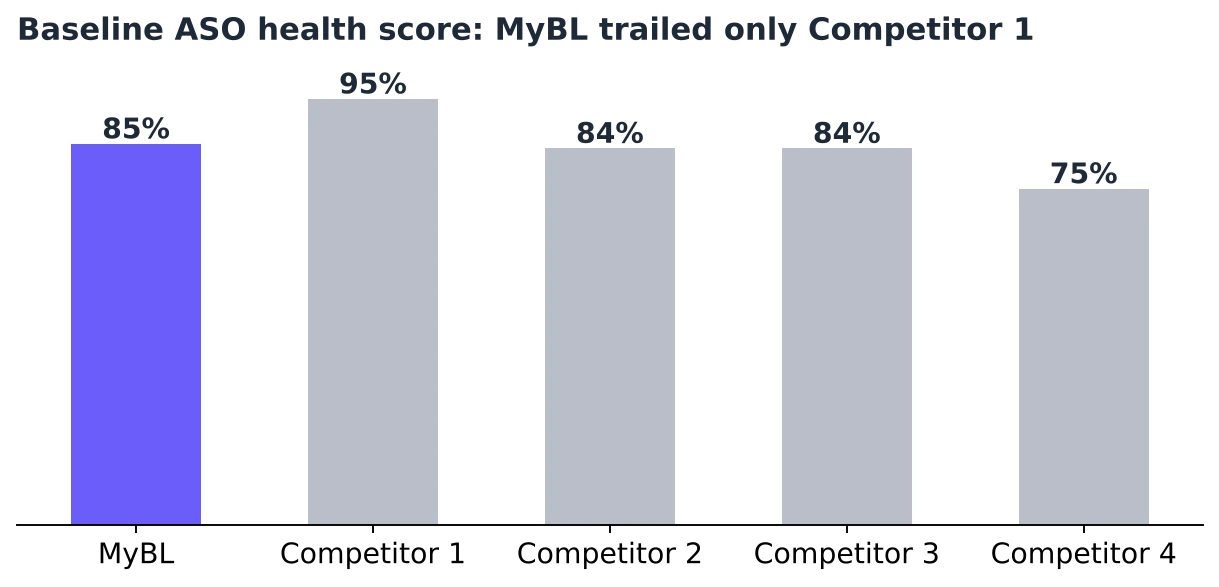
The audit gave MyBL an 85% ASO health score: strong on fundamentals, held back almost entirely by its text metadata. The listing did not need a redesign, it needed its words rebuilt around search demand.
- Working: 8 high-quality screenshots with clear benefit headlines, each showcasing one service.
- Working: a 31.5 MB install with no in-app purchases, regular releases and benefit-led release notes.
- Working: a 4.75 rating, #1 in Lifestyle and more than 1,100 equity backlinks to the listing.
- To fix: a title and short description well below their limits, with no service terms.
- To fix: a long description whose service vocabulary was diluted by generic words, and a plain brand feature graphic.
Search demand research and semantic core
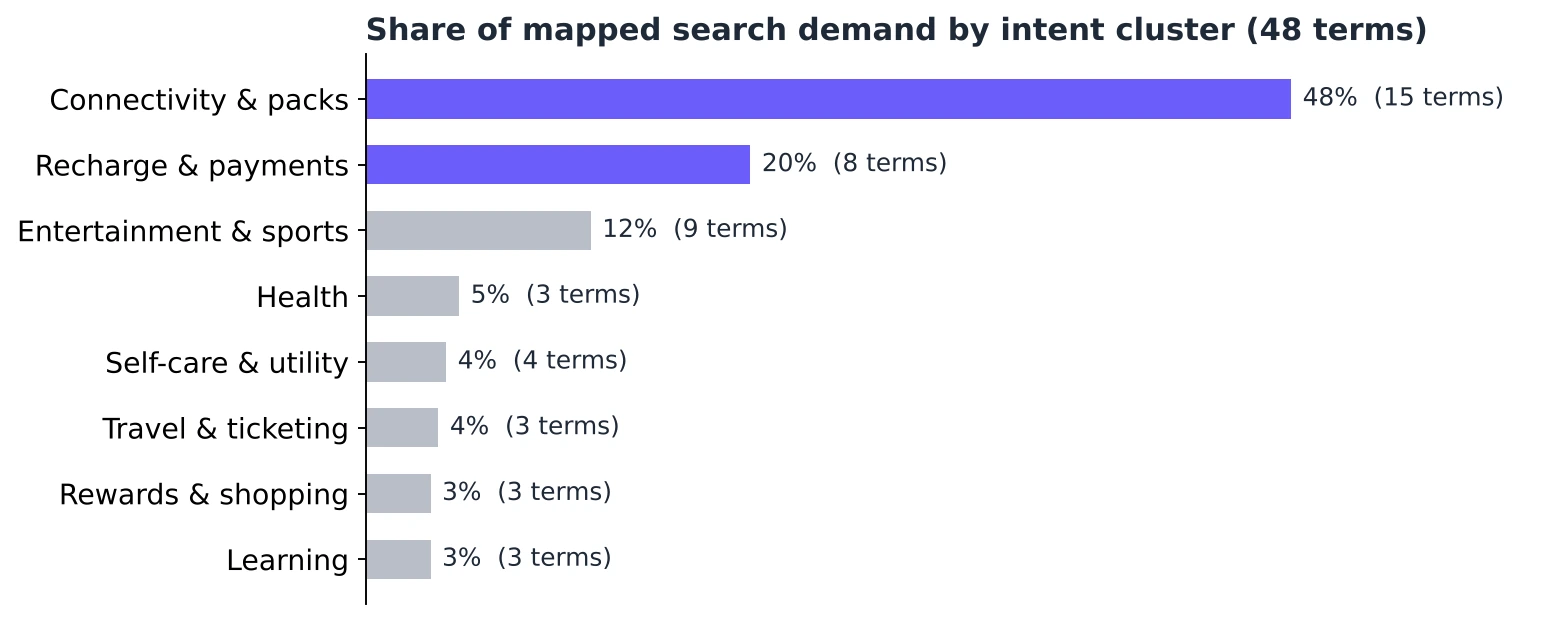
We mapped 48 high-demand search terms to eight intent clusters. Two of them, connectivity and recharge, account for roughly two-thirds of all demand. Each term was tagged by cluster, demand level and the MyBL feature that serves it, and that mapping is what we wrote the new listing from. The term list itself remains the client's property.
- Connectivity and packs (48%): the core reason people open an operator app, so it set the priority for the title and short description.
- Recharge and payments (20%): top-ups, emergency balance and bill payments.
- Lifestyle clusters (32% combined): entertainment, health, learning, travel, rewards and utility, which make MyBL a super app and gave the long description its structure.
Competitor and market analysis
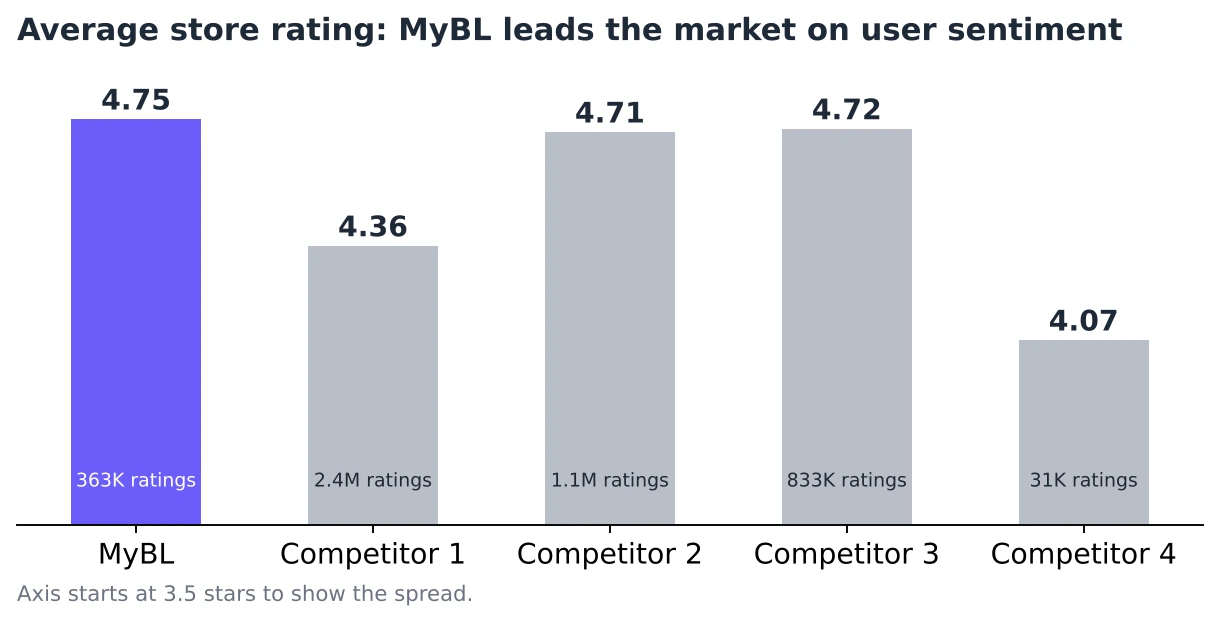
MyBL had the best user sentiment in the market but the weakest search footprint of the larger apps, which meant the opportunity was relevance, not reputation.
- Competitor 1 had the highest ASO score (95%) and the most ratings, but a lower rating (4.36) than MyBL.
- Competitors 2 and 3 had strong ratings (4.71 and 4.72) but weak non-brand coverage or a weak category position.
- Competitor 4 had the lowest ASO score (75%) and rating (4.07) and was barely visible in search.
- MyBL's daily new ratings rose sharply during the cycle and repeatedly outpaced Competitors 1 and 3.
- MyBL is #1 in Lifestyle while the others sit in Productivity or Tools, so a lifestyle-first position gave it a lane of its own.
Metadata optimization
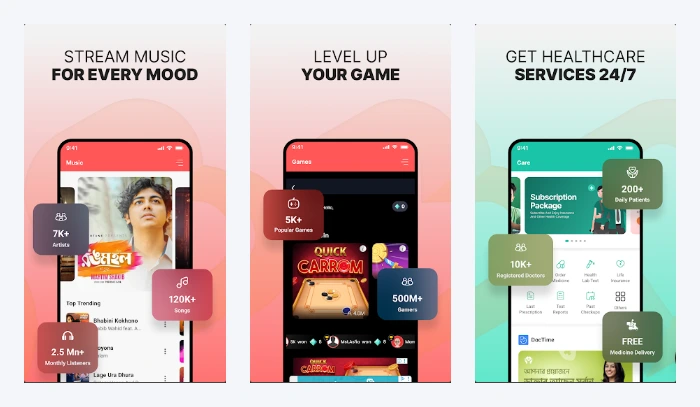
We rebuilt every indexed metadata field so that the brand stays first and the app's purpose is stated in the same line.
- Google Play title: a brand-plus-value structure that keeps the full Banglalink name and adds the app's service and lifestyle positioning.
- iOS app name and subtitle: the same message split across Apple's two fields, without repeating words Apple already indexes.
- Short description: one sentence listing the six service areas users came for, from recharge to learning, close to the full character limit.
- Rules we held to: brand first, no term repeated across fields, and plain copy that works for a person scanning the results.
Content optimization
We replaced the launch-style description with a structured store page that mirrors the demand clusters from the research, one section per job the user wants done: core utility and connectivity, entertainment and gaming, health care and smart learning, transactions and rewards, accessibility and security, and a closing call to action.
- Natural density: each service term appears where it is genuinely described, never stuffed.
- Scannable format: bold feature labels and short bullets, because most users read only the first lines.
- One voice across fields: the description extends the title and short description instead of repeating them.
#1 on 13 of 22 terms, ahead of every competitor.
After the cycle, MyBL held the #1 position on 13 of 22 tracked terms, while none of the four competing operator apps held #1 on any of them.
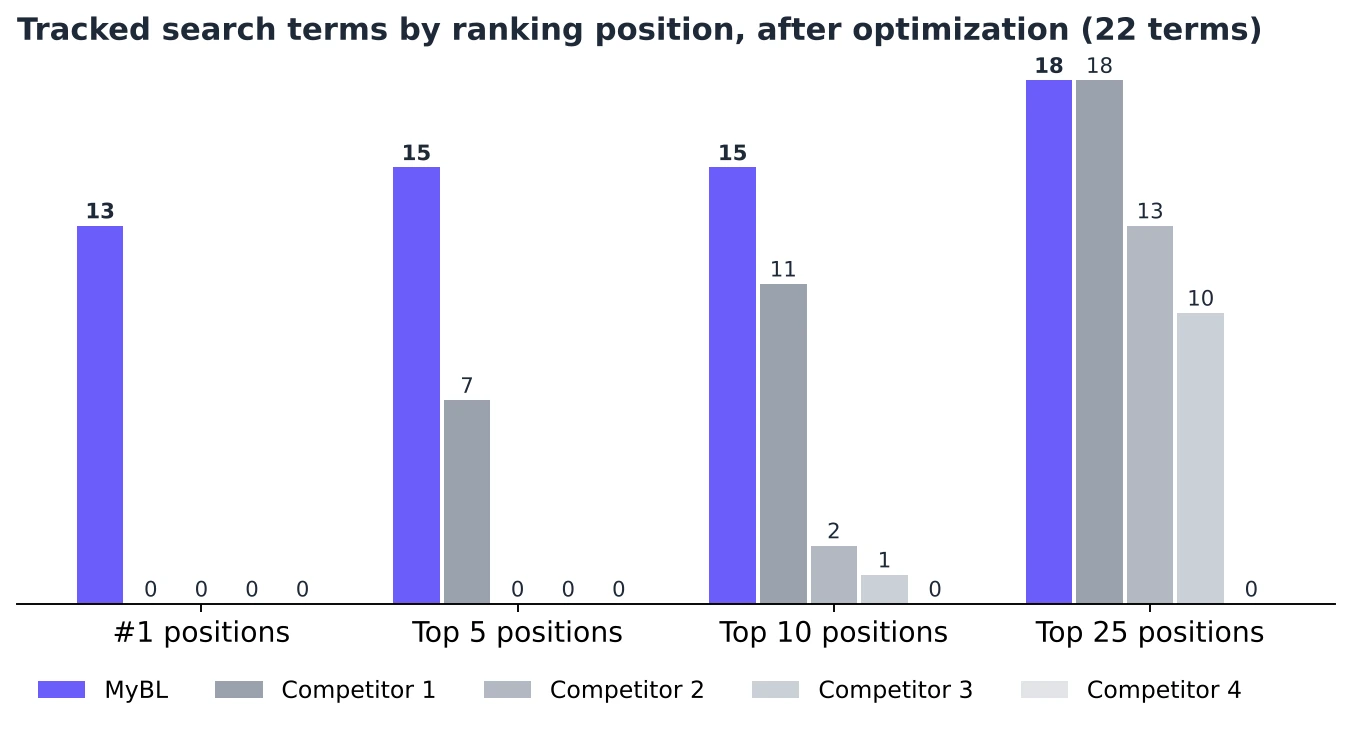
Terms at #1
up from 1 at baseline, while no competing operator app holds a single #1.
Terms in the top 5
more than twice Competitor 1, the strongest app in the market, with 7.
Brand terms secured
#1 on every tracked brand-related term, including the short forms users type.
Generic terms won
#1 on 3 of 12 generic category terms and in the top 25 on 8, demand that does not depend on brand recall.
Rating held
up 0.026 over the period, the largest gain among the apps measured, with MyBL still #1 in Lifestyle.
In summary: MyBL went from 1 ranked term to 20 of 22 in a single cycle, with 18 in the top 25. The biggest gains came from words, not design. A well-rated app with strong visuals only needed its metadata to describe what users actually search for, and its high rating amplified every change.
Get a free auditFrequently asked questions
In a three-month campaign, MyBL reached the #1 position on 13 of 22 tracked search terms, while none of the four competing operator apps held #1 on any of them. It ranked in the top 5 for 15 terms against 7 for the closest competitor, was ranked on 20 of 22 terms (up from 1 at baseline), and kept the highest store rating among the five operator apps at 4.75.