
SEO for Bangladeshi Garment & RMG Exporters: Getting Found by International Buyers
Pujan Kumar Saha · August 18, 2026 · 11 min read
Key takeaways
- International sourcing managers now build supplier shortlists from search results rather than trade associations, so a factory absent from search is absent from the shortlist entirely.
- Capable RMG factories lose orders not on capability or price but because their entire online presence is a static PDF catalogue and a dormant Facebook page.
- Compliance credentials such as BSCI, GOTS, and LEED work as both trust signals and search content, and belong on indexable pages rather than buried in email attachments.
- AI visibility matters as much as rankings in B2B sourcing, because buyers increasingly ask AI tools to suggest suppliers before they ever open a search results page.
This is happening constantly, and it’s arguably the single biggest untapped opportunity in Bangladesh’s garment export sector right now. The factories winning new international buyers aren’t always the ones with the best pricing or the newest machinery. Increasingly, they’re simply the ones that show up when a buyer starts looking.
Why This Matters More Right Now Than It Used To
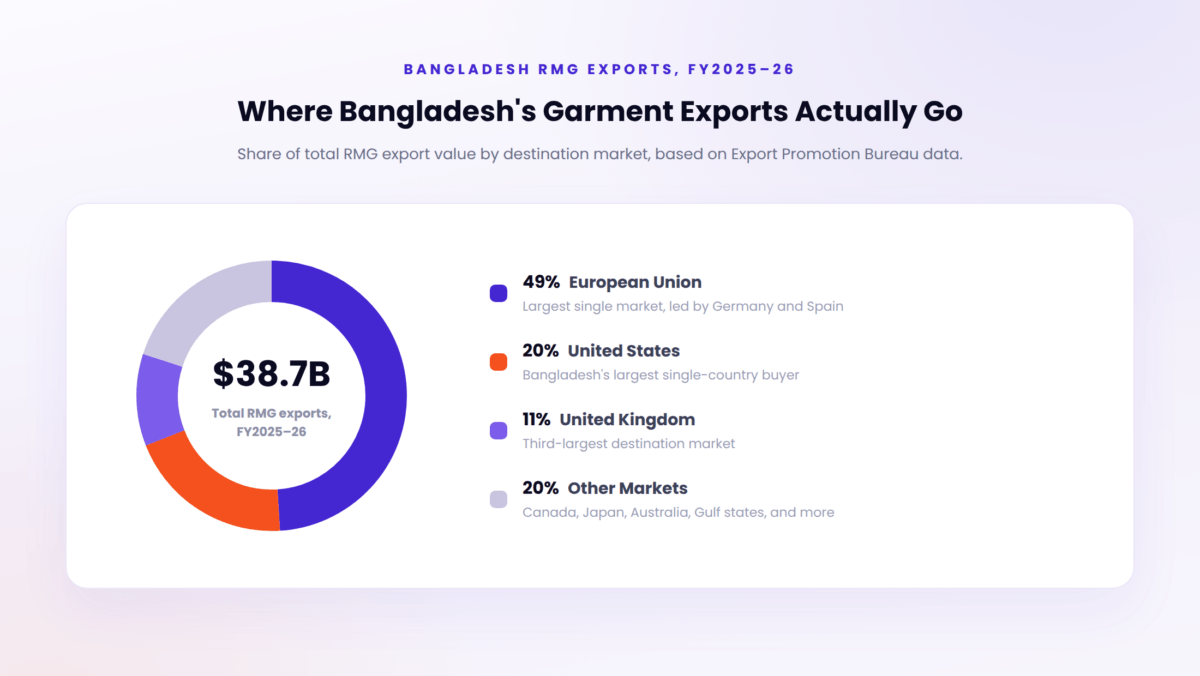
Bangladesh remains the world’s second-largest garment exporter after China, with the ready-made garment sector earning roughly $38.7 billion in FY2025-26 and accounting for over 80% of the country’s total export earnings. The European Union takes in about 49% of that total, the United States around 20%, and the United Kingdom roughly 11%, with the remainder spread across Canada, Japan, Australia, and a growing set of non-traditional markets.
But the underlying picture in 2026 isn’t one of comfortable, guaranteed growth. EU apparel imports from Bangladesh dropped sharply in early 2026, with Eurostat recording a 19.4% decline in shipments during the January-April window compared to the same period a year earlier, pulling Bangladesh’s overall EU market share down from 24.4% to 21.9%, the steepest share loss of any major supplying nation over the period. US orders have shown similar volatility, and competitors like Vietnam, Cambodia, and India have been gaining ground in specific categories and periods even as Bangladesh’s overall position holds.
None of this means the industry is in decline, Bangladesh still holds its position just behind China and continues attracting major buyers. It does mean the assumption that orders will keep flowing through the same legacy relationships and the same handful of trade fair contacts is no longer safe. Buyers are actively diversifying and re-evaluating suppliers, which means every factory is now competing for a share of buyer attention that used to arrive automatically. Whoever is actually visible when that re-evaluation happens is the one who gets considered.
How International Buyers Actually Find Suppliers Now
The idea that sourcing decisions happen through relationships and referrals alone hasn’t been accurate for years, and the shift is bigger than most exporters realize.
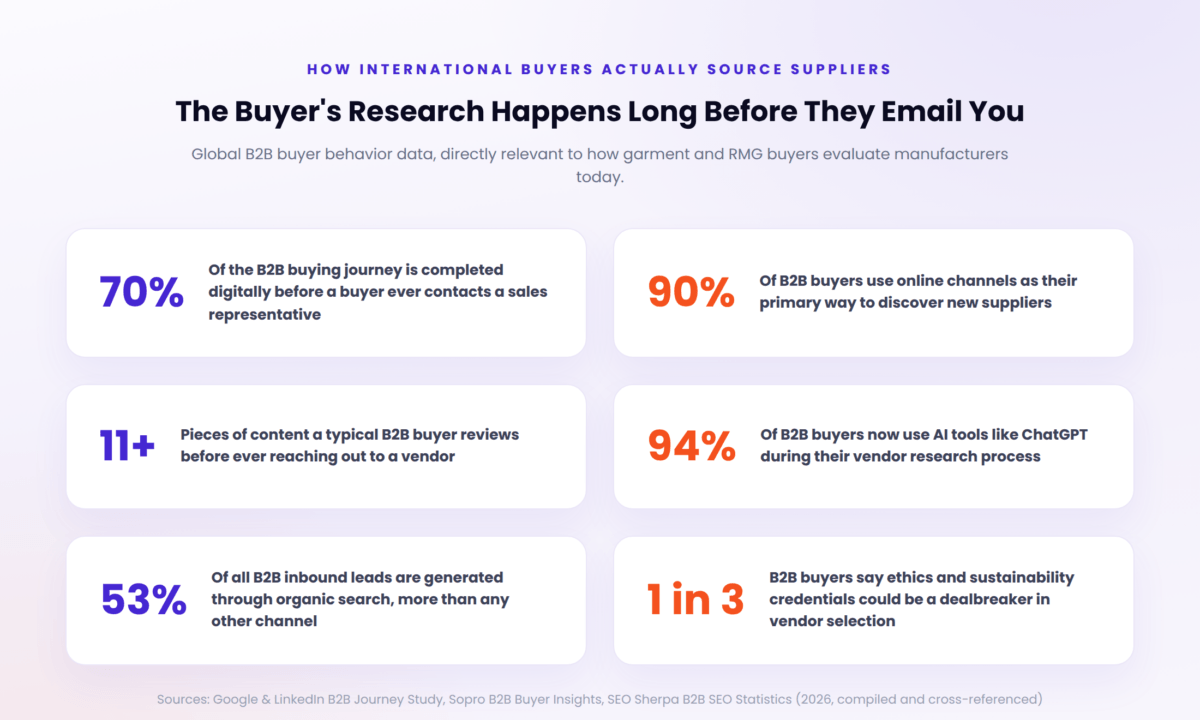
Research from Google and LinkedIn found that roughly 70% of the B2B buying journey is now completed digitally before a buyer ever contacts a sales representative directly, and separate research puts the number of B2B buyers who rely on online channels as their primary way of discovering new suppliers at 90%. Before reaching out to anyone, the average B2B buyer reviews 11 or more pieces of content, comparing specifications, certifications, and capabilities across multiple potential suppliers before narrowing down a shortlist.
The more recent shift is the growing role of AI tools in that process. Current research puts the share of B2B buyers using tools like ChatGPT, Perplexity, or Google’s AI Mode during vendor research at 94%, and a large share of those buyers encounter AI-generated summaries during that research and click through specifically to the sources those summaries cite. A buyer might genuinely type a question like “which Bangladeshi garment manufacturers are GOTS certified for organic cotton knitwear” directly into an AI tool, and whichever factories are structured clearly enough to be cited in that answer get considered. The ones that aren’t simply don’t come up.
Organic search itself remains the single largest source of B2B leads, generating an estimated 53% of all B2B inbound leads globally, more than any other channel. For a Bangladeshi exporter, this means the buyer who eventually places a six-figure order likely started that relationship with an ordinary Google search, not a trade show handshake.
What International Buyers Are Actually Searching For
Buyer search behavior in this industry tends to fall into three distinct layers, and a website built for only one of them misses the others entirely.
Discovery searches are broad and category-based: “garment manufacturer Bangladesh,” “RMG exporter Bangladesh,” “knitwear factory Bangladesh,” or “clothing supplier Bangladesh for export.” These are often a buyer’s very first search, and ranking here at all is the entry ticket to being considered.
Compliance and trust searches get more specific, and this is where Bangladesh has a genuine competitive advantage most factories don’t fully use: “BSCI certified garment factory Bangladesh,” “GOTS certified organic cotton manufacturer,” “Oeko-Tex certified apparel supplier,” or “sustainable garment factory Bangladesh.” Buyers searching these terms already know they want a Bangladeshi supplier, they’re now filtering for who can actually prove compliance.
Capability and transaction searches are the closest to a purchase decision: “low MOQ clothing manufacturer Bangladesh” (MOQ meaning minimum order quantity), “private label apparel manufacturer Bangladesh,” “OEM ODM garment factory Bangladesh,” or searches naming a specific product category, like “denim manufacturer Bangladesh” or “activewear supplier Bangladesh.” A buyer at this stage is close to sending a request for quote, and a factory that doesn’t rank here, or that ranks but doesn’t clearly answer the underlying question, loses the inquiry to a competitor who does.
Most exporter websites are built entirely around the first layer, a homepage that says “welcome to our factory,” with none of the compliance or capability content that actually moves a buyer toward contacting them.
The Trust Signals That Actually Convert a Buyer
Sourcing garments internationally carries real risk for a buyer, quality failures, compliance violations, and supply chain disruptions all reflect directly on the brand placing the order. This is exactly why trust signals matter more in this industry than almost any other B2C or domestic B2B context.
Bangladesh holds a genuinely rare advantage here: the country has more LEED-certified green factories than anywhere else in the world, with roughly 284 certified facilities and more than 120 rated at the elite Platinum level. That’s not a minor detail, it’s one of the strongest, most differentiating trust signals available to any exporter in this industry, and one third of B2B buyers globally say ethics and sustainability credentials could be an outright dealbreaker in vendor selection. Yet a large share of Bangladeshi factory websites either bury this information on a hidden subpage or leave it out entirely.
A website that actually converts buyer trust needs, at minimum: a dedicated, easy-to-find certifications page listing BSCI, WRAP, GOTS, Oeko-Tex, and LEED status with real documentation, not just logos; clear answers to the questions every serious buyer asks before requesting a quote, minimum order quantities, typical lead times, payment terms, and sampling process; and real production evidence, factory photos, production capacity figures, and case studies describing past work, even if specific brand names can’t be disclosed under NDA. Buyers reviewing 11 or more pieces of content before making contact are actively looking for exactly this kind of substance, and a thin, generic “About Us” page simply doesn’t hold up against a competitor’s website that answers these questions directly.
Why AI Visibility Matters As Much As Search Rankings Here
Given how many B2B buyers now use AI tools during vendor research, a factory’s digital strategy in 2026 can’t stop at traditional search rankings. This is exactly the gap that Answer Engine Optimization is built to close, structuring a website’s content, certifications, and capability information so that when a buyer asks an AI tool a direct question about Bangladeshi manufacturers, the factory’s own content is clear and well-structured enough to be pulled into that answer, not just findable through a traditional search result further down the page.
For an export business, the value of a single well-placed AI citation or top search ranking can be enormous, one new international buyer relationship is often worth more than months of an entire domestic SEO campaign for a typical local business. That’s exactly why this is a high-value use case for combined SEO strategy: the potential return per successful inquiry justifies a level of investment and content depth that would be excessive for most other industries.
A Practical Roadmap for RMG Exporters
Turning this into an actual plan comes down to a few concrete priorities, in roughly this order:
- Build dedicated pages for each product category, knitwear, wovens, denim, activewear, or whatever the factory actually specializes in, rather than one generic “our products” page. Each category has its own search demand and its own buyer questions.
- Create a real, detailed certifications and compliance page. List every relevant certification with documentation, audit summaries, and clear explanations, not just logos in a footer.
- Answer the buyer’s practical questions directly and early. Minimum order quantities, lead times, payment terms, and sampling process should be easy to find, not something a buyer has to email to ask.
- Build genuine case studies or portfolio content, even anonymized, showing real production runs, product categories, and capabilities, since this is exactly the kind of proof-heavy content buyers review before making contact.
- Prioritize English-language content quality specifically. Unlike domestic Bangladeshi SEO, where Bengali and mixed-language content matters enormously, this audience is overwhelmingly international and English-first, and content quality in English is a direct proxy for professionalism in a buyer’s eyes.
- Optimize the request-for-quote process itself. A slow, clunky, or email-only quote request process loses buyers who are comparing several suppliers at once and expect a fast, professional response.
- Structure content for AI visibility, not just traditional rankings. Clear, direct answers to compliance and capability questions, backed by structured data, give both search engines and AI tools what they need to trust and cite the content.
- Maintain a genuine presence on LinkedIn tied back to the website, since B2B buyers frequently cross-reference a company’s website against its LinkedIn activity as an additional trust signal.
The Bottom Line
The next major international buyer for a Bangladeshi garment exporter is very likely starting their search the same way that German sourcing manager did: alone, on Google or inside an AI tool, with no salesperson in the room and no existing relationship to lean on. Whether that search ends at your factory or a competitor’s depends almost entirely on whether your website was actually built to answer the questions that buyer is asking. In an industry where a single new buyer relationship can be worth more than an entire year of typical marketing spend, treating that website as an afterthought is one of the most expensive mistakes an exporter can make.
Ready to make sure international buyers can actually find your factory when they start searching? Talk to our team about a B2B export SEO and AEO strategy, or explore our full portfolio of case studies to see how we’ve helped other Bangladeshi businesses grow their visibility.
Want more of our work in your Google results?
Frequently asked questions
Given that 90% of B2B buyers now use online channels as their primary way of finding new suppliers, and that a single new buyer relationship can be worth far more than a typical trade show lead, SEO is increasingly a direct complement to trade shows and agents rather than a replacement for them, capturing the buyers actively searching online who a factory would otherwise never meet in person.
Comments
No comments yet. Be the first to share your thoughts.