
Why Your Website is Not Ranking on Google? And How a Professional SEO Can Help
Pujan Kumar Saha · August 20, 2026 · 14 min read
Key takeaways
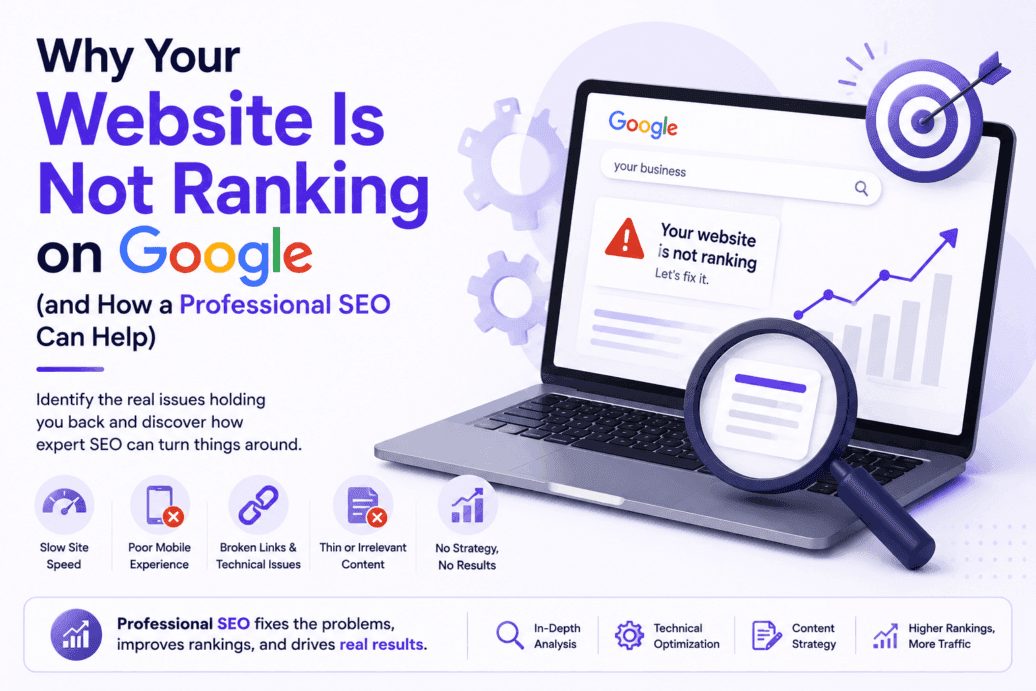
- A website almost never fails to rank for one single reason; it is usually two to five smaller problems stacking on top of each other, each capping visibility a little further.
- Start by confirming Google can actually crawl and index the site at all, because technical blockers make every other SEO effort pointless until they are cleared.
- Content that targets a keyword but does not answer what the searcher actually wanted will not rank, regardless of how well the page is technically optimized.
- Ranking is no longer the whole picture: a site can hold a strong position and still lose the click to an AI Overview that answers the question first.
This piece walks through the real reasons this happens, in the order that’s actually most useful to check them, and then gets into what a professional SEO does differently that usually gets a stuck website moving again.
Start With the Basics: Is Google Actually Able to Find Your Site?
Before worrying about rankings at all, it’s worth confirming Google even knows your pages exist, because a surprising number of “why isn’t my site ranking” problems turn out to be “my site was never properly indexed in the first place.”
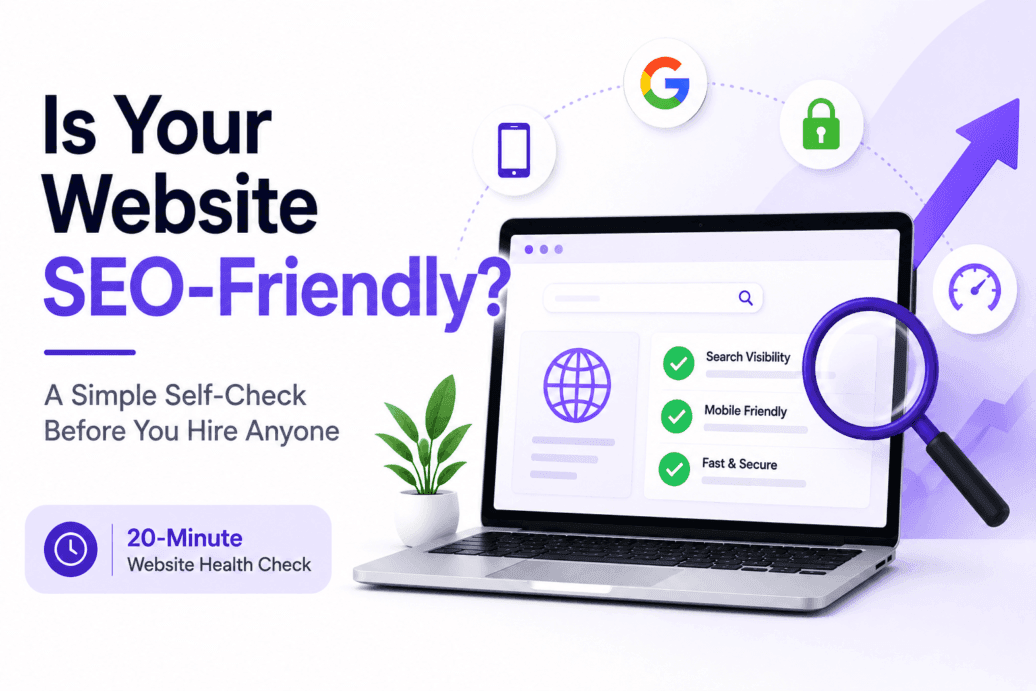
This happens more often than most business owners expect. A developer sets up a staging version of a website with a “noindex” tag telling search engines not to index it, launches the live site, and forgets to remove that tag. A robots.txt file, the small instruction file that tells search engines which parts of a site they’re allowed to crawl, gets configured too aggressively during development and accidentally blocks the entire site instead of just the admin area. A website built heavily on JavaScript renders perfectly in a browser but shows Google’s crawler a mostly empty page, because the content only appears after scripts run that the crawler doesn’t always wait for. None of these show up as an obvious error to a visitor. The site looks completely normal. It’s just invisible to Google. We’ve covered a simple way to check this yourself in our self-check guide for non-technical business owners, and it’s worth doing before anything else on this list.
Technical Problems That Quietly Cap What You Can Achieve
Once a site is properly indexed, a separate layer of technical issues can still hold rankings back, often without any obvious symptom pointing to the cause.
Site speed is one of the most common silent killers. A page that takes six or seven seconds to load on mobile isn’t just annoying, it actively works against your rankings, since Google factors real-world loading performance into how it ranks pages, and a slow page also loses visitors before they even see your content, which sends its own negative signal back to Google through poor engagement.
Mobile usability matters just as much, arguably more, given how much of Bangladesh’s search traffic happens on phones. A site that requires pinching and zooming, or that has buttons too small to tap accurately, is fighting an uphill battle no matter how good the content underneath it actually is.
Duplicate content quietly splits your ranking potential across multiple pages instead of concentrating it on one. This happens constantly on e-commerce sites, where filter and sorting options generate dozens of near-identical URLs for the same handful of products, and it happens on ordinary business sites too, when the same service is described almost word for word on two different pages. Without a technical signal called a canonical tag telling Google which version is the “real” one, search engines end up splitting authority across near-duplicates instead of ranking one strong version clearly.
Broken internal links and orphan pages, pages that exist but aren’t linked to from anywhere else on the site, quietly waste content that could otherwise be helping. If Google can’t easily find a path to a page through your site’s own internal linking, that page is far less likely to rank well, no matter how good the content on it actually is.
Content That Doesn’t Actually Answer What Someone Is Searching For
This is the one most business owners get wrong without realizing it, because the content exists, it’s just not built around what a searcher actually wants.
A page that talks generally about a service, using the same kind of soft, brochure-style language a printed pamphlet might use, often fails to rank simply because it doesn’t clearly and specifically answer the question behind the search. Someone searching “emergency plumber Dhaka available now” wants to see availability, response time, and service area immediately, not three paragraphs about the company’s twenty-year history before any of that information appears. This mismatch between what a page says and what the search actually needs, often called a search intent mismatch, is one of the most common reasons a technically sound page still doesn’t rank.
Thin content is a related but distinct problem. A page with two short paragraphs and a contact form gives Google very little to work with compared to a competitor’s page covering the same topic in genuine depth, with real answers to the follow-up questions a customer would naturally have. This doesn’t mean padding a page with unnecessary length, it means actually covering the topic thoroughly enough that a visitor doesn’t need to go elsewhere to get their remaining questions answered.
A lack of any real content strategy compounds this over time. A handful of scattered blog posts published without any real plan, on wildly different topics with no connection to each other, builds far less topical authority than a smaller number of genuinely comprehensive, connected pieces that clearly establish expertise in a specific area. Google increasingly rewards sites that demonstrate real depth in their subject area over ones that have simply published a lot of unrelated content.
No Authority Behind the Website
Content and technical health only go so far without a third ingredient: some signal, from outside your own website, that other sources consider you credible and worth referencing. This is largely what backlinks provide, and their absence, or worse, their poor quality, is a common and often invisible reason a website plateaus.
A website with very few backlinks is starting from a real disadvantage against established competitors who’ve accumulated years of links from directories, press coverage, partners, and industry mentions. This is fixable, but it takes deliberate, ongoing work rather than a one-time fix.
A damaged backlink profile is a different and more serious problem, and it’s surprisingly common among Bangladeshi businesses that tried a cheap SEO package in the past. Low-quality link building services often build large numbers of links from spammy, irrelevant, or obviously low-quality websites, the kind of links that used to work years ago but now actively signal manipulation to Google’s current algorithms. A site carrying this kind of backlink history can genuinely rank worse than a site with almost no backlinks at all, and cleaning it up is a real, sometimes lengthy piece of work in its own right.
For Local Businesses: An Incomplete or Inconsistent Local Presence
If your business depends on local customers, a huge share of “why can’t people find me” problems trace back to Google Business Profile and local consistency issues rather than anything on the website itself. An unclaimed or incomplete Google Business Profile, missing hours, no photos, no category selection, means Google has very little information to work with when deciding whether to show your business in local map results. Inconsistent business information across the web, a phone number on your website that doesn’t match what’s listed on Facebook or a directory, a slightly different address format in different places, quietly undermines the trust signals Google uses to confirm your business is legitimate and where you say it is.
You Might Be Targeting the Wrong Fight
Sometimes a website isn’t ranking not because anything is technically broken, but because the keywords being targeted are simply out of reach for where the site currently stands. Trying to rank a brand-new website for a broad, highly competitive term that’s dominated by companies with a decade of accumulated authority is a losing battle in the short term, no matter how well the page itself is built. This is often paired with a second, related factor: very new websites frequently go through a period, sometimes informally called a sandbox period, where Google seems hesitant to rank them competitively at all while it gathers more signals about the site’s trustworthiness. Neither of these is a flaw in your website. They’re simply realities that need a realistic, staged keyword strategy rather than an attempt to compete immediately for the hardest possible terms.
Sometimes the Problem Is a Penalty, Not a Missing Piece
Occasionally, a website that used to rank reasonably well suddenly drops sharply, and the cause isn’t a gradual technical or content weakness, it’s an actual penalty. This can be a manual action, a direct flag from a member of Google’s search quality team after detecting manipulative practices, or an algorithmic devaluation that happens automatically when an update detects patterns like keyword stuffing, hidden text, or a manipulative link scheme.
This is exactly what happened to one of our clients, Green Delta Insurance, whose website was compromised through a security breach and subsequently hit with a Google manual penalty, wiping out its visibility almost entirely. Recovering from this kind of situation is genuinely different from ordinary SEO growth work, it requires first fixing the underlying security issue, then formally addressing the penalty with Google directly, and only then rebuilding the trust and rankings that were lost. It took a full year of sustained work before traffic returned to, and eventually past, its original levels. If your rankings didn’t decline gradually but instead dropped suddenly and sharply, this is worth investigating specifically, since the fix looks nothing like ordinary content and technical improvements.
Or You Simply Haven’t Given It Enough Time Yet
This is the least exciting possible answer, but it’s often the correct one. SEO in Bangladesh typically takes 3 to 6 months to show meaningful movement even when everything is being done correctly, with significant, compounding results usually appearing between 6 and 12 months, as we’ve covered in detail in our guide to realistic SEO timelines. A website that’s only had consistent SEO attention for six or eight weeks isn’t underperforming, it’s simply early in a process that takes months to compound, and judging it against an unrealistic timeline is one of the most common reasons businesses give up right before results would have started showing.
Ranking Isn’t Even the Whole Picture Anymore
It’s worth adding one more layer to all of this. A website can genuinely fix every issue above, rank respectably in traditional search results, and still be functionally invisible to a growing share of searchers who now get their answer directly from an AI Overview or an AI chat tool instead of clicking through a list of blue links. This doesn’t replace anything covered above, it sits on top of it, and it’s covered in far more depth in our guide to AI visibility for Bangladeshi businesses. The short version: fixing the fundamentals above is necessary, but in 2026, it’s no longer automatically sufficient on its own.
How a Professional SEO Actually Diagnoses and Fixes This
Reading through everything above, the honest pattern that emerges is that these problems rarely show up alone, and they’re genuinely difficult to diagnose accurately without the right tools and enough pattern recognition from having seen this play out across many different websites.
A professional starts with a real audit, not a guess. Tools like Google Search Console, Ahrefs, and Screaming Frog surface indexing errors, technical issues, and backlink problems that simply aren’t visible from looking at a website in a normal browser. Without this kind of audit, most business owners are left guessing at which of the dozen possible causes above is actually the one holding their site back, and guessing wrong means wasting months fixing something that was never the real problem.
Experience matters more than it might seem, because these issues interact with each other. A site with both a site speed problem and a content depth problem needs both addressed, in the right order, since fixing content on a page nobody can load quickly won’t move rankings much on its own. Someone who’s diagnosed this pattern across dozens of websites recognizes it immediately. Someone doing this for the first time on their own website often fixes the more obvious, more visible issue while missing the one actually doing the most damage.
A professional also knows how to prioritize by actual impact, not by what feels most urgent. Not every issue found in an audit is worth fixing immediately. Knowing which three fixes will move the needle the most in the next few months, versus which ten are lower priority, is exactly the kind of judgment that comes from experience rather than a generic checklist.
Perhaps most importantly, a professional avoids the mistakes that make things worse. DIY attempts to fix technical SEO issues without fully understanding them, changing URL structures without proper redirects, for example, can accidentally cause more damage than the original problem. This is a real risk of trying to self-diagnose a genuinely broken website without the right background.
If you’re still deciding whether hiring outside help makes sense for your specific situation, or trying to work out what a realistic budget looks like, both of those questions are covered in detail in our guides on what to ask before hiring an SEO agency and what SEO actually costs in Bangladesh.
The Bottom Line
A website that isn’t ranking almost never has one clean, single cause. It’s usually a combination, a technical issue capping what content improvements can achieve, a content gap undermining an otherwise solid technical foundation, or a lack of authority holding back pages that are genuinely well built. Diagnosing which combination applies to your specific website, and fixing them in the right order, is exactly the value a professional SEO brings that a generic checklist or a single quick fix can’t replicate.
Not sure which of these issues is actually holding your website back? Talk to our team for a straightforward diagnostic conversation, or explore our full portfolio of case studies to see how we’ve solved this for other Bangladeshi businesses.
Want more of our work in your Google results?
Frequently asked questions
Start by checking whether your pages are properly indexed at all, using the site search trick covered in our self-check guide. If indexing looks fine, compare your content directly against whatever is currently ranking for your target keyword. If competitors’ pages are noticeably more thorough or directly answer the search better than yours, that points toward a content gap rather than a technical one.


Comments
No comments yet. Be the first to share your thoughts.