
Bangladesh Isn't Mobile-Only: About Half of Web Traffic Is Still Desktop
Pujan Kumar Saha · · 9 min read · Updated
Key takeaways
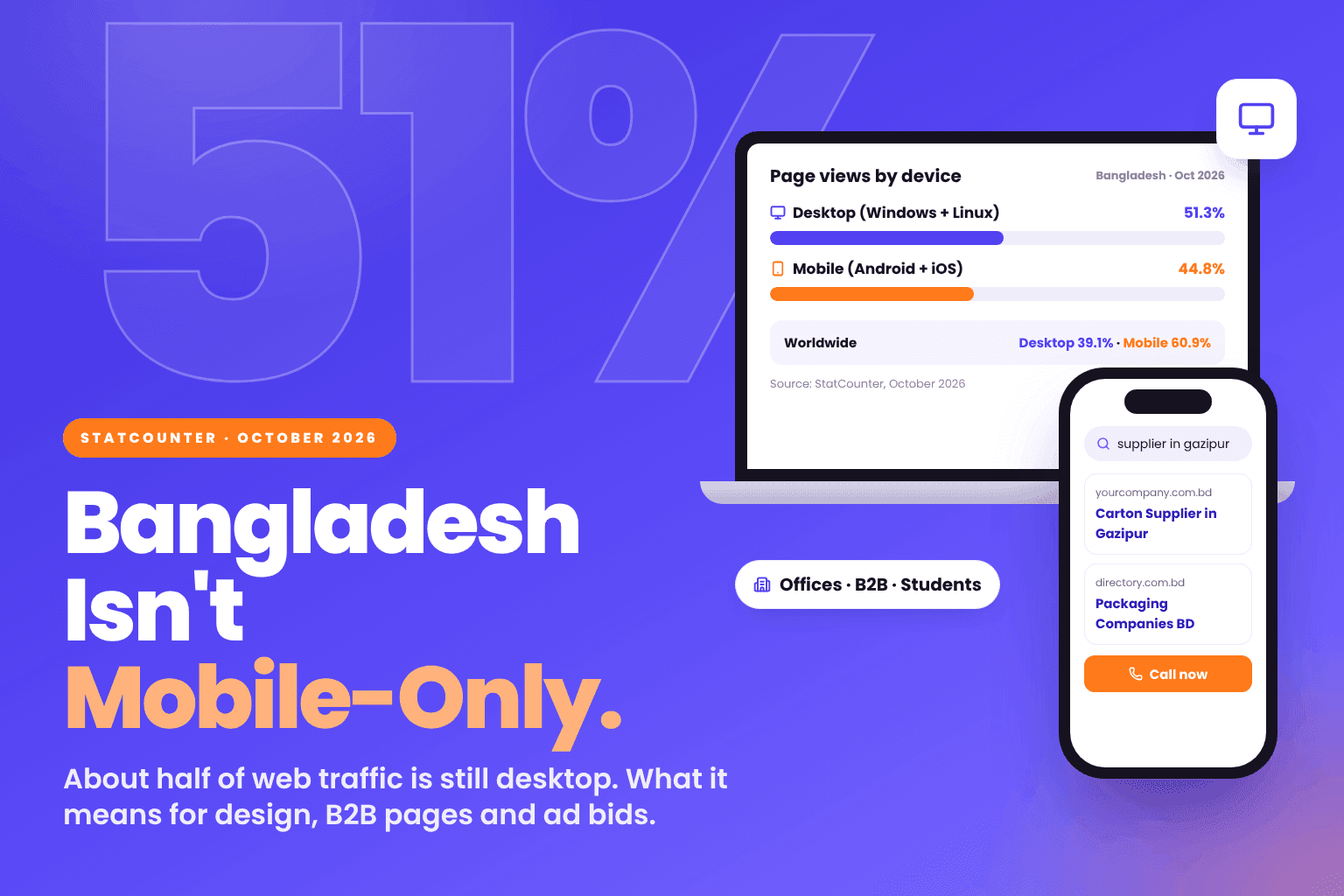
- StatCounter's October 2026 data puts Windows and Linux computers behind about 51% of tracked page views in Bangladesh, against about 45% for Android and iOS.
- Bangladesh leans far more towards desktop than the world, where mobile takes about 61% of page views, even though most Bangladeshi internet connections are mobile.
- Offices, B2B buyers, students, freelancers and cyber cafes keep desktop browsing strong, so check device splits and conversions by device in Search Console and GA4.
- Build mobile-first because Google indexes the mobile version, but design desktop layouts deliberately and set Google Ads device bids from your own conversion data.
The short answer: Bangladesh is not a mobile-only web market. StatCounter's October 2026 figures put Windows and Linux computers behind just over half of tracked page views in Bangladesh, against about 45% for Android and iOS phones. Offices, B2B buyers, students and freelancers still do much of their browsing on desktops. Build mobile-first for Google, but design, write and bid for the desktop visitor too.
"Everyone in Bangladesh is on mobile" is one of the most repeated lines in local marketing, and I have said versions of it myself. It is true for subscriptions and social media. It is not true for web traffic, and the gap matters if you sell to businesses, run Google Ads or design pages with long forms and tables. This post looks at the current numbers, why they differ from the mobile-only story, how to check your own split, and what to change.
Desktop vs Mobile Traffic in Bangladesh: What the 2026 Data Says
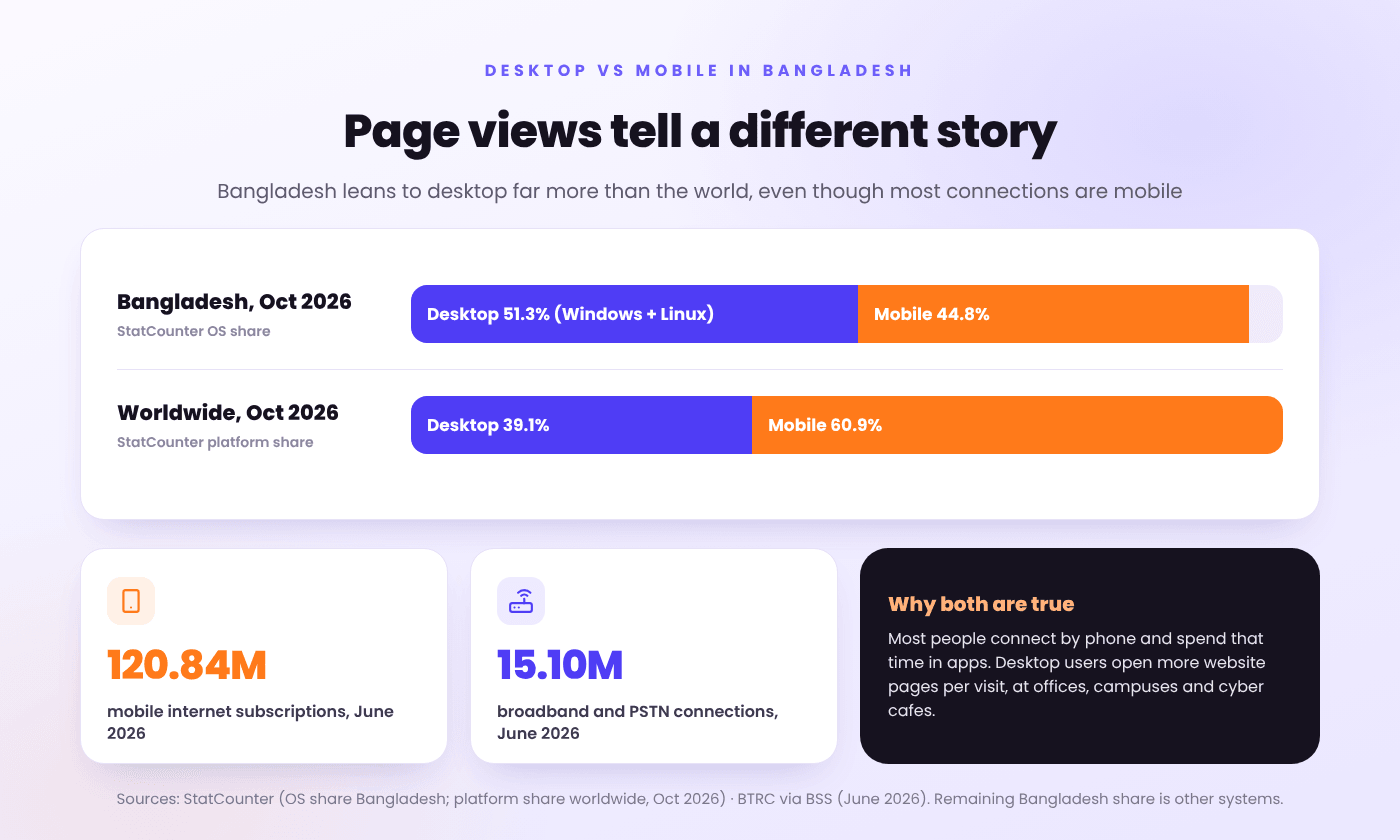
The best public source for device share is StatCounter, which measures page views across sites that use its tracking code. Its operating system data for Bangladesh in October 2026 shows Windows at 47.54%, Android at 41.5%, Linux at 3.73% and iOS at 3.33%. Add the desktop systems together and computers account for at least 51.3% of page views, with phones at about 44.8%.
That is very different from the global picture. Worldwide, StatCounter puts mobile at 60.87% and desktop at 39.13% for October 2026. Bangladesh leans towards desktop far more than the average country.
Its platform charts for Bangladesh tell the same story with bigger swings. Monthly snapshots in 2026 range from a near-even split to an August reading of 71.67% desktop, 28.08% mobile and 0.25% tablet. Whichever month you pick, desktop is roughly half or more.
Why the Mobile and Desktop Numbers Disagree
If desktops carry half the page views, why does everyone say Bangladesh is mobile-first? Because both statements measure different things.
Count connections and mobile wins easily. BTRC reported 120.84 million mobile internet subscriptions against 15.10 million broadband and PSTN connections in June 2026. Most Bangladeshis who go online do it on a phone, and most of their time goes to Facebook, YouTube, TikTok and messaging apps, which never show up as website page views.
Count website page views and desktop catches up. A person at an office computer opens more pages per visit, keeps more tabs open and reads longer pages than a person scrolling on a phone. One office worker can generate the page views of several mobile visitors.
There is also a measurement caveat. StatCounter samples sites that run its tracker, and month-to-month swings like 50% to 72% suggest its Bangladesh sample is noisy. Treat the figure as a strong signal that desktop matters, not a census. Your own analytics are the number that counts.
Why Bangladesh Still Browses on Desktops
The desktop share is not a mystery once you look at who uses the web for work.
Offices and B2B buyers. Procurement officers in Motijheel, merchandisers in garment buying houses, bank staff and accountants do their research on office PCs during working hours. If you sell software, machinery, logistics or professional services, your buyer is probably at a desk.
Freelancers and IT workers. Bangladesh is one of the world's largest sources of online freelance labour. The Oxford Internet Institute's Online Labour Index once ranked it second globally, with 16% of online workers. That is a 2017 snapshot, but the freelancing community it describes works almost entirely on laptops.
Students. University students in Dhaka, Rajshahi and Chattogram research assignments, scholarships and admission notices on laptops and campus labs.
Shared computers. Cyber cafes and computer shops in district towns still serve people filling in government forms, job applications on Bdjobs and visa paperwork, all tasks that are painful on a phone.
Search on Desktop Behaves a Little Differently
Google dominates search on every device, but not equally. StatCounter shows Google with 98.71% of mobile search in Bangladesh, while on desktops, tablets and consoles it holds about 96%, with Bing at roughly 3%. Microsoft Edge, the default browser on Windows office PCs, sends searches to Bing unless someone changes it.
Three percent sounds small. For a B2B company whose buyers search from office PCs, it is often worth claiming a free Bing Places listing and checking Bing Webmaster Tools, a one-hour job.
The kind of search differs too. Desktop searches tend to be longer research queries: comparisons, specifications, price lists, tender notices and "supplier in Bangladesh" style searches. Phone searches lean towards quick local actions: directions, opening hours, "near me" and a phone number to tap. If your business serves both, you need pages that answer both kinds of question.
How to Read Your Own Desktop vs Mobile Split
National averages only tell you so much. Your own customers may be 85% mobile or 70% desktop, and you can see which in ten minutes with free tools.
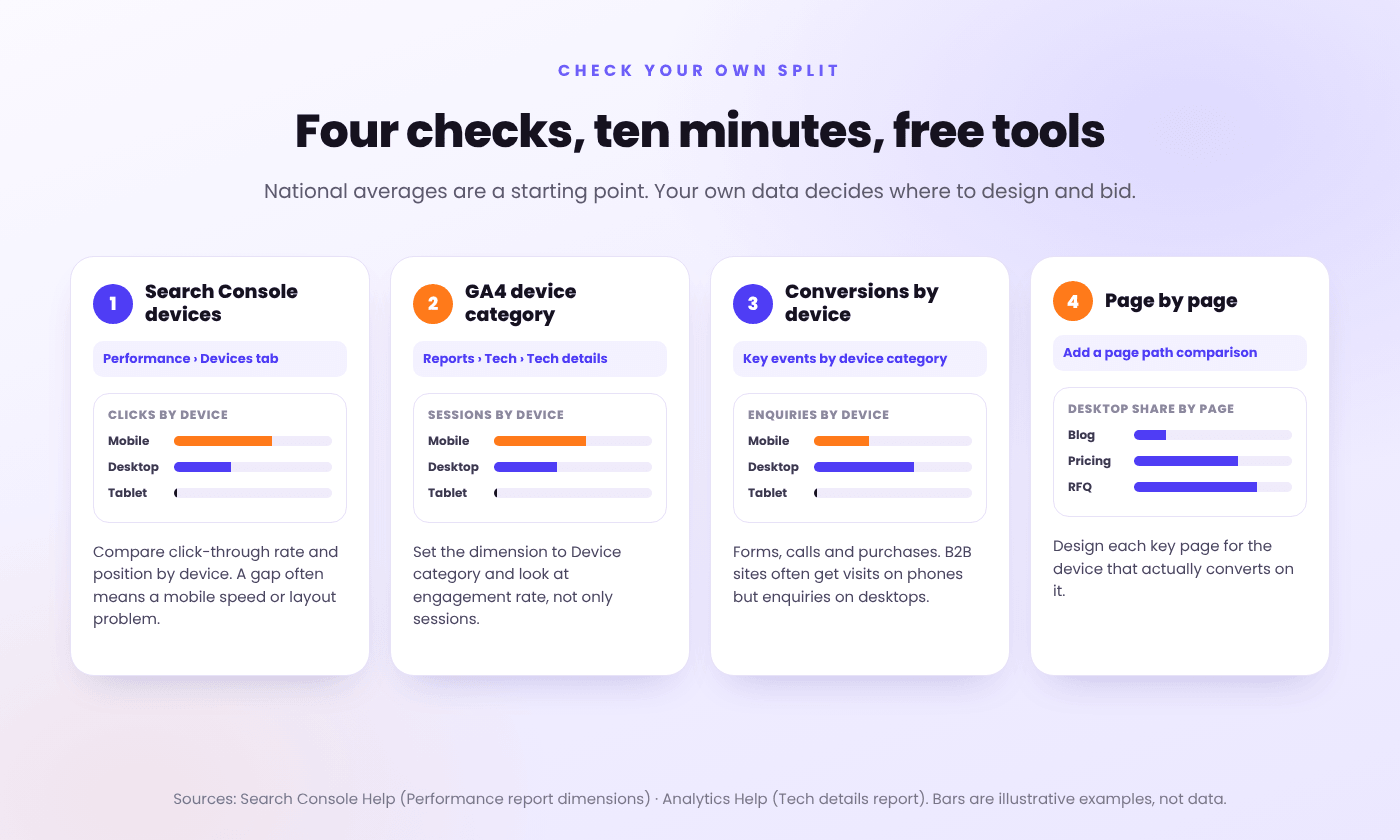
In Google Search Console, open the Performance report and choose the Devices tab, which groups clicks and impressions by desktop, mobile and tablet. Compare click-through rate and average position by device. A page that ranks well on desktop but poorly on mobile usually has a mobile usability or speed problem.
In Google Analytics 4, go to Reports, then Tech, then Tech details, and set the dimension to Device category. Look past sessions to engagement rate and key events such as form submissions, calls and purchases by device. In our client accounts, B2B sites often get most visits from phones but most enquiries from desktops.
Check by page, not just sitewide. Your blog may be 80% mobile while your pricing or RFQ page is mostly desktop. Design each page for the device that actually converts on it.
What Each Kind of Business Should Expect
The national figure hides big differences between industries. Here is the split we typically see across Bangladeshi client accounts. It is a pattern from our own Search Console and GA4 data, not a market study, so check your own numbers before acting on it.
| Business type | Typical device lean | What to prioritise |
|---|---|---|
| Restaurants, salons, local shops | Mostly mobile | Tap-to-call, maps, fast mobile pages |
| Fashion and lifestyle e-commerce | Mostly mobile | Mobile checkout, bKash and Nagad, light images |
| Software, IT and B2B services | Often desktop-heavy for enquiries | Detailed service pages, case studies, contact forms |
| Garment and export suppliers | Desktop-heavy, many overseas visitors | Capability pages, certifications, downloadable profiles |
| Education and admissions | Mixed; desktop for applications | Clear notices, PDFs that open on both devices |
What It Means for Website Design
None of this means going back to desktop-first design. Google indexes the web with its smartphone crawler: its documentation says it uses the mobile version of a site's content for indexing and ranking. If content is missing or broken on your mobile layout, it is missing for Google too.
So the rule is: build mobile-first, then design the desktop view on purpose instead of stretching the phone layout across a 24-inch monitor. On desktop, use the extra width for comparison tables, side-by-side product details, visible phone numbers and longer forms that would be painful on a phone.
Test both. Open your key pages on a mid-range Android phone over mobile data and on an office PC with a normal monitor. If either experience feels like an afterthought, fix it. Good responsive website design for desktop and mobile visitors means one site that works properly at every size, with the same content on both.
B2B Landing Pages: Design for the Office Desk
If your buyers are businesses, your most valuable visitor is probably sitting at a desk in Gulshan, Motijheel or an EPZ office, comparing three suppliers in three browser tabs.
Give that visitor what a desk makes easy. Put specifications, minimum order quantities, certifications and delivery terms in scannable tables. Offer a company profile or price list as a PDF. Show a direct phone number and email, not only a WhatsApp button, because some offices block messaging apps on work PCs. Keep the enquiry form on the page instead of a popup.
Write for the longer research queries desktop users type, such as "corrugated carton manufacturer in gazipur" or "ERP software for garment factory bangladesh". Our guide to SEO for RMG exporters and international buyers shows how to build those pages for overseas buyers, who are almost always on desktop too.
Bidding by Device in Google Ads
If you run Google Ads, device data should change how you bid. Google lets you set device bid adjustments from -100% to +900%, so you can raise bids where conversions happen and cut them where clicks rarely turn into enquiries.
Start by segmenting your campaigns by device for at least a month. Compare cost per conversion, not cost per click. Mobile clicks are often cheaper, but if desktop clicks convert three times as often for a B2B form, desktop is the better buy.
Two cautions. With automated strategies such as Maximize Conversions or Target ROAS, Google supports only the -100% device setting, so the algorithm decides the rest from your conversion data. That makes accurate conversion tracking more important than manual adjustments. And do not switch mobile off entirely for B2B: buyers often discover you on a phone and come back on a desktop to enquire. Our Google Ads management with device-level bidding starts with exactly this split.
When Mobile-First Is Still the Right Call
I want to be fair to the mobile-only view. For many Bangladeshi businesses it is still the right priority. If you sell food, fashion, beauty, mobile recharge or anything people buy on impulse after seeing it on Facebook, most of your traffic and sales will be on phones, whatever the national average says.
The point is not that desktop is winning. It is that Bangladesh is two audiences at once: a huge mobile audience and a smaller but valuable desktop audience that does research, works and buys for companies. Check which one pays your bills, design properly for both, and keep watching the numbers every quarter. A simple routine works: every quarter, export device share and conversions by device from GA4, note which pages convert on which device, and put the next quarter's design and ad budget where the enquiries actually come from. Write the numbers down so you can see the trend, because a single month can mislead in either direction. For the wider set of search fixes behind this, see our Bangladesh SEO playbook.
Not sure which device your customers buy on? Ask us to read your device data from Search Console and GA4, or see how we have shaped sites around real buyers in our client work.
Want more of our work in your Google results?
Frequently asked questions
It is close to even, with desktop slightly ahead in recent data. StatCounter's October 2026 figures show Windows and Linux on about 51% of tracked page views in Bangladesh and Android and iOS on about 45%. Monthly figures swing a lot, so check your own analytics for your site.
Comments
No comments yet. Be the first to share your thoughts.