Facebook Page or Website? The Real 12-Month Cost for a Bangladeshi Seller
Pujan Kumar Saha · · 10 min read · Updated

Key takeaways
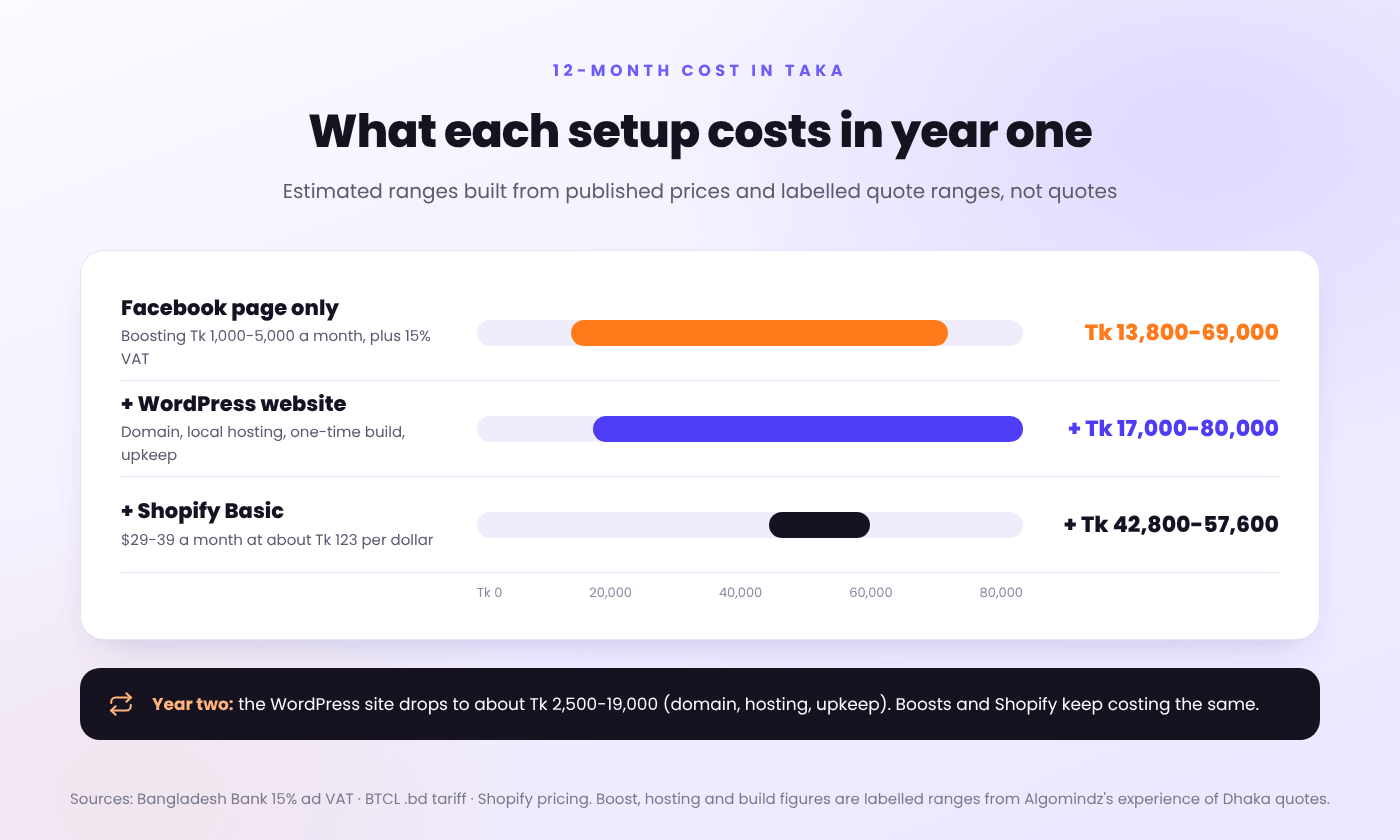
- A Facebook page is free to open, but a seller boosting Tk 1,000 to 5,000 a month spends about Tk 13,800 to 69,000 a year once 15% VAT on ads is added.
- A basic WordPress website costs roughly Tk 17,000 to 80,000 in year one and about Tk 2,500 to 19,000 a year after that, as labelled estimates.
- Stay Facebook-only while testing products or selling made-to-order items; build a site once you have repeat buyers, a larger catalogue or Google searches for your products.
- Most growing sellers should keep both: the page for discovery and chat, the website for search traffic, trust, payments and a customer list they own.
The short answer: a Facebook page costs nothing to open, but a seller who boosts posts every month can spend about Tk 13,800 to Tk 69,000 a year, ads plus 15% VAT, and still owns no customers. A basic website adds roughly Tk 17,000 to Tk 80,000 in the first year. Stay on Facebook while you are testing products. Build a site once you have repeat buyers, a real catalogue or customers who search on Google.
I get this question from home-based sellers in Mirpur, clothing brands in Chattogram and gadget shops in Bashundhara: "Bhai, do I really need a website, or is my page enough?" The honest answer depends on money and on what stage your business is at, so this post puts both options side by side for one full year, in taka. Where a price comes from a published source, I link it. Where it comes from quotes we see at Algomindz, I label it as a range.
Facebook Page vs Website: What You Are Really Comparing
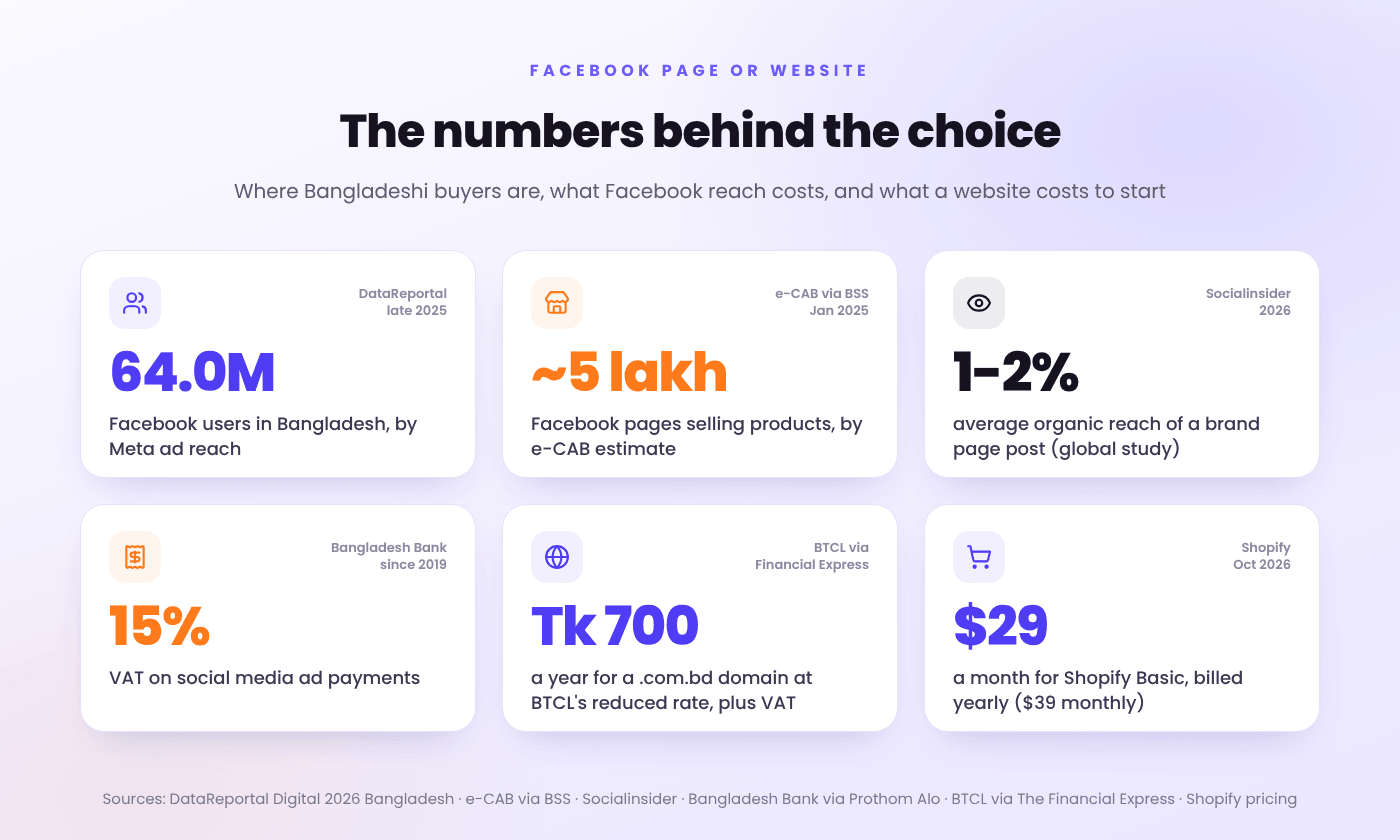
Facebook is where Bangladeshi buyers already are. DataReportal counted 64.0 million Facebook users in Bangladesh in late 2025, based on Meta's advertising tools. e-CAB has estimated that the country has around 5 lakh Facebook pages selling products, and that more than half of the regular sellers are women entrepreneurs. That is why f-commerce works: you go where the crowd is.
A website is a different thing. A page is rented space on Meta's platform, reached mostly through the feed and ads. A website is your own address, reached through Google, links and anyone you send there. So the real choice is not "Facebook or website". It is whether you rely only on rented reach or also build something you own. Almost every seller who builds a site keeps the page too. The question is when the extra cost starts paying for itself.
What a Facebook Page Really Costs in a Year
Opening a page is free, and that is the honest appeal. But very few sellers sell without boosting. The average organic post now reaches only a small slice of your followers. Socialinsider's 2026 study of brand pages found an average Facebook reach rate of about 1.8%, falling to around 0.5% for big pages. That is global data, but it matches what Bangladeshi sellers tell us: without a boost, a new post reaches very few people.
So the real Facebook cost is your ad budget. If you spend Tk 1,000 to Tk 5,000 a month on boosts, a common range among the small sellers we speak to, that is Tk 12,000 to Tk 60,000 a year. Add VAT: Bangladesh Bank has required 15% VAT on social media ad payments since 2019, which takes the total to about Tk 13,800 to Tk 69,000. Product photos, a part-time moderator for the inbox and courier software come on top, whichever route you choose.
What a Basic Website Costs in a Year
A website has more line items, but most of them are small. These are the costs for a simple store or catalogue site in year one.
| Item | Year-one cost | Where the number comes from |
|---|---|---|
| .com.bd domain | Tk 700 + VAT (renewal Tk 1,020) | BTCL's reduced 2026 tariff |
| Shared hosting, Bangladeshi provider | Tk 1,500 to Tk 6,000 | Labelled range from local hosting price lists; stores need the upper end |
| Design and build (WordPress with WooCommerce) | Tk 15,000 to Tk 60,000, one time | Labelled range from freelancer and agency quotes we see in Dhaka |
| Theme, plugins and upkeep | Tk 0 to Tk 12,000 | Labelled range; free plugins cover most small stores |
| Payment gateway | A small percentage of each online payment | Rates vary by provider and method; confirm with SSLCommerz or your bank |
The domain figure is official: BTCL cut the .bd domain fee by 36%, from Tk 1,100 to Tk 700 a year, for a limited period, with VAT on top. Resellers may charge more. Added up, year one lands at roughly Tk 17,000 to Tk 80,000, and year two drops to the domain, hosting and upkeep only.
The 12-Month Cost Comparison in Taka
Here are the three most common setups side by side. All totals are estimates built from the sources and ranges above, not quotes.
| Setup | Year one | Year two | What you own at the end |
|---|---|---|---|
| Facebook page only, boosting Tk 1,000 to 5,000 a month | Tk 13,800 to Tk 69,000 | The same again | A page Meta controls and your inbox history |
| Page plus a WordPress site | Page budget + Tk 17,000 to Tk 80,000 | Page budget + Tk 2,500 to Tk 19,000 | Your domain, customer list, Google rankings |
| Page plus Shopify Basic | Page budget + about Tk 42,800 to Tk 57,600 | About the same | Your domain and customer list; the store runs on Shopify |
The Shopify row uses its Basic plan at $29 a month billed yearly or $39 billed monthly, converted at about Tk 123 to the dollar, the market rate in October 2026. You also need a card that can pay in dollars. For most small Bangladeshi sellers, a local WordPress build is cheaper over two years.
A Worked Example: When Does a Website Pay for Itself?
Take an illustrative seller: a women's clothing page in Dhanmondi that boosts Tk 3,000 a month. That is Tk 36,000 in ads plus Tk 5,400 VAT, about Tk 41,400 a year on Facebook alone. These numbers are an example to show the method, not a real client.
Now add a modest WordPress site: Tk 805 for the domain with VAT, Tk 3,000 for hosting, Tk 35,000 for the build and Tk 5,000 for upkeep. That is about Tk 43,800 in year one and around Tk 9,000 in year two.
Next, work out what one order is worth to you after product, packaging and delivery costs. Say it is Tk 400. In year one, the site needs about 110 extra orders to cover itself, roughly 9 a month from Google, repeat buyers and people who trusted the site enough to pay. In year two, it needs only about 23 extra orders for the whole year. Do this sum with your own margin before you decide. If you cannot imagine those orders, wait.
The Hidden Costs of Staying Facebook-Only
The budget line is not the whole cost. Three things never show up on the bill.
You rent your customers. Your followers belong to your page, and your page lives under Meta's rules. Pages get hacked, hit with copyright strikes or restricted without warning, and the appeal process can be slow. A website with a customer email or phone list survives that.
You miss Google. When a buyer types "baby stroller price in bd" or "best panjabi shop dhanmondi", Google shows websites, maps and marketplaces, rarely a Facebook post. Those buyers are already looking to buy, and they cost nothing per click once you rank.
Trust and payments. Many buyers check for a real website before paying in advance, especially after the Evaly and e-Orange collapses of 2021. Payment gateways also usually ask for a working website with clear refund and privacy policies before they approve a merchant. A page with "inbox for price" loses some buyers at exactly the point they were ready to pay.
What a Website Gives You That a Page Cannot
Search is the biggest difference. StatCounter puts Google at about 98% of search traffic in Bangladesh in September 2026, and a website is the only way to show up for product and service searches on your own terms. A good product page keeps bringing visitors for years after you write it, with no boost needed. That compounding is why our SEO playbook for online stores in Bangladesh starts with product and category pages.
A website also gives you data you control. With Google Analytics and Search Console you can see which products people search for, which pages sell and where visitors drop off. Facebook Insights only shows how your posts performed inside Facebook.
Finally, a site lets you run proper campaigns. A sale page on your own domain can rank, collect links and come back every year, as our 11.11 sale SEO checklist explains. On a page, every campaign starts again from zero followers' attention.
Who Should Stay on Facebook for Now
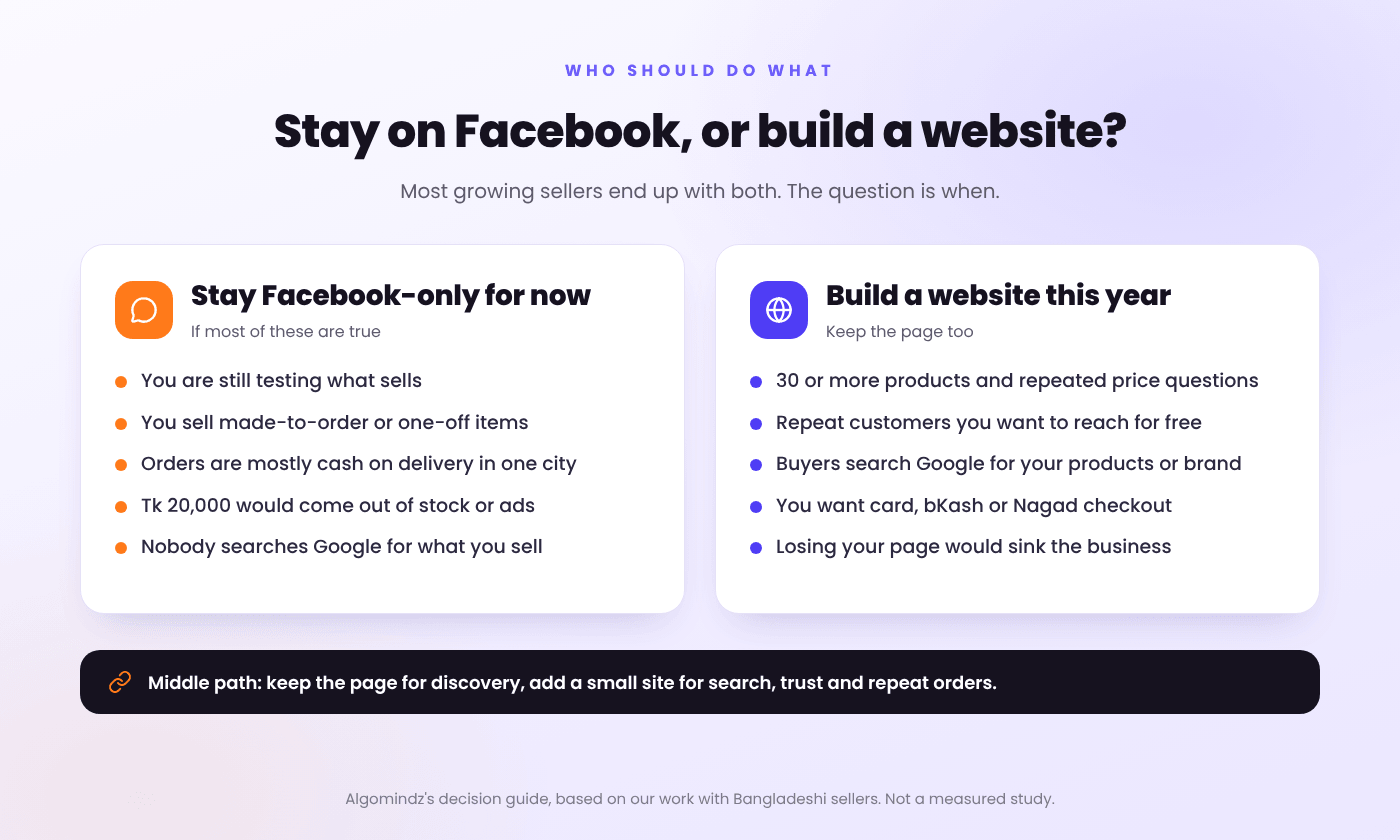
I tell plenty of sellers not to build a website yet. Stay Facebook-only if most of these are true:
- You are still testing what sells, and your product list changes every few weeks.
- You sell made-to-order or one-off items, such as custom cakes, handmade jewellery or tailoring, where every order starts with a chat anyway.
- Almost all orders are cash on delivery inside one city, and you handle them yourself through Messenger and WhatsApp.
- You cannot set aside Tk 20,000 without cutting your ad budget or stock.
- Nobody searches Google for what you sell, because buyers only discover it by seeing it.
In that stage, money spent on stock, better photos and a steady boost budget usually earns more than a website no one visits. Use the time to write down your bestsellers, prices and common questions. That list becomes your website later.
Who Should Build a Website This Year
Build a site, and keep your page, once you recognise your business in this list:
- You have more than 30 or 40 products and buyers keep asking for the same prices and sizes.
- You get repeat customers and want to reach them without paying Meta every time.
- Buyers search Google for your products or your brand name. Check Google Trends or ask new customers how they found you.
- You want online payment through cards, bKash or Nagad at checkout, or you sell to corporate, wholesale or overseas buyers who expect a website.
- You would lose most of your business if your page were hacked tomorrow.
Even then, start small. A clean catalogue with good product pages, prices in taka, delivery charges and a WhatsApp button does more than a complex store nobody maintains. If you want help planning it, our website development service for growing online sellers starts with exactly that scope question.
The Middle Path: Keep the Page, Add a Small Site
For most growing sellers, the best answer is both. Keep the page for discovery, conversation and boosts. Add a small site for search, trust and repeat orders, and connect the two. Put your website link in the page's About section and in every product post. Install the Meta Pixel on the site so your boosts can retarget people who visited a product. Send Messenger customers to a product page with the full details instead of typing the price again for the hundredth time.
Start with five to ten pages: home, your main categories, your bestsellers, delivery and returns, and contact. Then grow it from what customers ask. Within a year you have an asset that keeps working when your ad budget is paused.
If you are weighing how much to put into search once the site is live, our breakdown of SEO pricing in Bangladesh shows what each level of spend buys.
Still deciding between your page and a website? Tell us how you sell today and we will give you an honest view of whether a site would pay for itself yet, or browse the businesses we have helped grow online.
Want more of our work in your Google results?
Frequently asked questions
Yes, at the start. A Facebook page is enough while you are testing products, selling made-to-order items or handling cash-on-delivery orders in one city. Once you have repeat customers, a larger catalogue or buyers searching on Google, a website starts to earn back its cost.

Comments
No comments yet. Be the first to share your thoughts.