
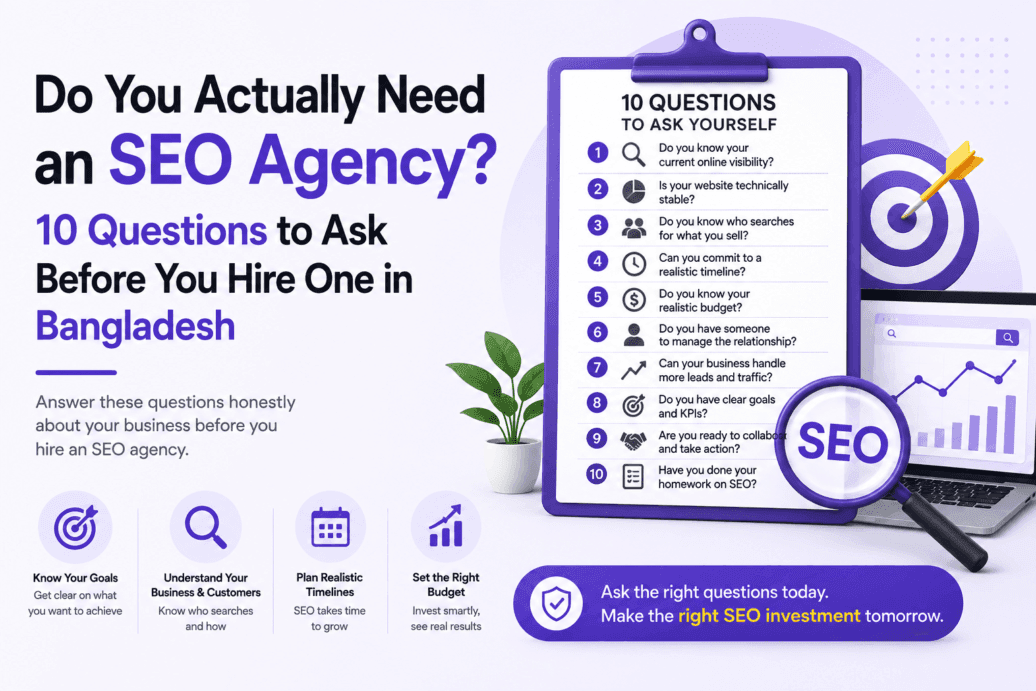
Do You Actually Need an SEO Agency? 10 Questions to Ask Before You Hire One in Bangladesh
Algomindz SEO Team · August 14, 2026 · 9 min read
Key takeaways
- A competitor's new website, a sales pitch promising page one in three months, and a friend's recommendation are the three most common reasons businesses hire an SEO agency, and none of them is a good one.
- The questions worth answering first are about your own business, not the vendor: your current visibility, your site's technical stability, your realistic timeline, and your actual budget range.
- A business that cannot handle more leads, or has nobody internally to own the relationship, will waste an SEO retainer regardless of how good the agency is.
- Mismatched expectations from day one are why owners conclude that SEO does not work, when the real problem was readiness rather than the channel.
This is a self-assessment, not a vendor checklist. Before you evaluate a single agency, these are the questions worth answering honestly about your own business first, because the answers determine whether you’re actually ready to get value from SEO, or whether you’d be better off fixing something else first.
1. Do You Actually Know Your Current Online Visibility?
Most businesses answer this question with a guess. “We’re probably not ranking for much” is not a baseline; it’s a shrug. Before hiring anyone, check what you can see for free: search your business name, your core products or services, and a few obvious customer questions, and note what actually shows up. If you have no idea whether you currently rank for anything, you have no way to judge whether an agency’s proposed improvement is realistic or wildly inflated. A five-minute audit of your own visibility, even a rough one, puts you in a far stronger position going into any conversation with a provider.
2. Is Your Website Technically Stable Enough to Support the Work?
SEO invested into a website that’s about to be redesigned, migrated to a new platform, or rebuilt from scratch is money spent twice. If you know a rebuild is coming in the next few months, that’s the project to finish first, since a large share of SEO work, technical fixes, content structure, internal linking, gets undone or has to be redone when the underlying site changes. This is a common and expensive mistake among Bangladeshi businesses moving from a basic website or a Facebook-only presence to a proper e-commerce platform: paying for SEO on the version of the site that’s about to be replaced.
3. Do You Know Who Actually Searches for What You Sell?
This sounds obvious, but a surprising number of businesses haven’t actually thought through how their real customers search. Do they search in English, Bengali, or a mix of both? Do they search by product name, by problem, or by location? Do they search on Google, or do they primarily discover businesses through Facebook and word of mouth instead? If you can’t describe, even roughly, how your actual customers look for what you sell, that’s worth sitting with before an agency starts guessing on your behalf, since keyword strategy built on assumptions instead of real customer behavior wastes budget from the first month.
4. Can You Commit to a Realistic Minimum Timeline?
SEO in Bangladesh typically takes 3 to 6 months to show meaningful movement, with significant, compounding results usually appearing between 6 and 12 months, as we’ve covered in detail in our full breakdown of realistic SEO timelines. If your honest internal expectation is results within four to six weeks, or if your budget approval only covers a two or three-month trial, that mismatch will surface eventually, usually as disappointment in month two, right before the work would have started compounding. Answering this honestly now saves both you and any agency a frustrating, prematurely cancelled engagement later.
5. Do You Know What Budget Range Actually Fits Your Situation?
Before talking to a single provider, it helps to know roughly what a realistic engagement costs for a business like yours. As covered in our complete SEO pricing guide for Bangladesh, most growing SMEs land in the BDT 30,000 to 60,000 per month range for genuinely strategic work, with local service businesses often starting lower and competitive or international-facing businesses running considerably higher. If your actual available budget sits well below what your industry and competition realistically require, that’s worth confronting directly, since it usually means either delaying the hire until the budget grows, or being upfront with a provider about scaling the scope down to match, rather than being surprised later that a bargain package underdelivered.
6. Do You Have Someone Internally Who Can Own the Relationship?
Even a fully outsourced SEO engagement needs an internal point of contact, someone who can answer questions about the business, approve content, provide product or service details, and make timely decisions. Without that person, an agency ends up guessing at details only your business actually knows, and progress stalls waiting for approvals that never come. In many Bangladeshi small businesses, this responsibility quietly falls on an owner who’s already stretched across sales, operations, and everything else, which is worth planning for honestly rather than assuming it’ll sort itself out once the contract is signed.
7. Can Your Business Actually Handle More Leads and Traffic?
This is the question almost nobody asks, and it matters more than most of the others. If SEO works exactly as intended and inquiries triple, can your team actually respond to them quickly? Can your inventory or service capacity handle the increased demand? Is there a functioning process for following up on leads at all, or do inquiries currently sit unanswered in a Facebook inbox for days? Investing in visibility before fixing response and fulfillment capacity means paying to generate customers your business isn’t actually positioned to convert or serve, which is a genuinely common and avoidable waste of an SEO budget.
8. Do You Have Real Subject Matter Expertise to Feed the Content?
Good SEO content depends on real knowledge of your industry, your products, and your customers’ actual questions, not generic filler. If nobody on your team can answer detailed questions about your own offerings, or provide the specific details, pricing logic, process explanations, common objections, that make content genuinely useful, that’s a gap worth closing before the content production starts, not after several months of thin, generic articles that don’t perform.
9. Do You Know Your Own Numbers Well Enough to Judge ROI?
To fairly judge whether an SEO investment is working, you need to already know a few things about your own business: your average order or deal value, your typical close rate on leads, and roughly what a new customer is worth to you over time. Without these numbers, even a genuinely successful SEO campaign is hard to evaluate, since you can’t translate traffic and rankings into a return without them. If you don’t currently track this, that’s worth fixing in parallel with, or ideally just before, starting an SEO engagement.
10. Is Organic Search Actually the Right Channel for Your Goals Right Now?
SEO is extremely effective for businesses whose customers actively search for what they offer, but it isn’t automatically the right first investment for every business. If you need revenue in the next four weeks, not the next four months, a paid channel may serve that specific need better in the short term while SEO builds in parallel. If your customers rarely search online at all and instead rely on referrals, physical location, or social media discovery, SEO may still be worth building for the future, but it shouldn’t be the only channel carrying urgent, near-term expectations. Being honest about this now prevents judging SEO against a job it was never suited to do in the first place.
What If You’re Not Ready Yet?
Answering “not really” to several of these questions doesn’t mean SEO is the wrong choice; it means there’s a shorter, cheaper step to take first. Fixing a shaky website, clarifying your customer research, setting up basic lead tracking, or simply building internal capacity to handle more inquiries are all quick wins that make an eventual SEO investment far more effective once it starts. Spending a few weeks addressing these gaps before signing a contract almost always produces a better outcome than starting immediately and discovering the gaps mid-engagement.
Once You’re Ready
If most of these questions have solid answers, the next step is evaluating providers themselves, their proposed scope, their transparency, their track record, which is exactly what we cover in the provider evaluation section of our SEO pricing guide for the Bangladesh market. The businesses that get the strongest results from SEO are rarely the ones who moved fastest into a contract. They’re the ones who did this internal groundwork first, so the agency they eventually hired could focus entirely on growth instead of untangling foundational gaps along the way.
The Bottom Line
Hiring an SEO agency is a decision about your own business readiness as much as it is a decision about which provider to choose. The businesses that answer these ten questions honestly before signing anything spend their budget more effectively from month one, because the foundation, realistic expectations, internal ownership, operational capacity, is already in place before the work even starts.
Not sure where your business actually stands on these questions? Talk to our team for an honest readiness assessment before you commit to anything, or explore our full portfolio of case studies to see what a well-matched engagement looks like in practice.
Want more of our work in your Google results?
Frequently asked questions
If you have a reasonably stable website, a rough understanding of how your customers search, a realistic budget and timeline expectation, and the internal capacity to handle both the collaboration and any resulting increase in leads, you’re likely ready. If several of these are missing, addressing them first typically produces a stronger outcome than hiring immediately.
Comments
No comments yet. Be the first to share your thoughts.