How Long Does SEO Take to Show Results in Bangladesh?
Pujan Kumar Saha · August 6, 2026 · 15 min read · Updated August 18, 2026
Key takeaways
- SEO timelines in Bangladesh differ from US or UK benchmarks because Google's dominance is near total, search is overwhelmingly mobile, and many local competitors still have not invested.
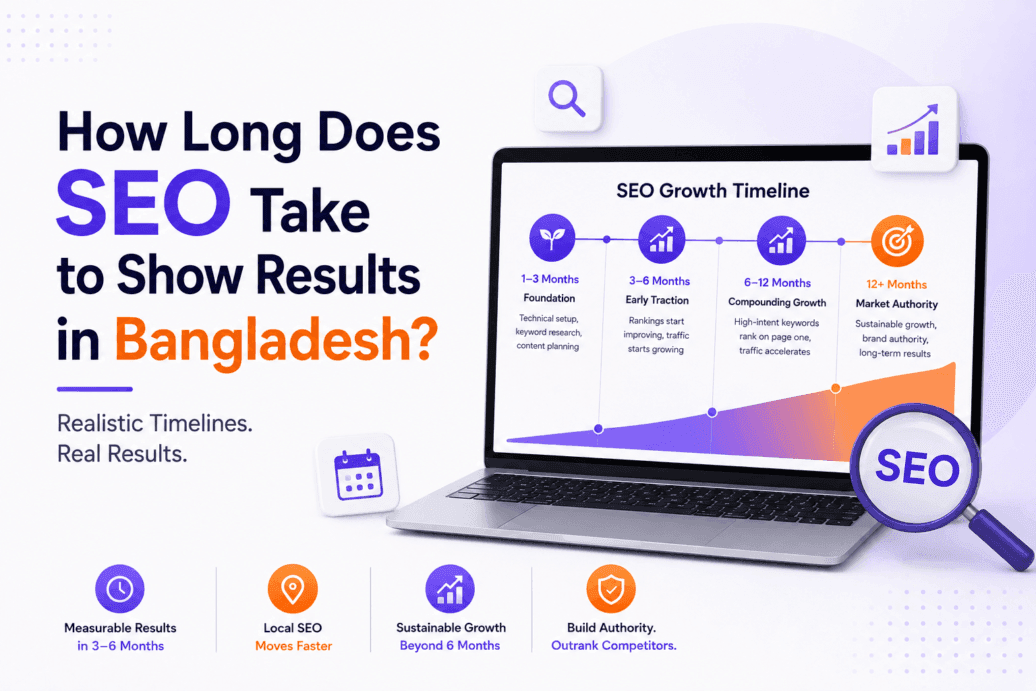
- A realistic arc runs from foundation work in months one to three, early traction from three to six, compounding growth from six to twelve, and market authority beyond a year.
- Unlike paid ads, SEO cannot be switched on for immediate results, because the early months are spent building the foundations the later results depend on.
- Starting position, competition, site quality, and content velocity are what actually move a timeline faster or slower, not the agency's promises.
It’s a fair question, and it deserves a locally grounded answer rather than a generic one. Bangladesh’s search landscape has its own shape: Google’s dominance is close to total, mobile is how the vast majority of people search, and a large share of local competitors still haven’t invested in SEO at all. That mix changes what a “realistic timeline” actually looks like here compared to a saturated market like the US or UK.
Unlike SEM or paid ads, where a campaign can start driving clicks within hours of going live, SEO doesn’t work on a switch. It works on trust and trust takes time to build with Google.
The short answer: most Bangladeshi websites start seeing measurable movement within 3 to 6 months, with significant, compounding results showing up between month 6 and month 12 broadly in line with global benchmarks, though local SEO and low-competition niches here often move faster than that global average because so few competitors have a real SEO strategy in place. The honest, longer answer depends on your site’s age, your competition, and how consistently the work gets done, and that’s what we’ll break down below, backed by both global industry data and real campaign timelines from Bangladeshi businesses in our own portfolio.
The Bangladesh SEO Landscape in 2026
Before getting into timelines, it helps to understand the market you’re actually competing in.
- Google is essentially the only search engine that matters here. Google holds roughly 97% of the search engine market share in Bangladesh, according to Statcounter data reported via industry sources, far higher than in many Western markets where Bing and other engines carve out a meaningful slice. That simplifies strategy: you’re optimizing for one algorithm, not several.
- The internet-using population is still growing fast, but far from saturated. DataReportal’s Digital 2026 Bangladesh report puts the country at roughly 82.8 million internet users, about 47% of the population, with 186 million active mobile connections. That means there’s still significant headroom for organic growth as more of the population comes online, a very different dynamic from mature markets where user growth has flattened.
- This is a mobile-first market. The large majority of Bangladeshi internet access happens on mobile devices, which makes page speed, mobile usability, and mobile-first indexing far more decisive ranking factors here than the desktop experience.
- Digital ad spend is rising quickly, but SEO adoption among local businesses is still low. Bangladesh’s digital advertising market has been projected to approach USD 669 million, yet by most industry estimates, fewer than a third of Bangladeshi businesses have a defined SEO strategy in place. For a business willing to invest properly, that’s a real competitive gap. It’s often easier to rank in Dhaka, Chattogram, or Sylhet against under-optimized competitors than to rank in a market where every competitor already has a mature, years-old SEO program.
- E-commerce is accelerating. The local e-commerce market has been valued in the $3–4 billion range and is growing at roughly 25–30% annually, which means organic visibility for product and category pages is becoming a bigger revenue lever every year, not a smaller one.
The upshot: the mechanics of SEO (crawling, indexing, trust-building, content quality) work the same way in Bangladesh as anywhere else, because Google’s algorithm doesn’t change by country. But the competitive intensity is often lower here than in saturated global markets, which is one reason well-executed Bangladeshi campaigns can sometimes hit meaningful milestones faster than the global averages below would suggest, as you’ll see in the case studies further down.
What the Data Actually Says
SEO timelines get thrown around a lot, so it’s worth grounding this in real research rather than guesswork.
- In a poll of 3,680 marketers run by Ahrefs, the most common answer to “how long does SEO take” was 3 to 6 months.
- Ahrefs’ own study of two million random pages found that roughly 95% of newly published pages never reach Google’s top 10 within their first year, and the pages that do usually have either a strong backlink profile or target low-competition search terms.
- That same research found the average page ranking in today’s top 10 results is over two years old, which says a lot about how much authority compounds over time.
- Semrush’s State of Search research reports a similar pattern: new pages typically need 3 to 6 months to generate meaningful impressions, and 6 to 12 months to reach page-one positions for genuinely competitive keywords.
- On the local side, Google Business Profile and map-pack optimizations tend to move faster, often showing measurable movement within 4 to 8 weeks, since you’re competing with businesses in your city rather than the entire web.
- Site-wide factors matter too: research from BrightEdge shows organic search drives roughly 53% of all website traffic, more than double what paid search drives, which is exactly why the long game pays off once it kicks in.
Put simply: if someone promises you first-page rankings in two weeks, be skeptical. If they tell you SEO is a 6-to-12-month relationship that gets stronger every month after that, they’re telling you the truth.
Why SEO Takes Time in the First Place
Search engines aren’t just indexing your page, they’re deciding whether to trust it more than every other page competing for the same query. That trust is built across a few layers:
1. Crawling and indexing aren’t instant. Even after you publish a page, Google needs to discover it, crawl it, and decide where it fits. For a brand-new website, Google’s own John Mueller has said it can take up to a year for the algorithm to fully figure out where a new site belongs, a phase many SEOs refer to as the “sandbox” period.
2. Rankings are relative, not absolute. You’re not just optimizing your page; you’re outranking every competing page on relevance, content quality, user experience, and backlink authority. If your competitors have been building authority for years, closing that gap takes sustained effort, not a single optimization sprint.
3. Algorithms reward consistency over time. Google’s ranking systems are designed to filter out short-term manipulation. A page that earns links, engagement, and updates steadily over months looks far more trustworthy than one that spikes and disappears.
This is also why SEO tends to outperform SEM in the long run, even though SEM wins on speed. SEM can put you at the top of the page almost immediately, but the moment your budget stops, so does your traffic. SEO traffic keeps compounding long after the initial work is done and in a market like Bangladesh, where digital ad costs are climbing as more local businesses discover paid search, that compounding advantage matters even more over a 2–3 year horizon.
A Realistic SEO Timeline, Month by Month
Every website is different, but most campaigns we run at Algomindz follow a similar arc:
Months 1–3: Foundation
This is where the groundwork gets laid, technical audits, fixing crawl and indexing issues, keyword research, on-page optimization, and setting up tracking through Google Search Console and Analytics. You may see small movements in impressions and long-tail keyword positions, but rarely a dramatic traffic jump yet.
Months 3–6: Early Traction
This is typically when the first real signals appear: long-tail keywords entering the top 10–30 positions, impressions climbing week over week, and for local businesses, the first meaningful jumps in Google Business Profile visibility. Traffic is still modest, but the trend line turns clearly positive.
Months 6–12: Compounding Growth
This is where the real gains show up. Rankings for competitive, high-intent keywords start moving into page one, organic traffic accelerates, and content published earlier in the campaign starts pulling its weight. Around 80% of SEO professionals agree that consistent, measurable results require at least six months of ongoing work before a campaign should be judged a success.
12+ Months: Market Authority
Beyond the first year, well-executed SEO becomes very difficult for competitors to displace. You’re not just ranking for a handful of keywords anymore. You’re building the kind of topical authority and backlink profile that keeps generating leads without ongoing ad spend.
Factors That Speed Up (or Slow Down) Your Results
Not every website moves through that timeline at the same pace. A few factors make the biggest difference:
- Domain age and authority: Established websites with existing backlinks and content history tend to rank faster than brand-new domains, sometimes cutting timelines by close to 40%.
- Competition level: Ranking for “SEO” is a multi-year fight against sites with tens of thousands of backlinks. Ranking for a specific, lower-competition long-tail phrase can happen in weeks.
- Content consistency: Sites that publish regularly and refresh older content tend to hit organic traffic milestones noticeably faster than sites that publish sporadically.
- Internal linking: A well-structured internal linking strategy, connecting your blog content to your service pages and other relevant articles, helps search engines understand your site’s structure and can meaningfully shorten time-to-rank.
- Technical health: Fixing site speed, mobile usability, and indexability issues can produce visible ranking lifts in a matter of weeks, even before content and links kick in.
- Local vs. national scope: Local SEO is inherently faster because you’re competing within a city or region instead of the entire country or globe, and in Bangladesh, where Google Business Profile adoption among small businesses is still inconsistent, a fully optimized profile can stand out quickly against half-finished competitor listings.
- How much of your competition is actually doing SEO: This is a bigger factor in Bangladesh than in more mature markets. With a large share of local businesses still relying primarily on Facebook pages and paid boosts rather than a real SEO strategy, ranking for many category and city-level keywords doesn’t require outcompeting a decade of accumulated authority, just outcompeting whoever else bothered to show up.
- Bengali and mobile-first search behavior: With the majority of local searches happening on mobile and a growing share in Bengali or mixed Bangla-English (“Banglish”) phrasing, content that reflects how people actually search, rather than a direct English-only translation of Western keyword patterns tends to gain traction faster.
- AI search visibility: With Google’s AI Overviews and other AI-driven answer surfaces now part of the search landscape, content structured with clear headings, FAQs, and direct answers can start showing up in AI-generated results before it even reaches a top organic ranking, a strategy closely related to Answer Engine Optimization (AEO).
Our Real Results: What SEO Timelines Look Like for Bangladeshi Businesses
Numbers are more convincing than promises, so here’s what these timelines have actually looked like across campaigns we’ve run for businesses based in Bangladesh, proof that the “3 to 6 months for early traction, 6 to 12 for real growth” pattern isn’t just a global statistic, it plays out locally too, and sometimes faster given the lighter competition described above.
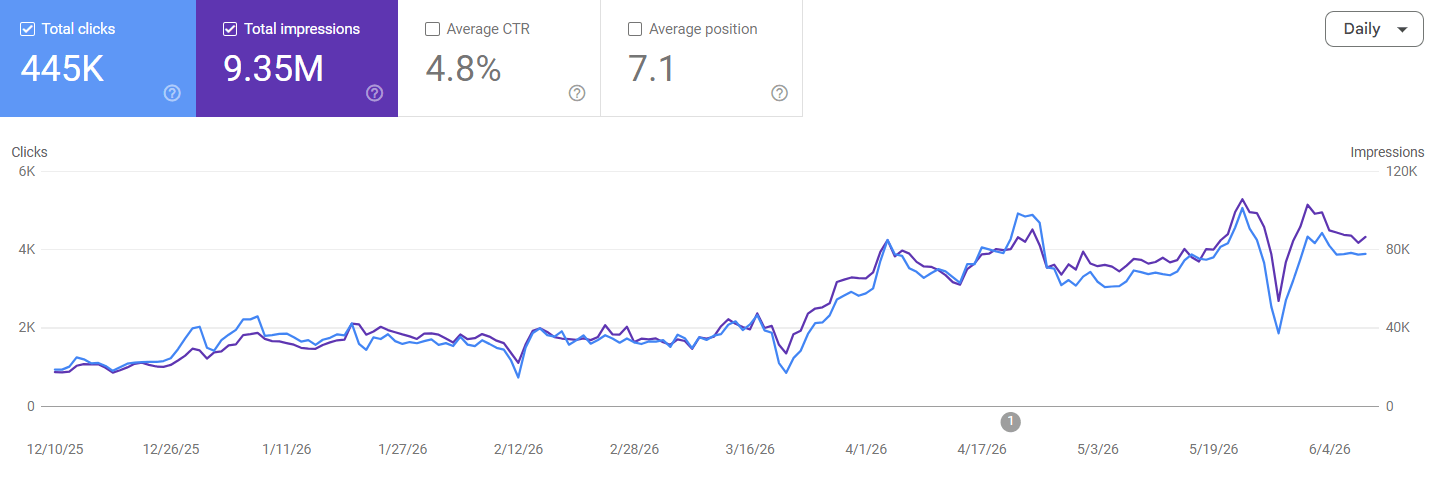
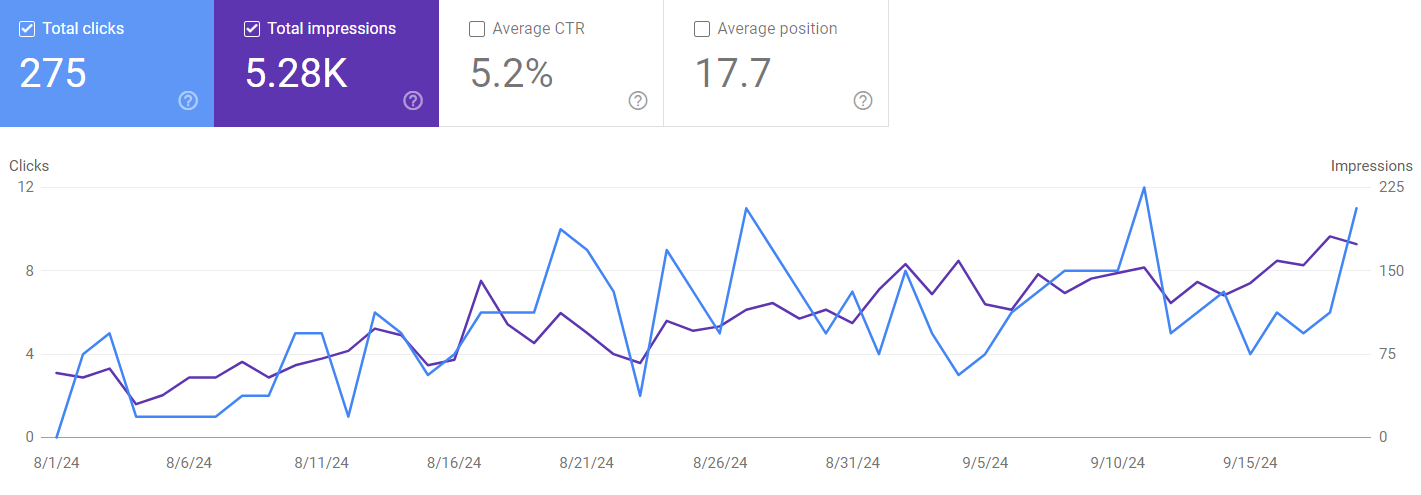
Rangs eMart: 3-month non-branded keyword campaign. Rangs eMart came to us with poor visibility on non-branded search terms, the kind of high-intent, category-level searches that drive real buyer traffic. Within three months of targeting on-page and technical SEO, all target keywords reached the top 10 and organic traffic grew by over 344%. The Search Console data below shows the shape of that growth: a slow, flat start for the first few weeks while indexing and trust caught up, followed by a clear upward break once the rankings started moving.
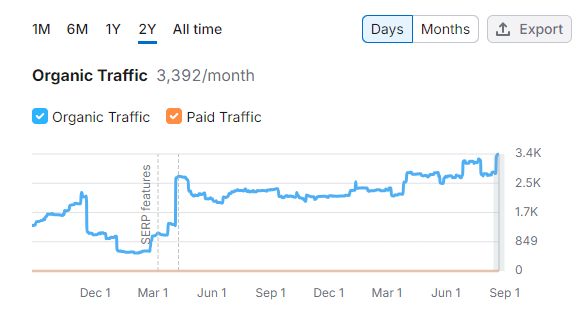
Green Delta Insurance: 1-year recovery campaign. Green Delta Insurance’s site had been hacked and hit with a Google manual penalty, which wiped out its visibility and traffic almost entirely. Penalty recovery is one of the slower SEO processes, because it means rebuilding trust from near zero rather than simply improving on an existing baseline. Over the course of a year, we resolved the security breach, secured the site, worked through the penalty recovery process with Google, and rebuilt traffic back to, and past, its original levels, as shown in the two-year traffic trend below.
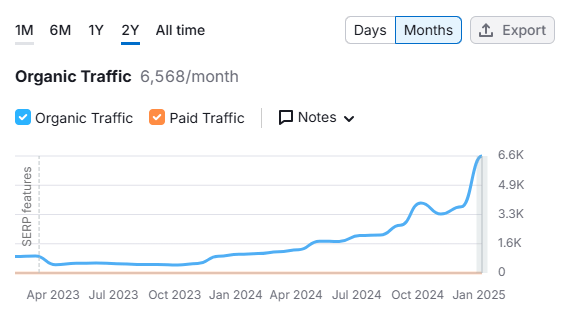
JCX Developments: 6-month keyword ranking campaign. JCX Developments needed stronger visibility, keyword rankings, and overall site optimization. Within three months, we’d already grown traffic by 60% through improved brand awareness and product-related keyword rankings, and the momentum continued to build, the chart below shows organic traffic climbing steadily over a two-year window as the campaign matured.
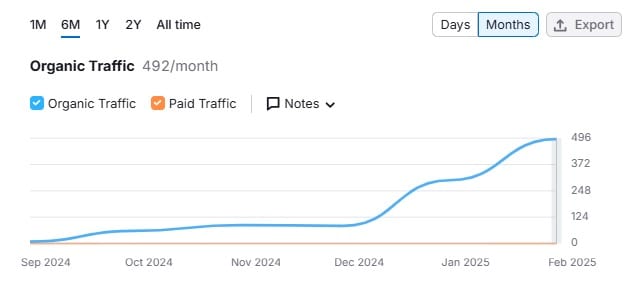
RITZ by Seeds and Scions, local SEO and Google Business Profile campaign. This fine dining restaurant in Dhaka had no organic visibility on search or Google Maps. We optimized their Google Business Profile and website, and within about six months, the site was attracting 500+ organic visitors from search, with keywords ranking on both the map and standard search results, a strong illustration of how much faster local SEO can move compared to national campaigns. Our published case study puts the longer-term numbers at an 884% increase in organic traffic and a 33,954% jump in Google Business Profile interactions.
Seraphic Associates: 1-year authority-building campaign. Competing against established industry giants and directories that dominated the search results for industrial machinery imports, Seraphic Associates needed a long-term strategy rather than a quick fix. Over 12 months of on-site SEO, technical fixes, content strategy, and a cleanup of a toxic backlink profile, organic traffic grew by more than 900%. Our published case study tracks the ongoing engagement at a 73% traffic increase with 60+ keywords ranked and a 69% lift in engagement, since authority-building campaigns like this keep compounding well past the first year.
These outcomes vary because every starting point is different, site age, technical health, competition, and industry all shift the timeline. But the pattern holds across almost every project: local and quick-win optimizations move first, and the larger, more durable gains build over 6 to 12 months.
How to Get SEO Results Faster
You can’t skip the trust-building process entirely, but you can shorten the runway:
- Start with technical health. Site speed, mobile usability, and indexability issues are often the fastest wins available, some show measurable lifts within a few weeks.
- Target low-competition keywords first. Ranking for accessible, lower-difficulty terms generates traffic and momentum while you build toward more competitive keywords.
- Fix your internal linking. Connecting related content and directing link equity toward your priority pages is one of the most underused ways to accelerate rankings.
- Optimize your Google Business Profile. If you serve a local market, this is consistently the fastest-moving lever in the entire SEO toolkit.
- Publish consistently, not sporadically. Sites that maintain a steady content cadence tend to hit their organic traffic milestones meaningfully faster than sites that publish in bursts.
- Refresh what you already have. Updating outdated, declining content often produces a faster traffic boost than starting from scratch.
Setting the Right Expectations
SEO isn’t a switch you flip. It’s a system you build. The businesses that get the best results treat the first 3 to 6 months as a foundation-building phase, not a failure if rankings haven’t spiked yet. If you need traffic immediately, for a launch, a sale, or a time-sensitive promotion. That’s exactly where SEM fills the gap, while your SEO investment compounds in the background.
If you’re weighing where to start, our SEO services are built around exactly this kind of phased, data-driven approach, technical foundation first, then content and authority, then sustained growth. And if you want to see how it plays out for businesses like yours, our case studies walk through the real timelines and numbers behind each campaign.
Want a realistic timeline for your own website in the Bangladesh market? Get in touch with our SEO team for a free consultation, or explore our full portfolio of case studies to see how these timelines have played out for real Bangladeshi clients.
Want more of our work in your Google results?
Frequently asked questions
Most Bangladeshi websites start seeing measurable ranking and traffic movement within 3 to 6 months, with significant, compounding growth typically appearing between 6 and 12 months. Local SEO and lower-competition niches can move faster here than the global average, since a large share of Bangladeshi competitors still don’t have a real SEO strategy in place.
Comments
No comments yet. Be the first to share your thoughts.