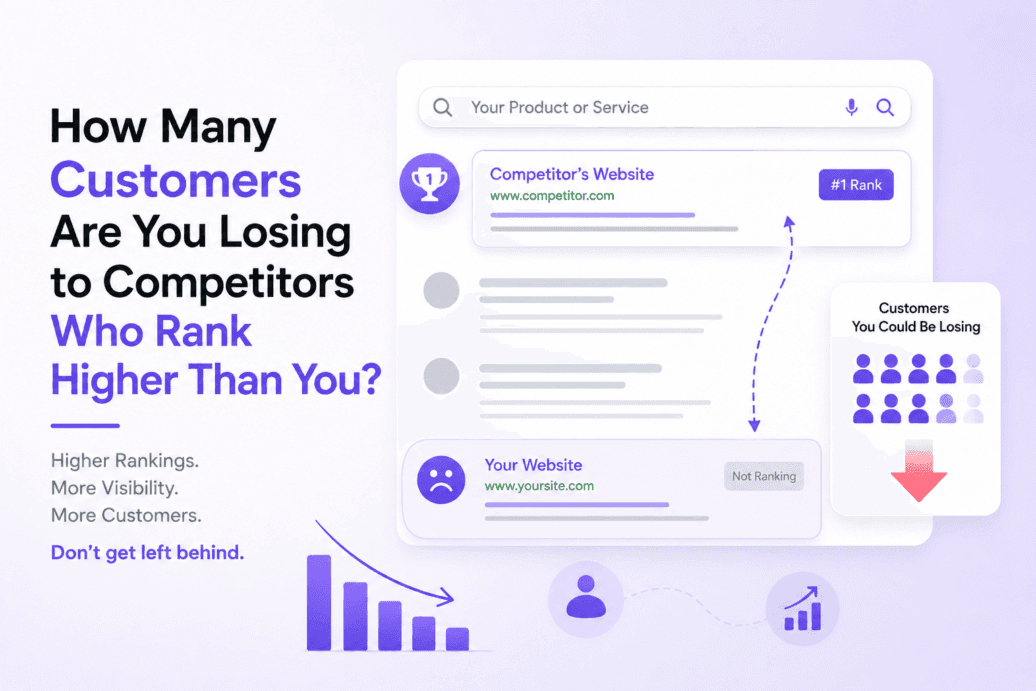
How Many Customers Are You Losing to Competitors Who Rank Higher Than You?
Pujan Kumar Saha · August 10, 2026 · 8 min read
Key takeaways
- Sitting at position five instead of position one costs real customers every day, not because your product or price is worse, but because searchers rarely look past the first few results.
- The loss is calculable rather than hypothetical: click-through rates by position translate directly into a number of customers going to competitors instead.
- For local businesses the gap is sharper still, because map pack and proximity results concentrate attention on even fewer names.
- Rankings alone no longer settle it, since an AI Overview can absorb the click even from a page that holds the top organic position.
This isn’t a hypothetical. It’s a number you can actually calculate, and once you see it in real clicks and real customers instead of abstract ranking positions, it becomes a lot harder to treat SEO as optional.
The Real Cost of Not Being #1
Search click behavior follows a steep, well-documented curve, and it hasn’t gotten any gentler in 2026. Compiled click-through rate data shows the top organic search result earns an average of 27.6% of all clicks, while position two captures roughly 15.8%, already less than half. By the time a result sits on page two, it captures less than 1% of clicks combined, functionally invisible to anyone who isn’t specifically hunting for it.
The gap compounds faster than most people expect. The same research found that moving up just one position in search results increases click-through rate by an average of 32.3%, meaning every position you’re sitting below a competitor isn’t a small, linear loss; it’s a compounding one. Separate analysis from First Page Sage’s 2026 ranking data found something even starker: position one alone typically receives more clicks than positions three through ten combined. Read that again. Seven competing results, added together, still don’t out-click the single business sitting at the top.
For Local Businesses, the Gap Is Even Sharper
If your business depends on local customers, the stakes are higher, not lower. The Google Local Pack, the map box with three business listings that appears above regular search results, runs on its own tight curve. First Page Sage’s 2026 Local Pack data puts position one at roughly 17.6% click-through rate, position two at 15.4%, and position three at 15.1%, a small gap between the top three, followed by a sharp cliff for anyone outside them.
That gap matters because of what happens next. Businesses that appear in the top three of the Local Pack receive 126% more traffic and 93% more customer actions, calls, clicks, and direction requests than businesses sitting in positions four through ten. And the people doing this searching aren’t casually browsing. Research on local search intent found that roughly 76% of people who search with “near me” visit a business within 24 hours, and 88% of people running a similar search on their phone call or visit a business that same day. If you’re not in the top three when that search happens, you’re not losing a future customer. You’re losing one who was ready to walk through the door today, straight to whichever competitor Google showed them instead.
Turning the Percentages Into Real Numbers
Percentages are easy to skim past. Here’s what they look like applied to an actual business.
Say your service page gets 10,000 monthly search impressions, meaning 10,000 people see your listing in results. At position five, industry data suggests a click-through rate somewhere around 4 to 5%, meaning roughly 450 people click through to your site. If a competitor holds position one instead, at a 27.6% click-through rate, they’re pulling in roughly 2,760 clicks from that same pool of searchers, more than six times what you’re getting, from the exact same audience actively looking for what you both sell.
Now apply a conversion rate to that gap. As we’ve covered in detail in our breakdown of how SEO turns visitors into paying customers, organic traffic converts to leads at an average of roughly 2.4%. Applied here, that 2,310-click gap between position one and position five isn’t just lost traffic, it’s roughly 55 leads a month that a competitor is capturing instead of you, from searches where your business was just as capable of answering the customer’s need.
It’s Not Just Google Rankings Anymore
The math above assumes a traditional results page. Increasingly, it isn’t one. AI Overviews now sit above the classic results for a growing share of searches, and they change the calculation further. Ahrefs’ February 2026 analysis of 300,000 keywords found that when an AI Overview appears, click-through rate for the top-ranking page drops by an average of 58%, meaning even holding position one no longer guarantees the volume of customers it used to, unless your business is the one being cited inside the AI-generated answer itself. We’ve covered what that shift means for visibility in detail in our piece on why businesses need AI answer visibility, but the short version applies directly here: ranking well and being seen are no longer automatically the same thing.
Where This Shows Up in Real Campaigns
This isn’t theoretical for the businesses we’ve worked with. It’s the exact problem several of them were losing customers to before ranking improvements changed the outcome.
JCX Developments is a direct example of what losing to higher-ranked competitors actually looks like. Before their AEO campaign, someone searching for a real estate developer in Bangladesh would see other companies recommended instead, competitors who simply had stronger visibility at the moment that search happened. After a 6-month campaign, JCX Developments appears directly inside Google’s AI Mode as a named recommendation for exactly that kind of query, standing alongside the same competitors who used to capture that customer alone.
Seraphic Associates was competing against established industry giants and long-standing directories that dominated the search results for their industry. Every one of those searches happening while a competitor’s listing sat above theirs represented a customer Seraphic never had a chance to reach. After a sustained SEO campaign, they grew organic traffic by 73% and ranked over 60 keywords, moving a meaningful share of that previously lost search traffic back in their direction.
RITZ by Seeds and Scions shows what closing the gap is actually worth in concrete customer actions. Before their local SEO campaign, this Dhaka restaurant had no meaningful visibility on Google Maps, meaning every “restaurant near me” search in their area was being answered by a competitor instead. After optimization, Google Business Profile interactions, calls, direction requests, and website clicks, increased by 33,954%, a direct measure of how many of those searches had previously been won by someone else.
How to Stop Losing Customers to Higher-Ranked Competitors
Closing this gap isn’t about one fix. It’s a combination of the same fundamentals covered throughout our other guides, applied specifically to the keywords where a competitor currently outranks you:
- Identify exactly where you’re losing to a specific competitor. Rank tracking by keyword shows you precisely which searches you’re losing, not just a general sense that “rankings could be better.”
- Prioritize the keywords with the highest impression volume first. A jump from position five to position two on a high-volume keyword recovers far more lost customers than the same jump on a low-volume one.
- Fix the technical gaps competitors have already closed. Site speed, mobile usability, and indexability issues are common reasons a well-written page still loses to a technically stronger competitor.
- Strengthen your Google Business Profile if local search matters to you. Given how sharply the Local Pack curve drops after position three, this is often the fastest place to recover lost customers.
- Structure content and schema markup to compete for AI citations too. Since AI Overviews now cut into position-one clicks significantly, ranking well isn’t enough on its own anymore.
- Track the gap in real numbers, not just position changes. Translating rank position into estimated lost clicks and leads, the way we did above, makes the cost of inaction concrete rather than abstract.
This is the exact structural work behind every SEO campaign we run, built specifically around recovering the customers a competitor’s higher ranking is currently capturing instead of you.
The Bottom Line
“We’re ranking okay” is a much weaker position than it sounds like. The gap between okay and first place isn’t a small percentage difference, it’s the majority of the customers searching for what you sell, going to whichever competitor Google decided to show first. Every month that gap stays open is another month of real, calculable leads walking toward someone else’s business instead of yours.
Want more of our work in your Google results?
Frequently asked questions
Based on current click-through rate data, page two results capture less than 1% of total clicks combined, compared to over 27% for the top position on page one. In practical terms, ranking on page two means the overwhelming majority of people searching that term never see your business at all.
Comments
No comments yet. Be the first to share your thoughts.