
How SEO Turns Website Visitors Into Paying Customers, Not Just Traffic
Pujan Kumar Saha · August 8, 2026 · 8 min read
Key takeaways
- A 300% traffic increase is a meaningless number on its own, because traffic does not pay invoices and a site converting none of it is worse off than a smaller one that converts.
- Organic search traffic tends to convert better than other channels because the visitor arrived already looking for what the page offers.
- Ranking is not the finish line: the page still has to answer the question, establish trust, and make the next step obvious.
- A website can rank well and convert poorly, which is why conversion belongs in the SEO brief rather than being treated as a separate problem.
The real question isn’t “how much traffic can SEO bring.” It’s “how much of that traffic turns into paying customers.” Done properly, a well-run SEO campaign answers both, and the data backs up why organic search specifically outperforms almost every other channel at making that second number bigger, not just the first one.
The Funnel Traffic Numbers Hide
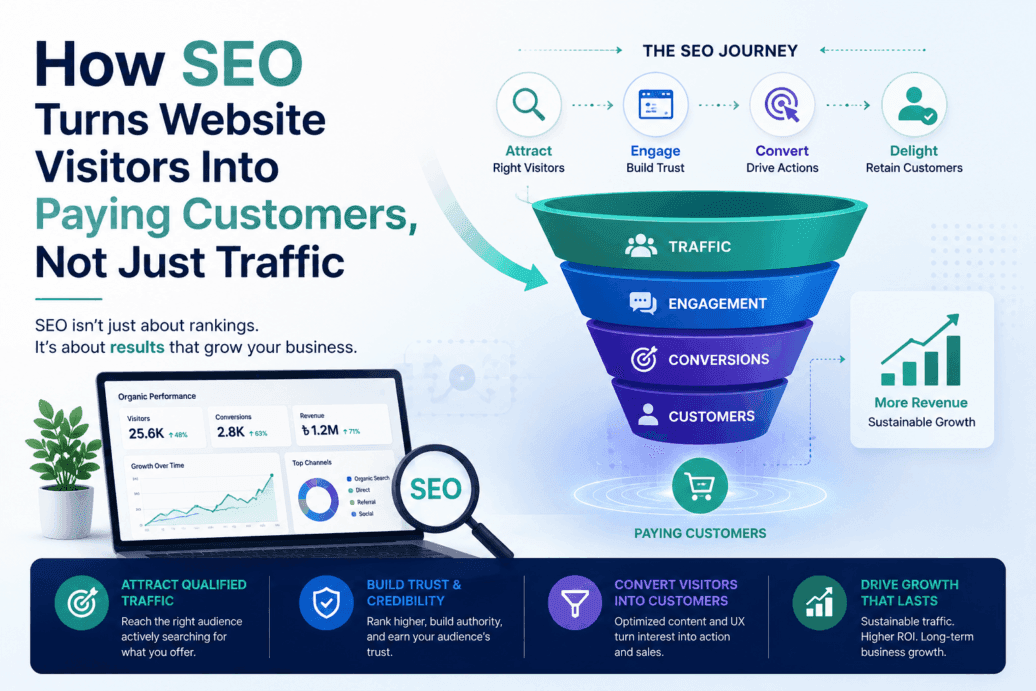
Every visitor who lands on your website moves through three stages: visitor, lead, customer. Most marketing reports only show the first stage. To actually judge whether SEO is working, you need to look at all three.
Visitor to lead (conversion rate): This measures how many visitors take a meaningful action, filling out a form, calling, adding to cart. Research compiled by Searchlab’s 2026 SEO statistics roundup puts the average conversion rate from organic traffic at 2.4%, compared to 1.3% for paid traffic and 0.7% for social. Organic visitors convert to leads at more than three times the rate of social traffic, before you’ve even gotten to the sales stage.
Lead to customer (close rate): This is where the gap becomes dramatic. According to HubSpot data cited across multiple 2026 industry reports, leads generated through SEO close at a 14.6% rate, compared to just 1.7% for outbound leads like cold calls and cold email, an 8.6x difference. The reason is intent. Someone who searched for your product and found you is already in a buying mindset. Someone who received an unsolicited call almost certainly is not.
Multiply those two numbers together and the picture is clear: SEO isn’t just filling the top of your funnel, it’s filling it with the kind of visitor who’s statistically far more likely to come out the other end as a paying customer.
Why Organic Traffic Converts Better Than Other Channels
This isn’t a coincidence of how SEO happens to work. It’s built into how people search and how much they trust what they find.
People trust organic results more than ads, and they act on that trust: Backlinko’s ranking data, compiled in the same 2026 statistics report, found the top organic search result earns 27.6% of all clicks, compared to just 2.1% for the top paid result, more than 13 times the click share. That same research found 70% to 80% of users skip paid ads entirely and go straight to organic listings. A visitor who chose your organic result over three paid ads above it has already made a small trust decision before they’ve even read your homepage.
Organic traffic costs less to acquire and compounds: Cost-per-lead analysis pulling from HubSpot and First Page Sage data puts the average cost per SEO lead at around $31, compared to roughly $181 to $198 for paid channels, meaning organic search generates leads at nearly 6 times lower cost. A paid campaign generates leads only while the budget is running. Content and rankings built through SEO keep converting visitors into leads for years after the initial investment, without a recurring media spend.
Search intent does the qualifying for you: Someone searching “best real estate developer in Dhaka” or “life insurance for small business” has already told you what they want, in their own words, before they ever reach your site. BrightEdge’s research puts organic search’s share of all website traffic at 53.3%, more than paid, social, and email combined, and unlike a cold audience reached through paid targeting, that traffic arrived already self-selected around a specific need your business can solve.
Ranking Isn’t the Finish Line: The Page Has to Convert Too
Here’s where a lot of SEO advice stops short. Getting someone to your website is only half the job. What happens in the next ten seconds decides whether that visit becomes a lead or a bounce, and speed alone can swing that outcome dramatically.
Research from Portent’s analysis of ecommerce load times found that sites loading in one second convert at 3.05%, compared to just 1.08% for sites taking five seconds, nearly a 3x difference from speed alone. Separately, compiled page speed research found that a one-second delay in load time can reduce conversions by up to 20%. This is why a serious SEO program doesn’t stop at keyword rankings. It includes technical performance, mobile usability, and page structure, because a visitor who clicks through from a perfectly optimized search result and then waits eight seconds for the page to load was never going to convert anyway, no matter how well the content was written.
This is also why local SEO factors like Google Business Profile optimization matter so directly for conversions rather than just visibility. When someone finds a business through a well-optimized local listing complete with reviews, accurate hours, and clear contact options, calling or requesting directions becomes a one-tap action rather than a multi-step search, which is precisely why local SEO tends to produce some of the fastest, most direct conversion actions in the entire SEO toolkit.
Proof From Our Own Campaigns: Visitors Becoming Real Actions
The clearest evidence that SEO drives customers, not just clicks, comes from looking at what visitors actually did after arriving, not just how many showed up.
RITZ by Seeds and Scions is the sharpest example. Our local SEO and Google Business Profile campaign for this Dhaka restaurant didn’t just grow organic traffic by 884%. It drove a 33,954% increase in Google Business Profile interactions, meaning calls, direction requests, and website clicks generated directly from the listing. That’s not a traffic metric. That’s thousands of people taking a concrete action toward becoming a customer, which is exactly the kind of number that matters more than raw visits.
Seraphic Associates grew organic traffic by 73% and ranked 60+ keywords, but the number worth paying attention to is the 69% increase in engagement that came with it, a signal that the additional visitors weren’t just arriving and leaving, they were actually interacting with the site the way a real prospective buyer would.
Neither of these results happened by accident. They happened because the SEO work behind them targeted the searches real customers were actually typing, not just any keyword with search volume, and because the pages those visitors landed on were built to move them toward an action, not just to rank.
What Actually Makes SEO Convert, Not Just Attract
If you’re evaluating your own SEO program, or a prospective agency, the difference between traffic-focused SEO and conversion-focused SEO comes down to a few concrete things:
- Targeting buyer-intent keywords, not just high-volume ones: A keyword with 10,000 monthly searches but no commercial intent behind it will inflate your traffic report and do nothing for your revenue. A keyword with 200 searches and clear purchase intent will often outperform it.
- Matching the landing page to the search intent: Someone searching for a specific service should land on a page about that exact service, not a generic homepage they have to navigate away from.
- Fast, mobile-friendly pages: As the data above shows, every second of load time is a direct conversion cost, not just a technical nitpick.
- Clear, visible calls to action: A page that ranks well but buries its contact form or phone number is optimized for the wrong metric.
- Trust signals throughout the page: Reviews, case studies, clear business information, and social proof all reduce the hesitation between “I found this business” and “I’ll contact this business.”
- Local SEO fundamentals for location-based businesses: A complete, accurate, review-rich Google Business Profile turns a search into a phone call far more often than a generic website visit does.
This is the same philosophy behind how we approach every SEO campaign, and it’s the reason our case studies get measured in engagement and profile interactions, not traffic numbers alone.
The Bottom Line
If your SEO reporting only ever talks about sessions and rankings, you’re only seeing half the picture, and it’s the half that doesn’t pay the bills. Traffic is the raw material. Conversions are the product. The businesses getting real value out of SEO are the ones treating every ranking as a step toward an action, a call, a form, a sale, not as the end goal in itself.
Want an SEO strategy built around actual leads and customers, not just traffic charts? Talk to our team about a conversion-focused SEO campaign, or see the real results in our full portfolio of case studies.
Want more of our work in your Google results?
Frequently asked questions
No. Traffic and conversions are related but different metrics. A smaller amount of highly targeted, intent-driven traffic will often produce more paying customers than a much larger volume of untargeted visitors.
Comments
No comments yet. Be the first to share your thoughts.