
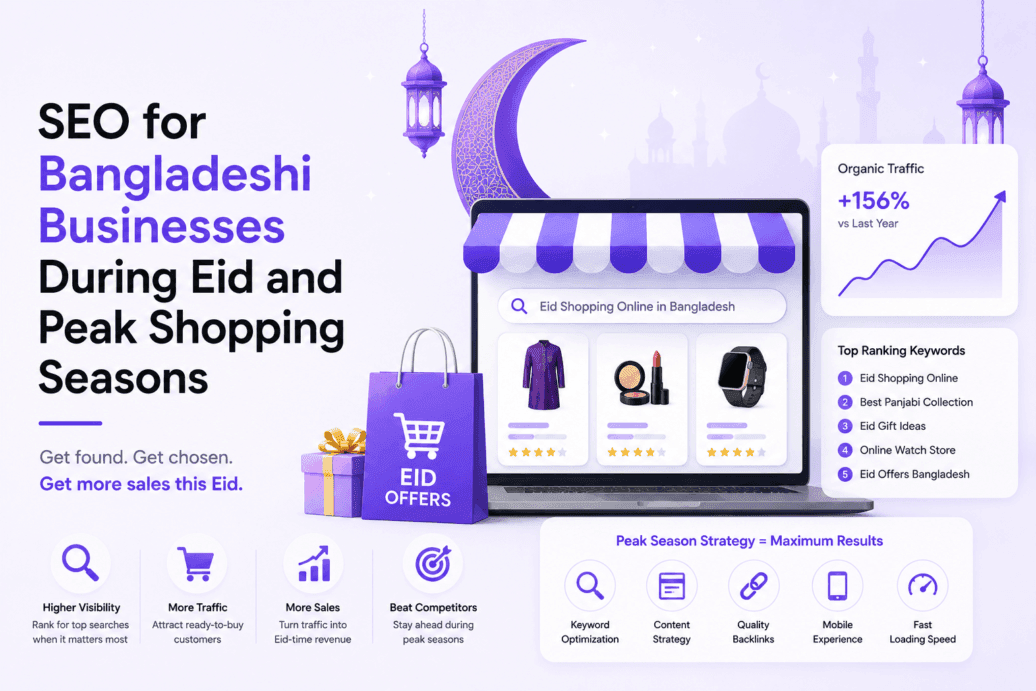
SEO for Bangladeshi Businesses During Eid and Peak Shopping Seasons
Algomindz SEO Team · August 10, 2026 · 13 min read
Key takeaways
- Eid is a search event as much as a social media event, yet most Bangladeshi businesses shift almost the entire budget to Facebook boosts and treat search as an afterthought.
- Eid demand builds across a predictable timeline of weeks, so preparation has to start well before the shopping surge rather than alongside it.
- Build one evergreen Eid page and strengthen it every year instead of creating a fresh URL each season, which throws away accumulated ranking authority annually.
- Local SEO and a well-maintained Google Business Profile matter more during Eid, when proximity and opening hours drive a large share of purchase decisions.
Eid is the single largest commercial moment on the Bangladeshi calendar, and it behaves like a search event just as much as a social media event. The businesses that treat it that way, months before the actual holiday rather than days before, are the ones capturing the surge instead of watching it pass by.
Why Eid Is a Search Event, Not Just a Shopping Event
The scale of Eid shopping in Bangladesh is large enough that treating it as a minor seasonal bump undersells it significantly. In the weeks leading up to Eid-ul-Fitr, online shopping activity climbs sharply as consumers move to digital platforms for clothing, accessories, and gifts, with particularly heavy demand for traditional attire like panjabis, sarees, salwar kameez, and children’s outfits, according to reporting from the Bangladesh Sangbad Sangstha covering the run-up to Eid-ul-Fitr in 2026. The same reporting estimates the country’s e-commerce and social commerce ecosystem now includes somewhere between 500,000 and one million entrepreneur-run Facebook pages, alongside roughly 200,000 to 250,000 active Facebook commerce entrepreneurs, a genuinely enormous field of competition all reaching for the same seasonal spike.
That competition is only growing. Industry projections cited by DHL Bangladesh put the number of e-commerce users in the country at close to 15.92 million by 2029, a 48% increase from 2024, with average revenue per user climbing alongside it. Major platforms feel this most acutely during the two biggest annual spikes in the local retail calendar: Eid and the November sales period, when, as one industry roundup put it, order volumes across the largest marketplaces climb into the millions within days.
Two things about Bangladeshi shopping behavior make search specifically important here, not just social advertising. First, research on Bangladeshi e-commerce habits found that roughly 4 in 10 online shoppers say reviews, recommendations, and social proof play a crucial role in their purchase decisions, meaning people are actively researching and comparing before they buy, not simply reacting to whichever ad appeared in their feed first. Second, cash-on-delivery remains the dominant payment preference across the country, which means a purchase decision is rarely a single impulsive click. It’s a multi-step process involving comparison, trust-building, and research, exactly the kind of behavior that search captures and paid social often doesn’t.
The Search Timeline Around Eid: When People Actually Start Looking
One of the most common mistakes is treating Eid preparation as a one- or two-week sprint right before the holiday. Search interest doesn’t spike that late, and by the time it does, the pages that are going to rank are usually already indexed and gaining traction.
For Eid-ul-Fitr, search interest begins climbing from early in Ramadan itself, as people start planning new clothes, gifts, and Eid travel well ahead of the holiday. Interest builds steadily through the month and accelerates sharply in the final ten days, chaand raat and the days immediately before it representing the single highest-intent, highest-volume window of the entire year for clothing, footwear, cosmetics, and gift categories.
For Eid-ul-Adha, the pattern is different in category but similar in shape. Search interest centers on qurbani cattle and livestock marketplaces, butchers and meat processing services, travel and transport bookings for people heading to their home districts, and a secondary wave of clothing and gift searches similar to Eid-ul-Fitr, just smaller in scale. A business selling in this window needs to recognize that “Eid SEO” isn’t one strategy, it’s genuinely two different search behaviors depending on which Eid is approaching.
There’s a scheduling detail specific to Bangladesh, and the Islamic calendar generally, that a generic global holiday SEO guide won’t tell you: because Ramadan and both Eids follow the lunar Hijri calendar, their Gregorian calendar dates shift roughly ten to eleven days earlier every year. A business that simply repeats “start Eid content in March” from a previous year will find itself increasingly out of sync as the years pass. The right approach is to work backward from the actual expected date each year, not from a fixed calendar month, and general seasonal SEO research suggests publishing and fully optimizing seasonal content six to eight weeks ahead of peak demand gives search engines enough time to crawl, index, and begin ranking the page before the surge actually hits. For Eid specifically, that means counting backward from the expected date each year rather than assuming last year’s timeline still applies.
The Technical Side Most Businesses Get Wrong
Content and timing solve half the problem. The other half is making sure the site itself can handle what happens when the traffic actually arrives, and this is where a lot of otherwise well-prepared Eid campaigns fall apart.
Site speed and stability under real load. A page that loads acceptably on a normal day can slow to a crawl or crash outright under Eid-level traffic spikes, particularly on the shared hosting plans common among smaller Bangladeshi businesses. Testing site performance under simulated peak load well before the season, not during it, is the difference between capturing the surge and losing customers to a slow or broken checkout page during the exact week that matters most.
Mobile performance specifically. Given how heavily mobile-driven search behavior already is across Bangladesh, a mobile page that loads slowly or renders awkwardly during a high-traffic period doesn’t just lose the sale, it actively pushes the shopper straight to a competitor’s listing one tap away.
Trust and payment clarity on the page itself. Because cash-on-delivery remains the default payment method for a large share of Bangladeshi shoppers, product and category pages need to make delivery timelines, COD availability, and return policies immediately clear. During Eid specifically, delivery deadlines matter enormously, a customer needs confidence their order will arrive before the holiday, not sometime vaguely afterward, and pages that answer this clearly convert meaningfully better than pages that leave it ambiguous.
Inventory and out-of-stock handling. Popular Eid items sell out fast, and how a page handles an out-of-stock product matters for both users and rankings. A page that simply disappears or 404s loses any ranking equity it had built. A page that stays live, shows the item as temporarily unavailable, and suggests similar in-stock alternatives keeps both the customer and the ranking intact for next year.
Build an Evergreen Eid Page, Not a New One Every Year
This is the single highest-leverage technical decision in seasonal SEO, and it’s one most Bangladeshi businesses get backward. The instinct is to create a fresh page every year, something like a URL with the year built into it, and let the old one sit unused once the season ends. That approach throws away the exact thing that makes ranking easier over time.
The better approach is a single, stable, evergreen URL, something like a permanent “Eid collection” or “Eid sale” page rather than a year-stamped one, that gets refreshed with new products, offers, and content every season rather than replaced. Seasonal SEO research is consistent on this point: reusing a stable URL year after year consolidates the page’s authority and backlinks instead of starting from zero each season, and it means that by the third or fourth year of doing this correctly, that page is competing from a position of accumulated trust that a fresh, dated URL simply cannot match.
A few specific things make this work well in practice. Keeping the page live year-round, even in a scaled-back “coming soon” or general-interest state outside the Eid season, preserves its authority rather than letting it go fully dormant. Updating the title tag, headline, and visible content each year while keeping the underlying URL untouched lets the page stay current without losing its accumulated ranking history. And applying structured data, Offer schema for specific promotions, Product schema for featured items, Event schema where relevant, helps the page qualify for the richer search result formats that a plain text listing won’t get, giving it a visible edge in a results page that’s about to get considerably more crowded than usual.
Local SEO and Google Business Profile Matter Even More During Eid
For any Bangladeshi business with a physical storefront, whether it’s a clothing shop in Dhaka’s New Market, a shoe store in Chattogram, or a bakery selling Eid sweets, local search behavior spikes just as hard as ecommerce search does. People search “Eid collection near me,” “eid bazar” for a specific area, and store-specific queries at a much higher rate during this window than during an ordinary month.
A few things matter specifically here. Updating your Google Business Profile with accurate Eid holiday hours, since many businesses shift their operating hours significantly during Ramadan and around the Eid holiday itself, prevents the single most common cause of a lost local customer: someone showing up to a business that’s closed or open at different hours than what Google displayed. Posting active updates about new Eid stock, special hours, or in-store promotions through Google Business Profile’s post feature keeps the listing active and relevant exactly when local search volume is highest. And responding to the wave of reviews that typically follows a strong Eid shopping season helps build the review volume and freshness signals that carry into the next season’s local rankings. We’ve covered the deeper mechanics of local ranking factors and profile optimization in detail in our guide to local search visibility in Bangladesh and our breakdown of Google Business Profile optimization, both of which apply directly to Eid preparation, just compressed into a much higher-stakes window.
What This Looks Like Applied to a Real Campaign
The underlying approach here isn’t new, it’s the same non-branded, purchase-intent keyword targeting that’s worked in other campaigns we’ve run, just applied to a seasonal spike instead of steady-state search volume. Our work with Rangs eMart focused on exactly this kind of high-intent, comparison-driven search behavior, ranking non-branded product searches rather than relying solely on brand recognition, and that same principle is precisely what wins during Eid: shoppers searching generic, category-level terms like “eid dress collection” or “best gift for eid” rather than a specific brand name, choosing whichever business shows up prepared when they search. A business that’s optimized its category pages, refreshed its evergreen seasonal content, and made sure its site holds up under load going into the season is positioned to capture exactly that kind of traffic, while a competitor relying purely on paid social reach is starting from zero the moment the ad budget runs out.
A Practical Eid SEO Timeline
Working backward from your expected Eid date each year, here’s roughly how the preparation should be sequenced:
8 to 10 weeks before Eid:
- Finalize or refresh your evergreen Eid landing page, updating products, offers, and content while keeping the same URL from previous years.
- Run a full technical audit, checking site speed, mobile performance, and checkout flow under simulated peak load.
- Research this year’s specific keyword trends, since gift categories, color trends, and popular product types shift slightly year to year even though the core search behavior stays consistent.
4 to 6 weeks before Eid: 4. Publish supporting content, gift guides, size guides, and category pages that internally link back to your main Eid landing page, building its relevance and authority before the traffic surge hits. 5. Update your Google Business Profile with anticipated Eid hours, holiday closures, and any special in-store promotions. 6. Apply or refresh structured data on key pages, particularly Offer and Product schema for anything running a specific promotion.
1 to 2 weeks before Eid: 7. Do a final technical check, confirming the site can handle a real traffic spike, checkout works cleanly on mobile, and stock levels are reflected accurately. 8. Make sure delivery deadline messaging is unmissable on every relevant product and category page, since this is often the single deciding factor in a purchase during this window.
During and immediately after Eid: 9. Monitor site performance in real time and be ready to address speed or stock issues immediately rather than waiting for the season to end. 10. Keep the evergreen page live in a scaled-back state after the holiday rather than taking it down, preserving its authority for next year instead of starting over. 11. Document what worked, which keywords drove the most traffic, which products sold fastest, which content converted best, so next year’s preparation starts from real data instead of guesswork.
The Bottom Line
Eid isn’t a marketing afterthought in Bangladesh, it’s arguably the single most valuable search window of the entire year, and it rewards businesses that prepare for it the same way they’d prepare inventory or staffing: months in advance, with a plan that gets reused and improved every year rather than rebuilt from scratch. The businesses still treating Eid SEO as a last-minute banner update are leaving the highest-intent shopping season of the year almost entirely to whichever competitor took search seriously first.
Want your website genuinely ready before the next Eid shopping surge, not scrambling the week before? Talk to our team about a seasonal SEO plan built for the Bangladesh market, or explore our full portfolio of case studies to see how we’ve prepared other Bangladeshi businesses for their biggest sales windows.
Want more of our work in your Google results?
Frequently asked questions
Ideally six to eight weeks before the expected Eid date, calculated from that year’s specific Hijri calendar date rather than a fixed Gregorian month, since Eid shifts roughly ten to eleven days earlier on the Gregorian calendar each year.
Comments
No comments yet. Be the first to share your thoughts.