
What Happens to Your Rankings If You Stop Doing SEO?
Pujan Kumar Saha · August 10, 2026 · 8 min read
Key takeaways
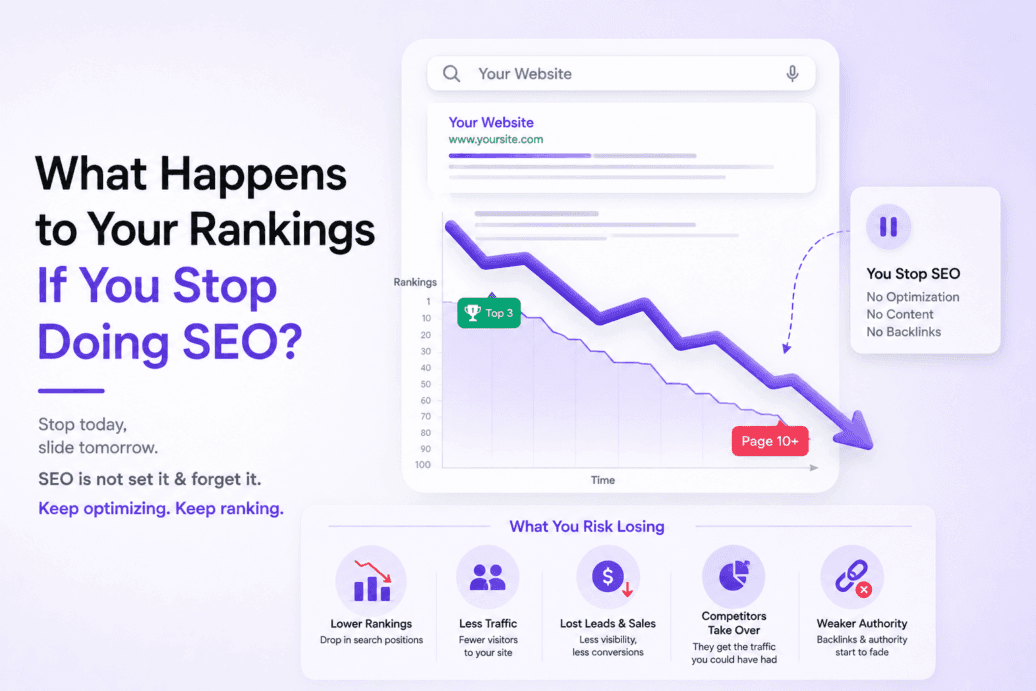
- Rankings were never finished; they were being actively maintained, so pausing SEO removes maintenance rather than locking in a completed result.
- The decline after stopping is gradual rather than immediate, which is precisely why the risk is easy to miss until the lost ground is expensive to recover.
- Pausing is riskier in Bangladesh right now because competitors are actively investing for the first time, so a gap that was uncontested may not stay that way.
- A reduced maintenance scope is usually a better option than a full stop, because holding existing positions costs far less than rebuilding them later.
This is what actually happens to your rankings when SEO stops, why the decline isn’t immediate, and why pausing right now is a riskier move in Bangladesh than it would be in a market where every competitor is already doing this work too.
SEO Isn’t Rented Like Ads, But It Isn’t Permanent Either
Paid advertising works like a tap. Stop paying, and the traffic stops within hours. SEO doesn’t behave that way, which is exactly why the question feels reasonable in the first place. Industry analysis comparing the two describes it more like physical fitness: strength built over months doesn’t vanish overnight the moment you stop training, but stop for long enough and things start slipping, quietly at first, then all at once.
That’s the trap. The gradual part is exactly what makes stopping feel safe. Rankings built on genuinely strong technical foundations, quality content, and real authority signals can hold for a while after the active work stops. But “for a while” is doing a lot of work in that sentence, and what happens during that window depends entirely on what your competitors do with it.
What Actually Happens When the Work Stops
Three things happen at once when SEO activity stops, and they compound each other rather than happening in isolation.
Content quietly goes stale, and Google notices before you do. Search algorithms weight freshness heavily for anything time-sensitive, pricing pages, service pages, industry statistics, and a page that stops being updated starts looking outdated to the algorithm, even if nothing on it is technically wrong. Research tracking over 300 blog posts across multiple client sites found that articles receiving regular updates maintained 3.2 times more traffic than static content over a 12-month period. Static content doesn’t just plateau, it measurably falls behind.
Backlink authority erodes without anyone actively attacking it. Other sites that once linked to you update their own content, redesign their pages, or simply let old links rot without replacing them. Without ongoing outreach and fresh content worth linking to, your backlink profile doesn’t grow to offset that natural decay, and domain authority drifts downward as a result, taking ranking strength with it.
Competitors keep moving even though you’ve stopped. This is the part that catches businesses off guard hardest. One documented case tracked a financial services company that took what they called a strategic break from SEO for a single quarter. By the following quarter, they had lost visibility for 40% of their previously top-ranked search terms, not because anything they’d built broke, but because competitors used that exact window to push harder while the field was temporarily open.
None of these three forces need anything to go wrong on your site. They happen simply because the market keeps moving and your presence in it stops.
Why Pausing SEO Is a Bigger Risk in Bangladesh Right Now
Here’s the part that matters most for a business operating in Bangladesh specifically, and it cuts against the instinct most business owners have. In a saturated market where every competitor already runs a mature SEO program, pausing for a quarter might not cost you much, since everyone around you is roughly holding steady too. Bangladesh is not that market, and that changes the risk calculation significantly.
The Bangladeshi digital landscape is still in an active growth phase, not a stable one. Digital ad spend and organic investment are climbing quickly as more local businesses discover the value of search visibility, which means the competitive gap here isn’t static, it’s actively shifting month by month. Pausing SEO during a period when the overall market is moving from low competition toward higher competition is a fundamentally different bet than pausing in a market that’s already settled. The businesses in your industry that haven’t started investing in SEO yet are the ones most likely to start soon, and a pause on your end is exactly the window that lets a newly motivated competitor close the gap you spent months building.
There’s a second local factor worth naming directly. Search behavior in Bangladesh is shifting toward AI-assisted discovery inside Google’s own AI Overviews and AI Mode, layered on top of a search market Google already dominates almost completely here. A ranking pause doesn’t just risk losing position in classic search results, it risks losing the citation signals, fresh content, structured data, and consistent authority that increasingly determine whether an AI system trusts your business enough to surface it at all. Falling behind on both fronts at once, in a market where most competitors haven’t caught up to either yet, is a much steeper hole to climb back out of than falling behind on rankings alone.
What Recovery Actually Looks Like
Rankings that decline after a pause aren’t necessarily gone for good, but recovery is real, sustained work, not a quick fix. Data on content refresh recovery suggests properly refreshed content can recover 60% to 80% of lost rankings within 30 to 45 days, but that’s for content decay specifically. Recovering from a longer pause, one that’s cost backlink authority and allowed competitors to establish themselves in your place, takes considerably longer and often costs more than the maintenance that would have prevented the drop in the first place. We’ve documented what a full recovery from a serious ranking setback actually looks like in our breakdown of realistic SEO timelines, and the pattern holds here too: rebuilding trust from a weakened position takes meaningfully longer than maintaining trust you already have.
How to Protect the Investment You’ve Already Made
If budget is the real concern rather than a belief that the work is finished, the answer usually isn’t stopping entirely, it’s shifting to a deliberate maintenance plan instead of an all-or-nothing decision.
- Keep a minimum content refresh cadence. Updating your highest-value pages on a regular schedule protects the freshness signal without requiring the same volume of new content production as an active growth phase.
- Monitor technical health on an ongoing basis. Site speed regressions, broken links, and indexing issues accumulate quietly through normal website maintenance, plugin updates, hosting changes, redesigns, and nobody notices until rankings have already dropped.
- Keep an eye on what competitors are doing. A pause on your end is only risky if competitors are actively moving. Tracking their content and ranking activity tells you how urgent maintenance actually is at any given moment.
- Protect your highest-value rankings first if budget must shrink. Not every page needs the same level of ongoing attention. Prioritizing the pages that drive the most business protects the majority of the value with a fraction of the full investment.
- Treat this as an ongoing function, not a project with an end date. The businesses that hold their rankings longest are the ones that plan for continuous, lighter-touch maintenance rather than swinging between full investment and complete stoppage.
This is exactly why our SEO services are structured as an ongoing engagement rather than a one-time project, because the market in Bangladesh isn’t standing still, and neither are the competitors deciding whether this is the quarter they finally start investing too.
The Bottom Line
SEO rankings don’t collapse the moment you stop paying for them, but they were never actually static achievements either, they were the visible result of continuous work holding a position against a market that keeps moving. In Bangladesh specifically, where competition is intensifying rather than settled, a pause doesn’t just risk a slow decline. It risks handing a fast-moving window directly to whichever competitor decides to use it.
Want more of our work in your Google results?
Frequently asked questions
It varies significantly based on how strong your existing foundations are, but decline is rarely instant. Some businesses hold steady for a few months before slipping, while others, especially in competitive niches, have lost visibility for a large share of their top rankings within a single quarter of stopping.


Comments
No comments yet. Be the first to share your thoughts.