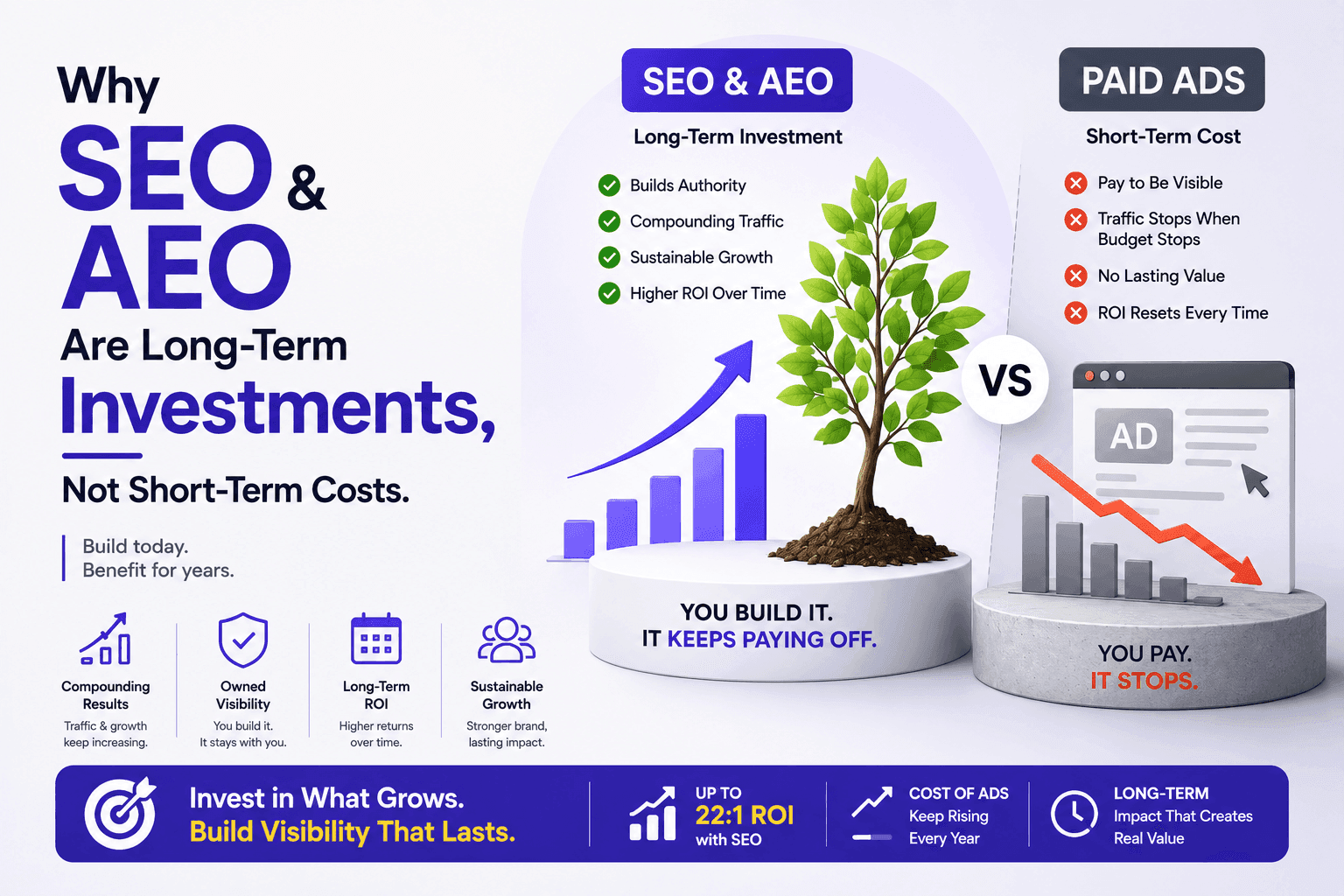
Why SEO and AEO Are Long-Term Investments, Not Short-Term Costs
Pujan Kumar Saha · August 14, 2026 · 9 min read · Updated August 17, 2026
Key takeaways
- The waiting period in SEO is not a delay before value starts; it is when the value is being built, and once built it keeps paying without repeat spend.
- Paid ads and SEO can consume the same three months of budget, but only one of them leaves an asset behind when the spending stops.
- Rising Meta and Google ad costs in Bangladesh make the gap wider over time, because renting attention gets more expensive while owned visibility does not.
- AEO follows the same compounding logic as SEO, which is why it is worth starting before AI answer surfaces become as competitive as traditional search results.
That’s the entire case for treating SEO and AEO as long-term investments rather than short-term marketing costs. The time isn’t a delay before the value starts. The time is when the value gets built, and once it’s built, it keeps paying without a repeat bill every month.
The Real Difference: Owning Visibility vs Renting It
Every marketing channel falls into one of two categories, and understanding which one you’re funding changes how you should think about the wait.
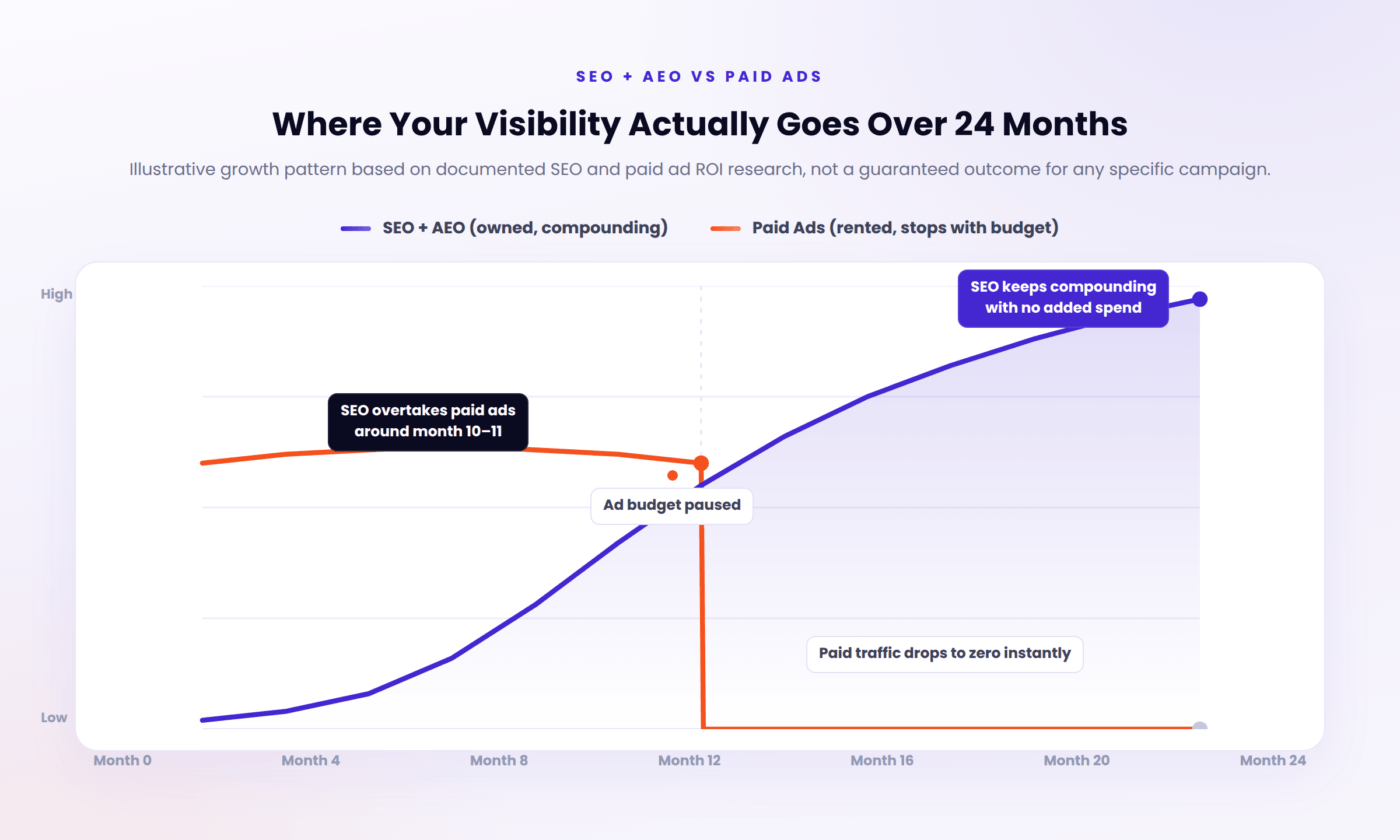
Paid advertising, Google Ads, Meta Ads, and similar platforms, is rented visibility. You pay for a slot, you occupy that slot for as long as the payment continues, and the moment it stops, so does every bit of traffic that slot was generating. Nothing carries over. Next month starts from zero again, at whatever the current auction price happens to be.
SEO and AEO are owned assets. A page that ranks well or gets cited inside an AI answer keeps generating traffic and visibility without a new payment every time someone searches. The content you published eight months ago doesn’t stop working just because you didn’t pay for it again this month. It keeps compounding, alongside every new page and every new citation added after it.
This distinction alone explains why patience with SEO isn’t naive, it’s the entire mechanism by which the investment pays off. You’re not waiting for a switch to flip. You’re waiting for an asset to finish being built.
The Data: SEO’s Return Compounds, Paid Ads Reset
This isn’t just a nice metaphor, it shows up clearly in the actual return data.
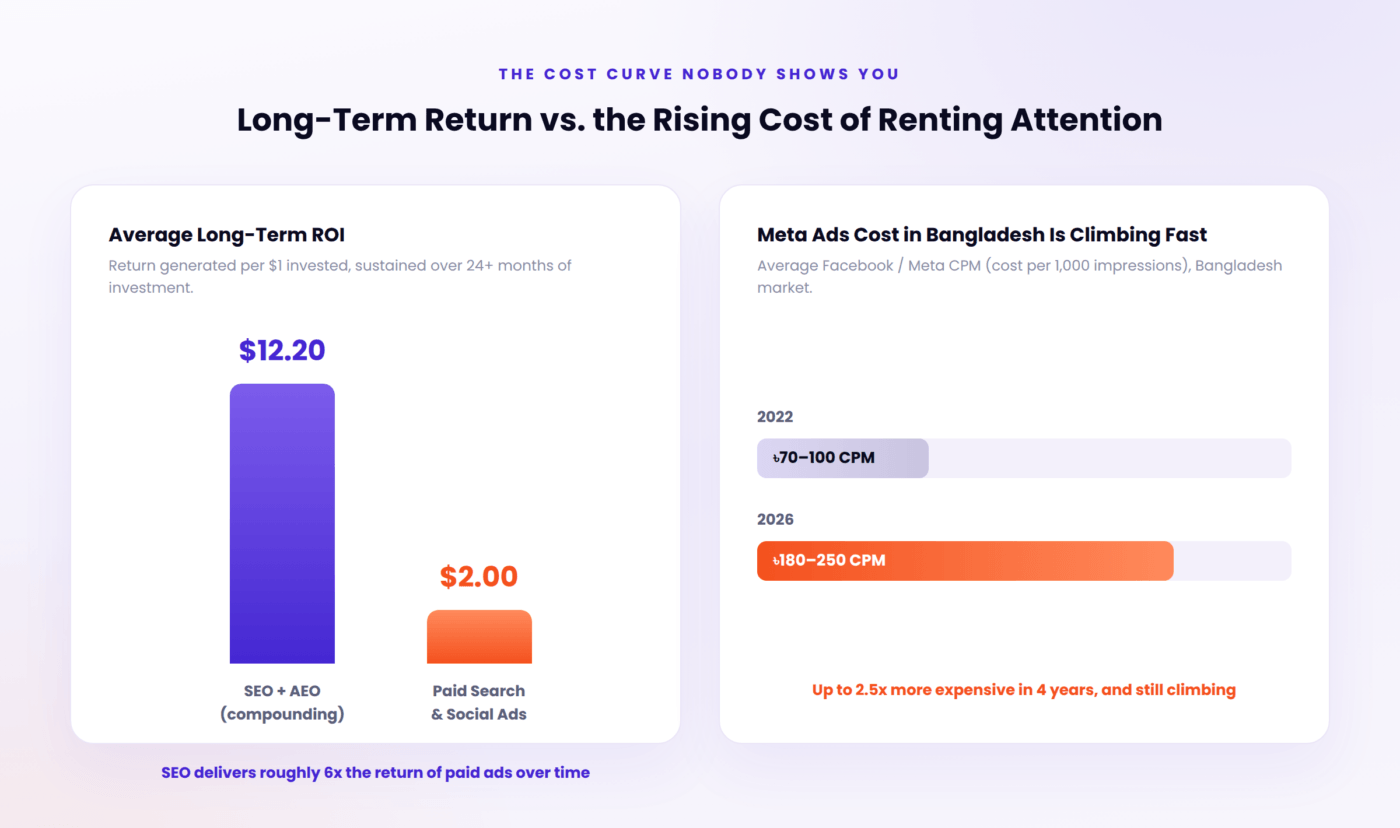
Research from Terakeet found that SEO can generate up to $12.20 in value for every $1 spent, driven specifically by compounding long-term visibility, while PPC delivers roughly $2 for every $1 invested according to Adcore and HubSpot benchmarks. Backlinko and WordStream data, compiled in a broader 2026 industry review, found an even sharper contrast over a longer window: SEO delivering roughly 22:1 ROI over a 24-month horizon, compared to approximately 2:1 for PPC. The gap doesn’t stay flat either. Sagapixel’s research found that SEO maintains roughly 25% higher ROI than PPC over time, specifically because SEO’s return keeps climbing as authority and content accumulate, while PPC’s return stays flat or even declines as competitors bid prices upward.
The industry breakdown makes this even more concrete. First Page Sage’s client data, compiled across dozens of campaigns, found long-term SEO returns reaching 1,389% in real estate, 1,183% in medical devices, 1,031% in financial services, and 994% in higher education, specifically in industries with high customer lifetime value and expensive paid keywords, exactly the conditions where the cost of continuously renting visibility adds up fastest.
There’s a genuinely useful nuance here too: this isn’t strictly an either-or decision. The same research found that businesses running SEO and PPC together see 25% more clicks and 27% more profit than running either channel alone, since paid campaign data helps identify the highest-converting keywords worth targeting organically, and organic credibility improves how paid ads themselves perform. The smartest approach usually isn’t choosing one over the other, it’s using paid ads for immediate needs while SEO and AEO build the durable asset underneath.
Why the Cost of Renting Attention Keeps Climbing
Here’s the part that makes long-term SEO investment even more compelling: the cost of the alternative isn’t staying flat while you wait.
In Bangladesh specifically, Meta advertising costs have climbed sharply in just a few years. Benchmark data from Arafat Labs, tracking real campaign data across Bangladeshi advertisers, found average Facebook and Meta CPM rising from around ৳70 to ৳100 in 2022 to ৳180 to ৳250 in 2026, up to a 2.5x increase in just four years. The reason is straightforward: roughly five times more advertisers are now competing for the same limited ad inventory, and AI-driven bidding systems increasingly favor accounts with bigger budgets, pushing smaller advertisers into a more expensive auction every year. Globally, the pattern holds on Google Ads too, with average cost per click sitting around $4.22, and climbing past $8.67 in competitive industries like legal services.
This is the quiet cost of choosing rented visibility as a long-term strategy rather than a short-term supplement: the rent doesn’t stay the same. It goes up, year after year, regardless of how well your campaigns perform. SEO and AEO don’t carry that same structural cost increase, since the value comes from content and authority you already built, not from an auction you have to keep winning every single month.
What This Means for AEO Specifically
Everything above applies to traditional SEO, and it applies just as directly to AEO, the work of earning citations inside AI Overviews, AI Mode, and AI chat platforms like ChatGPT and Perplexity. AEO is even newer than SEO, which means the compounding curve is earlier for most businesses, but the same mechanics apply: a well-structured, authoritative page that earns an AI citation today keeps being eligible for that citation in future AI-generated answers, without a repeated ad spend to stay there.
If anything, the case for patience is stronger here, not weaker. Very few Bangladeshi businesses have started building AEO-ready content and structured data yet, which means the early compounding curve is available to whoever starts first, before the space becomes as competitive as paid advertising already is. Waiting for AI citation visibility to build isn’t a cost specific to being early. It’s the exact advantage of being early.
What Compounding Actually Looks Like in Practice
The idea of “compounding” can sound abstract until you see it in real terms. Say a business publishes eight well-optimized pages a month as part of an SEO and AEO campaign. By month six, that’s roughly 48 pages live, each one still capable of ranking, earning links, and getting cited in an AI answer. By month twelve, it’s around 96 pages, and the earliest ones, now fully indexed, trusted, and often improved through refreshes, are usually pulling in more traffic than they did in month two, not less. None of those pages required a repeat payment to keep working. The only ongoing cost is producing the next batch and maintaining what’s already live.
Compare that to a paid ad budget covering the same twelve months. Every single click, in month one and month twelve alike, was paid for individually. Nothing from January is still generating value in December unless January’s budget is still being spent. The business running paid ads alone finishes the year with reporting screenshots. The business running SEO and AEO finishes the year with 96 working assets, most of which are still gaining strength.
When Paid Ads Are Still the Right Call
None of this makes paid advertising a bad channel, it makes it a different tool for a different job. Paid ads remain the right choice when a business needs revenue this month, not in month six, when testing a new offer or message before committing months of content strategy to it, when launching a genuinely new product with zero existing search demand to capture, or when a time-sensitive promotion needs guaranteed visibility on an exact date. In each of these cases, the short-term control and immediacy of paid advertising is doing a job that SEO and AEO simply aren’t built to do quickly.
The mistake isn’t using paid ads. It’s treating paid ads as the only channel, quarter after quarter, without ever starting the SEO and AEO work that would reduce dependence on an auction whose price keeps climbing. The businesses getting the best of both worlds use paid ads exactly where they’re strongest, immediate, controllable, testable, while letting SEO and AEO quietly build the asset that will still be generating traffic long after this particular ad campaign has ended.
The Bottom Line
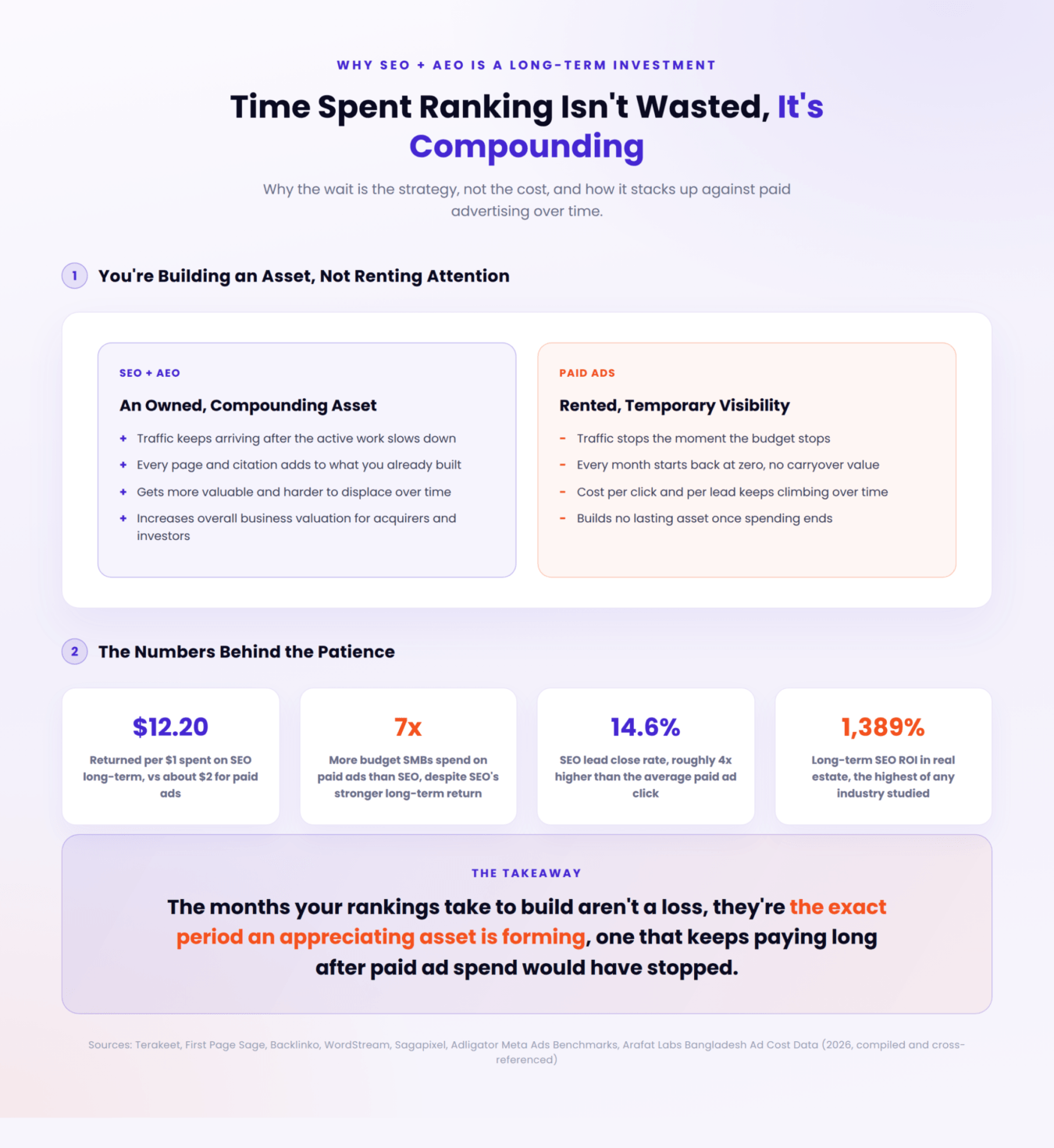
The months spent building rankings and AI visibility were never wasted time, they were the period when an appreciating asset was under construction. Paid ads will always win the race for the first thirty days. SEO and AEO win every month after that, for as long as the content and authority behind them keep being maintained, without paying the rising auction price all over again. The brands treating this as a long-term investment aren’t being patient for its own sake. They’re the ones who’ll still be visible, and profitable, long after this month’s ad budget would have run out.
Ready to start building an asset instead of renting attention every month? Talk to our team about a combined SEO and AEO strategy, or explore our full portfolio of case studies to see the long-term results behind these numbers.
Want more of our work in your Google results?
Frequently asked questions
Yes, based on consistent industry research. SEO has been shown to deliver roughly 6 to 22 times the return of paid advertising over a 24-month period, largely because SEO’s value compounds over time while paid ad traffic disappears the moment spending stops.
Comments
No comments yet. Be the first to share your thoughts.