Key takeaways
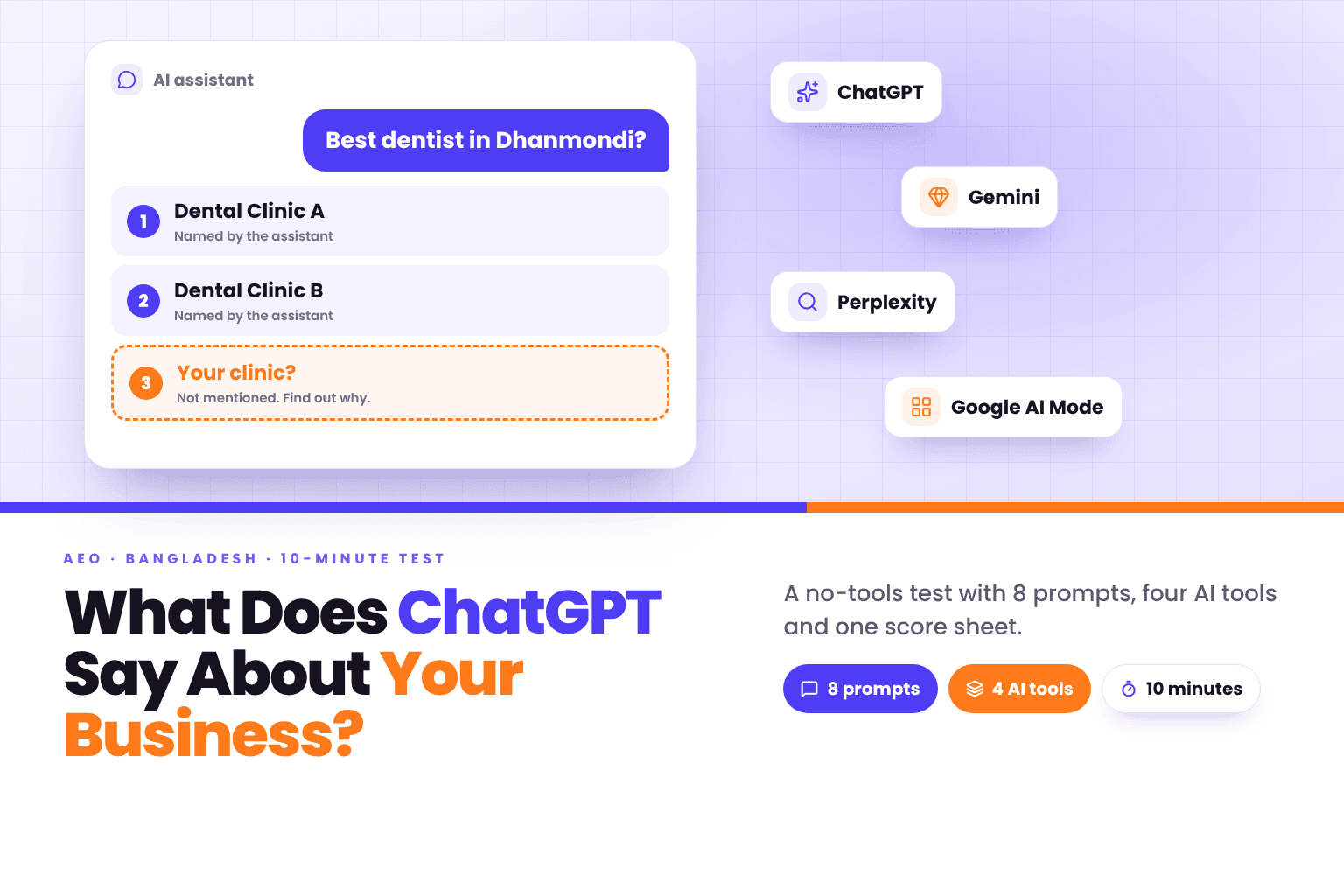
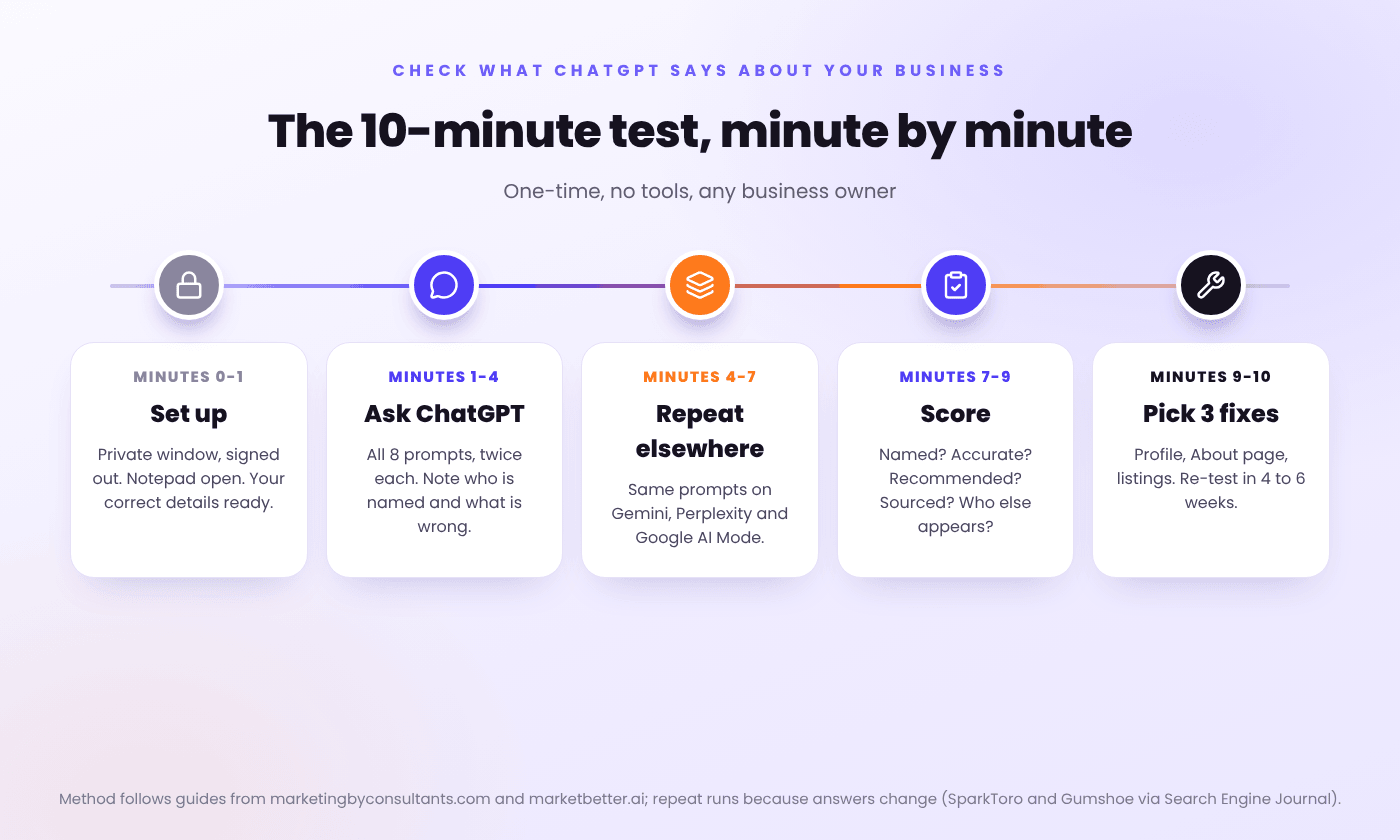
- A one-time check takes about 10 minutes: use a private window, ask 8 plain prompts on ChatGPT, then repeat them on Gemini, Perplexity and Google AI Mode.
- AI answers vary: a SparkToro and Gumshoe study found the chance of the same brand list twice was under 1 in 100, so run each prompt twice and look at patterns across runs.
- Score every answer on five questions: named, accurate, recommended, sourced, and which competitors appear.
- You cannot edit what ChatGPT says directly; fix the public sources it reads, such as your Google Business Profile, About page, consistent listings and independent mentions, then re-test in 4 to 6 weeks.
The short answer: to check what ChatGPT says about your business, open a logged-out or private window and ask it 8 plain questions: who you are, what you do, who you serve, and which businesses it would recommend in your category and area. Repeat the same prompts on Gemini, Perplexity and Google AI Mode, write down what each says, and mark what is wrong, missing or credited to a competitor. It takes about 10 minutes and needs no tools.
Most owners I speak to have never asked an AI assistant about their own business, even though their customers have started to. The result is often a surprise: a half-right description, an old address, or three competitors named and no mention of them. This guide is the one-time, no-tools version of that test, written for a Bangladeshi business owner. A team that wants ongoing tracking needs a different setup, and I only touch that in one line below.
Why Check What ChatGPT Says About Your Business?
Because the audience is large and still growing. eWeek reported in February 2026 that ChatGPT had around 900 million weekly active users, counting anyone who sent a message in the prior week. OpenAI's own research on adoption says lower-income countries have seen the fastest relative growth in weekly users since July 2023. I could not find a Bangladesh-only user count, so treat both as global and regional signals, not a local figure.
What it means for you: a share of the people who would have Googled your name now ask an assistant instead, and the assistant answers in one paragraph with no ten blue links. If that paragraph is wrong or leaves you out, you lose the customer before they ever reach your site. Checking costs 10 minutes. Not checking leaves the paragraph to chance.
What You Need Before You Start
Almost nothing. Use a private or incognito window, and sign out of ChatGPT if you can, so the answers are not shaped by your own chat history. Keep a notepad or a spreadsheet open. Have your correct name, address, phone number, services and opening hours to hand, so you can compare.
One warning before you trust a single answer. A study by SparkToro and Gumshoe, reported by Search Engine Journal, found that the chance of getting the same brand list twice from the same prompt was under 1 in 100, across ChatGPT, Claude and Google's AI. Brands were more consistent across many runs than within one, so run each prompt twice and look at patterns, not one answer. Other vendors found steadier results on comparison prompts, so results vary by prompt type.
Guides on this subject suggest anywhere from 10 to 20 customer-style questions to 20 to 30 for a full audit. For a one-time owner check, 8 is enough.
The 8 Prompts to Ask ChatGPT
Ask them as a customer would, in plain words, one at a time. The first three test whether the assistant knows you. The last five test whether it recommends you.
- "What is [your business name]?" Tests basic recognition.
- "Tell me about [your business name] in [your area]." Tests whether it understands where you operate, not just your name.
- "What does [your business name] charge?" or "How much does [your product] cost at [your business name]?" Tests whether it invents prices.
- "Best [your category] in [your area]." For example, "best dentist in Dhanmondi" or "best digital marketing agency in Dhaka".
- "Which [category] should I choose in Bangladesh for [your main customer]?" Tests the recommendation for your core buyer.
- "[Your business name] vs [your closest competitor]." Tests how you compare.
- "Is [your business name] legit?" or "Is it safe to order from [your business name]?" Tests trust. Online shops should always run this one.
- "Where can I buy / book [your main product or service] in Bangladesh?" Tests whether you appear for the transaction.
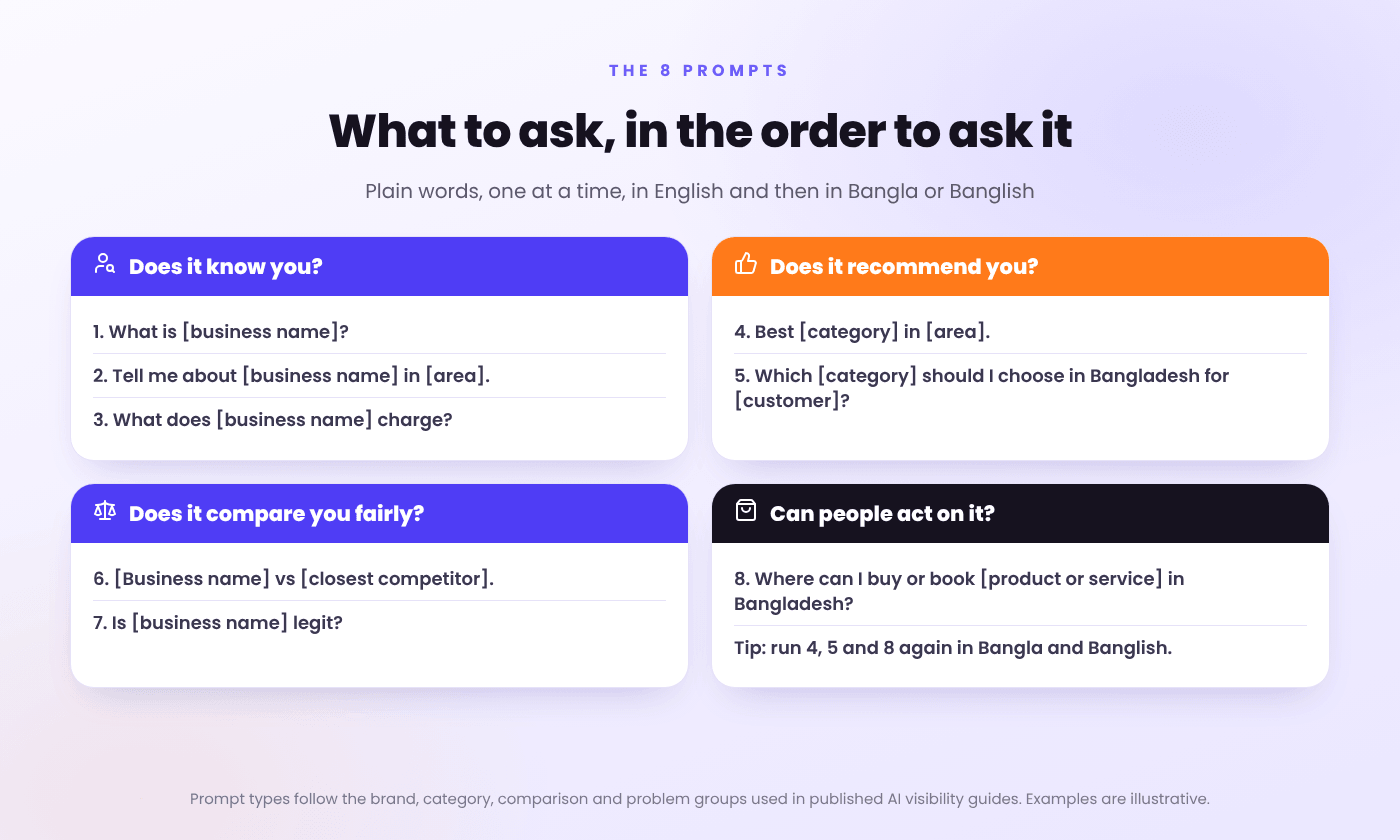
Run prompts 4, 5 and 8 once in English and once in Bangla or Banglish, since your customers type both. I cover that choice in more depth in choosing between Bangla, Banglish and English.
Repeat the Test on Gemini, Perplexity and Google AI Mode
Paste the same 8 prompts into each tool. They behave differently, which is why the repeat is worth five of your ten minutes.
| Tool | What to look for | Note |
|---|---|---|
| ChatGPT | Whether it names you, and the Sources link when it searches the web | OpenAI says ChatGPT search results and citations can be incomplete, outdated or incorrect |
| Gemini | Whether it describes you correctly and whether it shows where the facts came from | Check what your own answer shows; I did not verify its source features |
| Perplexity | The sources listed beside each answer | One third-party guide says Perplexity also shows its search queries |
| Google AI Mode and AI Overviews | The AI summary above or in place of the normal results | Google's own announcement covers AI Mode in Bengali for India; I could not confirm Bangla availability in Bangladesh |
If AI Mode does not appear for you, run your normal Google searches for prompts 4 and 5 and look at the AI Overview where one shows. Our guide to showing up in AI Overviews and AI answers explains why that box matters.
How to Read the Answers
For each prompt and tool, answer five questions in your notepad. A simple score sheet beats a vague feeling.
| Question | What a good answer looks like | If it fails |
|---|---|---|
| Named? | Your business appears by name | You are invisible for that prompt |
| Accurate? | Services, location, hours and prices match yours | A source it reads is wrong or old |
| Recommended? | You are in the shortlist, not just mentioned | Competitors have more proof than you |
| Sourced? | The answer links to your site or a trusted page | It is guessing from weaker pages |
| Who else? | You can see which competitors appear | Study their pages and mentions |
Count how many of the 8 prompts name you, per tool. A rough tally such as "named in 3 of 8 on ChatGPT, 1 of 8 on Perplexity" tells you where to start. Do not read anything into the order of a list: the SparkToro study found rankings were the least stable part of the answers.
A Worked Example: A Dhaka Skincare Shop
Here is how a result might look, using an invented shop so no real business is named. Say the owner runs a small skincare store in Banani that sells on Facebook and her own website. She asks the 8 prompts on ChatGPT and Perplexity and fills in her sheet.
On "What is [shop name]?" ChatGPT gives a vague line and says it has limited information. Perplexity finds the Facebook page but not the website. On "best skincare shop in Banani", neither names her; both list two larger stores. On "Is [shop name] legit?", ChatGPT hedges and tells the buyer to check reviews. The tally: named in 1 of 8 on Perplexity and 0 of 8 on ChatGPT.
Her three fixes follow from the sheet. Complete the Google Business Profile with the Banani address, publish an About page with her real name and a return policy page, and ask five happy customers for reviews on Google. She re-runs the test five weeks later and compares the tally. That is the whole method: a small, honest score you can repeat.
Test in Bangla and Banglish Too
Many customers do not type in English. Ask prompts 4, 5 and 8 again the way a customer in Mirpur, Chattogram or Sylhet might: in Bangla script, and in Banglish such as "Dhanmondi te bhalo dentist ke". Assistants often answer differently by language, and the sources they read in Bangla may be thinner, which can leave you out even when you appear in English. Note which language gave a better result for your category.
If you appear in English but not in Bangla, that is a content gap you can close with a Bangla version of your main service pages and a Bangla FAQ. It is also a sign that fewer local businesses have bothered, which makes it a real opportunity.
Quick Fixes You Can Make This Week
You cannot edit what ChatGPT says directly. OpenAI does not document a public business control for how it describes your company, as one guide on the subject notes. What you can change is the public information it reads. In my experience these six come first:
- Finish your Google Business Profile. Correct name, category, address, phone, hours and a real description.
- Make one clear About page. Say who you are, where you work, what you sell and who for, in plain sentences, with real people and a real address.
- Match your details everywhere. The same name, address and phone on your website, Facebook page and listings. The directories worth claiming in Bangladesh are the place to start.
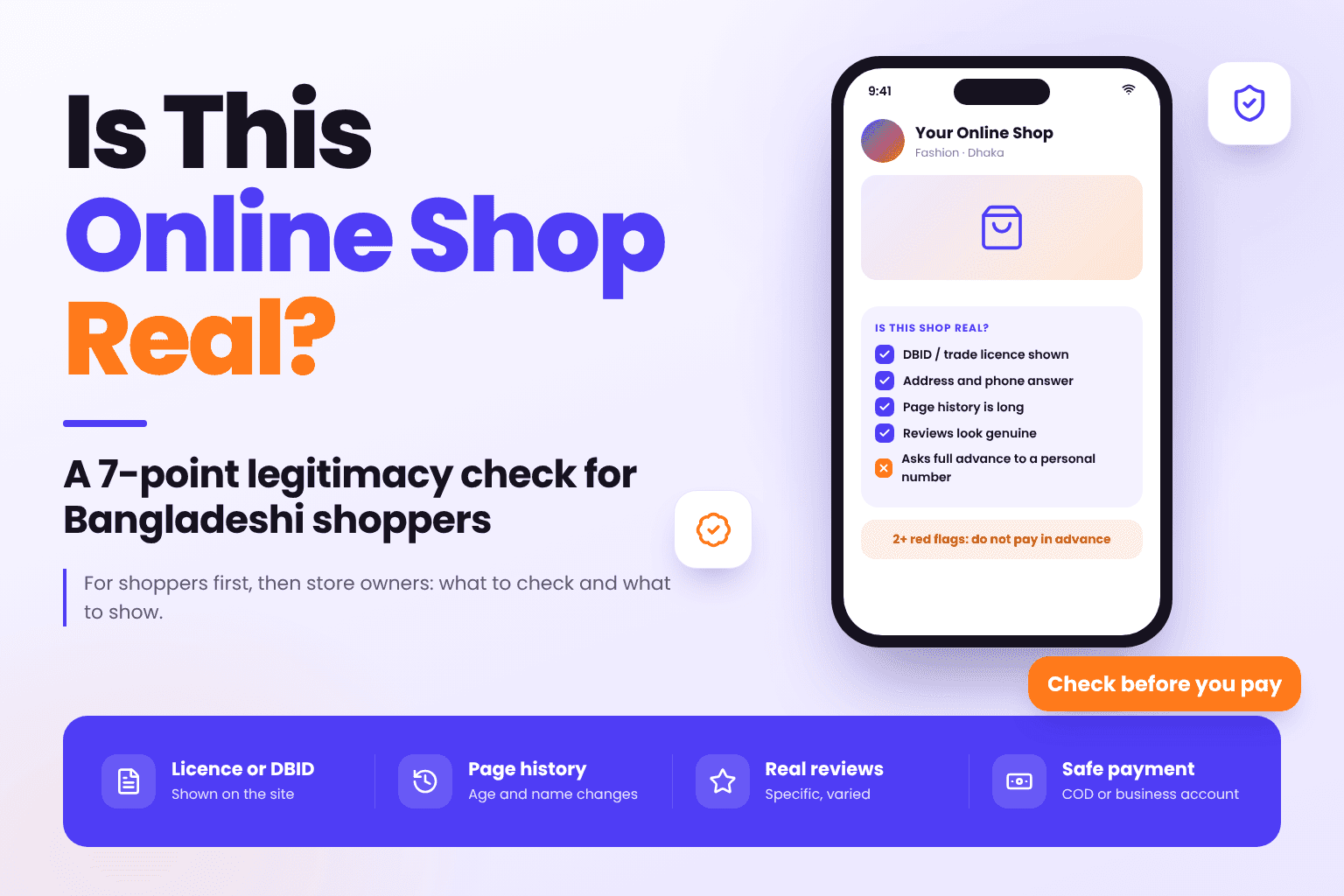
- Show your trust details on the site. If you sell online, put the identifiers and policies customers look for on the pages. The trust layer for Bangladeshi online shops lists them.
- Answer the questions customers ask. A short FAQ per service, written as direct answers, is easier for an assistant to quote than a brochure paragraph.
- Earn a few outside mentions. A review profile, a local news mention or a trade association listing gives the assistant a second source that agrees with you.
For the wider approach, see our guide to answer engine optimization strategies that earn citations. If you want it done for you, our answer engine optimization service covers it.
What This Test Cannot Tell You
A 10-minute check is a snapshot, not a measurement. Answers change by day, by phrasing and by tool, and a logged-out session in Dhaka may differ from your customer's. It also cannot tell you why you are missing, only that you are. Three things I deliberately leave to their own guides: what to do when ChatGPT states wrong facts about your company, why it keeps recommending a competitor, and how a team tracks all this every month. Run the check again in 4 to 6 weeks after your fixes, and keep your notes so you can compare.
Not sure what your results mean, or what to fix first? Send us your notes and we will read them with you, or look at how local businesses improved their AI search visibility before you decide.
Want more of our work in your Google results?
Frequently asked questions
Open a private window, sign out if you can, and ask ChatGPT what your business is, what it does in your area, what it charges, and which businesses it recommends in your category. Run each prompt twice, write down whether you are named and whether the facts are right, then repeat on Gemini, Perplexity and Google AI Mode.

Comments
No comments yet. Be the first to share your thoughts.