How Do You Know If an Online Business Is Legitimate in Bangladesh?
Pujan Kumar Saha · · 9 min read · Updated
Key takeaways
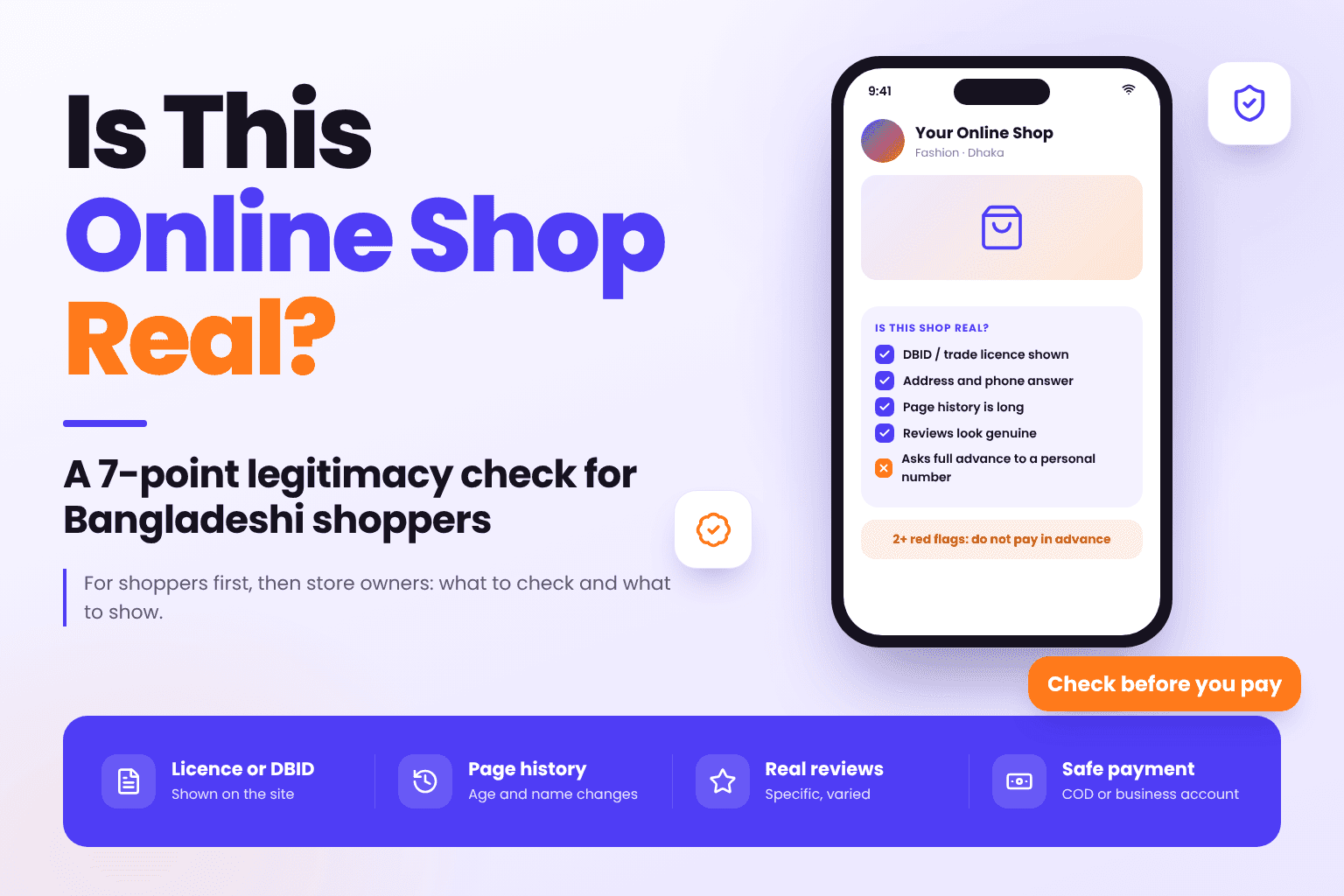
- No single sign proves a Bangladeshi online shop is real; check seven things in about ten minutes: business identity, address and phone, Facebook page history, reviews, return policy, payment route and public complaints.
- Two or more red flags, such as a brand-new page, generic five-star bursts or a request for full advance payment to a personal number, mean you should not pay in advance.
- Reports point to the DNCRP hotline 16121 and the Commerce Ministry complaint system for e-commerce; confirm current details on official sites and keep invoices, screenshots and receipts.
- Store owners can earn trustworthy results for review, fake and legit searches with real reviews, third-party mentions, an About page with real people and public answers to complaints.
The short answer: you cannot prove a Bangladeshi online shop is real from one sign, but you can check seven in about ten minutes: a trade licence or DBID number on the site, a real address and phone, a Facebook page with a genuine history, reviews from real profiles, a clear return policy, a safe payment route and public complaints. Two or more red flags mean do not pay in advance. This is shopper advice, not legal advice.
I get this question from friends before they order a phone, a saree or skincare from a page they found on Facebook. I also get it from store owners, who want to know why shoppers hesitate. This post answers the shopper's question first, with a checklist you can run on your phone. The second half is for owners: what shoppers type into Google, what ChatGPT and Google's AI say, and how a real store earns results that build trust.
Why Checking an Online Shop Matters in Bangladesh
Because the risk is real and the usual protection, paying on delivery, only covers part of the cases. The Bangladesh Bureau of Statistics household survey reported in 2026 found that cash on delivery was used by 86.8% of online shoppers, which tells you most buyers already try to avoid paying before they see the parcel. The trouble starts when a seller asks for an advance, a delivery charge or a "booking" payment first.
The worst cases have been public. The Daily Star has reported that customers were still chasing refunds years after e-commerce scams, and Dhaka Tribune's headline on the complaint backlog reads "Over 58,000 e-commerce complaints lodged, Tk3,869cr in arrears". Those figures come from several big platforms rather than small shops, but the lesson is the same: money paid in advance to a seller you cannot trace is hard to get back.
What it means for you: spend ten minutes before you pay, and the checks below are in the order I would run them.
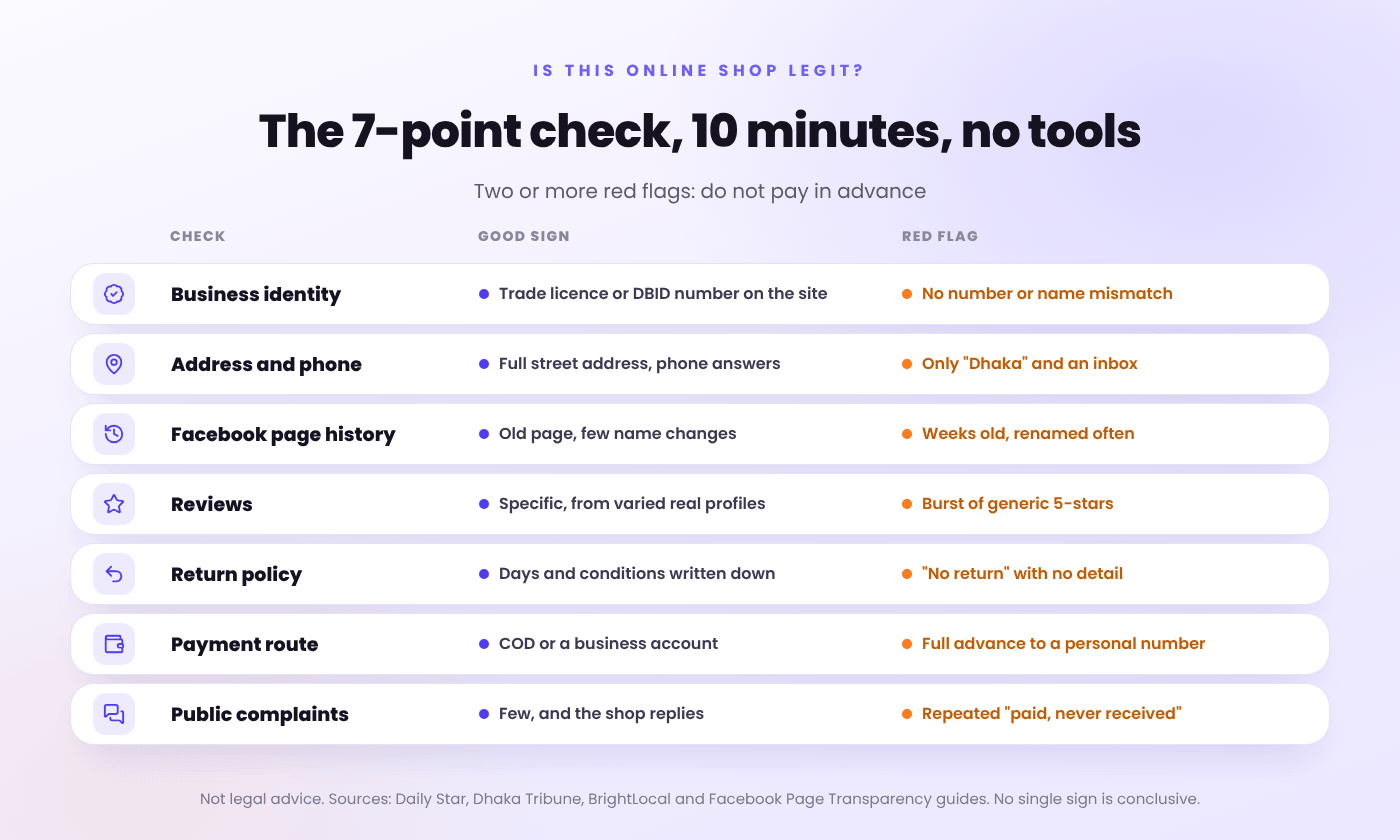
The 7-Point Checklist at a Glance
| Check | What good looks like | Red flag |
|---|---|---|
| 1. Business identity | Trade licence or DBID number written on the site | No number, or a number you cannot match to the name |
| 2. Address and phone | A full street address and a number that answers | Only "Dhaka" and an inbox |
| 3. Facebook page history | Page created long ago, few name changes | Page weeks old or renamed often |
| 4. Reviews | Specific reviews from varied real profiles | A burst of generic 5-star reviews |
| 5. Return policy | A written policy with days and conditions | "No return, no exchange" with no detail |
| 6. Payment route | Cash on delivery or a business account | Full advance to a personal number |
| 7. Public complaints | Few complaints, and the shop replies | Repeated "paid, never received" posts |
Check 1 and 2: Business Identity, Address and Phone
Look at the footer and the About page. The Daily Star reported that the Digital Commerce Operation Guidelines and later DBID rules make it mandatory for online businesses to display a registered DBID number on their website or social page, so a serious store usually shows its number, and often a trade licence number too. I could not open the official gazette from here, so treat that as reported, not confirmed. Our guide to the identity, policy and contact details an online shop should show covers what stores should display and why.
A number on a page proves little by itself, because anyone can type one. Use it as a prompt: does the name match the page name, does the phone answer, and does the address exist on Google Maps with a shop front, an office or at least a building name? A shop that hides all three is asking you to trust a stranger.
Check 3: Does the Facebook Page Have a History?
Most Bangladeshi online sellers start on Facebook, so check the page like a passport. Facebook's Page Transparency section, found under the About details, shows when a page was created and whether its name has changed, according to one guide, and it shows the countries where page managers are posting. Features can change, so check what your own app shows.
A page that is two weeks old but claims "five years of trust" is a red flag. So is a page renamed three times, since scam pages often rebrand after complaints. A verified badge helps less than you think; check the history even on verified pages. Compare the page with the website: a real business links the two, and the phone number matches.
Check 4: How to Spot Fake Reviews
Read reviews on Google Maps and on Facebook, and sort by newest. BrightLocal's guide on how to spot fake reviews lists patterns that repeat across guides, and none is conclusive alone:
- Bursts. Many 5-star reviews posted within days, then silence.
- Vague praise. "Best shop, highly recommended" with no product, price or delivery detail.
- Thin profiles. Reviewers with no photo and one review, all for this shop.
- Repeated wording. The same phrases across different names.
- No bad reviews at all. Real shops collect a few complaints, and a good one replies politely.
Look for the opposite signs too: specifics such as "delivered in Chattogram in 3 days, size fit was right", photos from customers, and owner replies that address the problem. Combine several signals before you decide, and remember that one angry review proves less than a pattern of the same complaint.
Check 5 and 6: Return Policy and Payment Route
Ask for the return policy before you buy. A real policy states how many days you have, what condition the product must be in and who pays the courier. "No return, no exchange" with nothing else is common among small sellers, and it is not proof of a scam, but it does mean you carry the risk. Take screenshots of the product page and the promised delivery time.
Prefer cash on delivery, and open the parcel in front of the rider if the courier allows it. If a seller asks for a delivery charge or full payment upfront, pay to a business account or payment gateway, not a personal bKash or Nagad number, and never pay more than you can afford to lose to a seller you have not verified. Our guide to how a well-designed cash on delivery checkout works shows what a careful store offers instead of asking for full advance payment.
Check 7: Public Complaints and Where to Complain
Search the shop name with the words "review", "fake" and "fraud" in English and in Bangla, and look at Facebook groups where buyers post experiences. A few unhappy posts are normal. A pattern of "paid and never received" posts with screenshots is not.
If you have been cheated, reports and guides point to the Directorate of National Consumer Rights Protection (DNCRP), whose hotline is 16121, as reported by the Daily Star. The Commerce Ministry has also set up a central complaint management system for e-commerce. Some guides also advise filing a police General Diary for fraud, and say complaints should generally be filed within 30 days. I could not confirm these details on the official sites, so check the current hotline, portal and deadline with the DNCRP before relying on them. Keep the invoice, screenshots, payment receipt and chat history.
What Online Shoppers Type Into Google
Now the store owner's side. Before they order, many careful shoppers search for your shop name followed by a word such as "review", "fake" or "legit", often in Bangla or Banglish too. Whatever appears for those searches is your reputation, whether you wrote it or not.
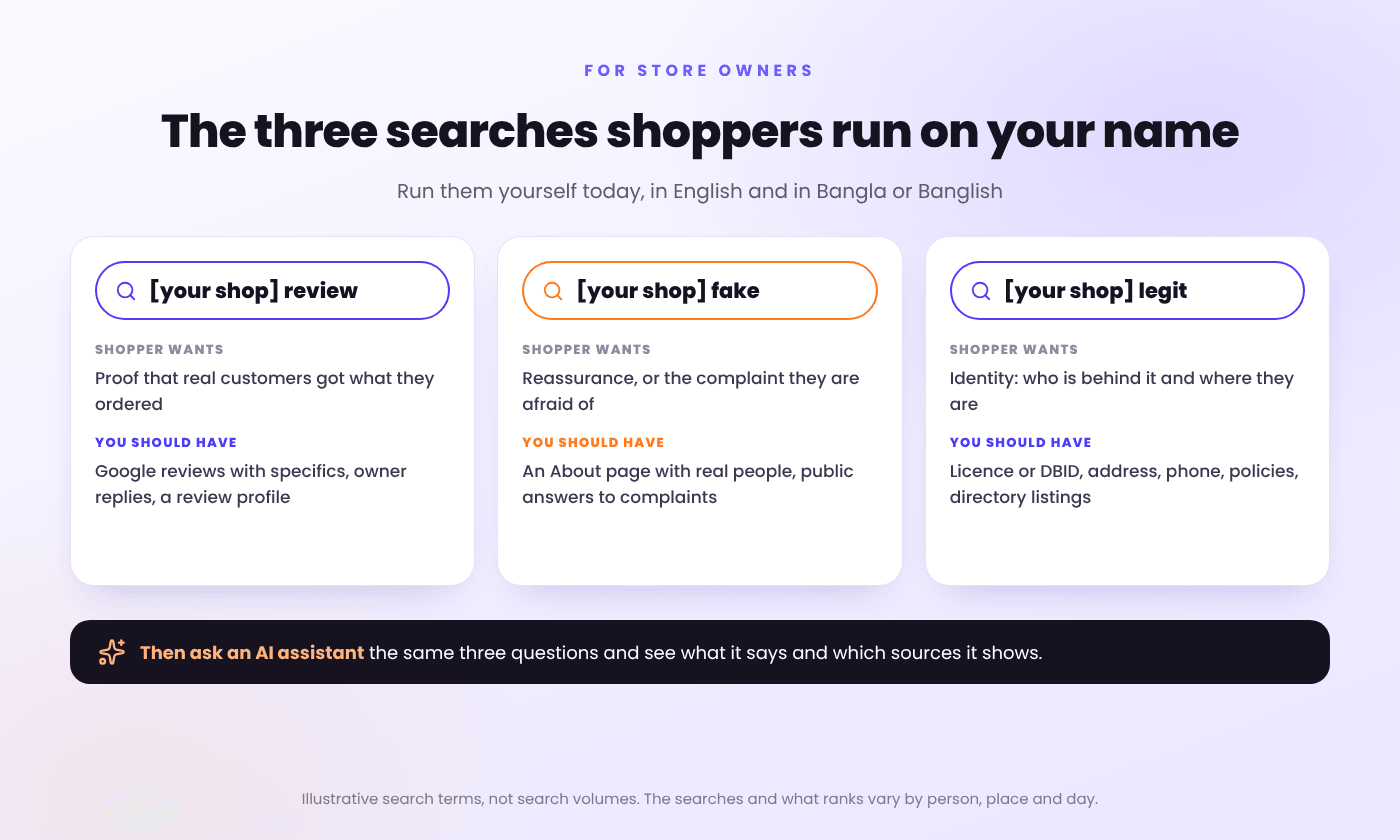
Run those three searches for your own brand today. Note what ranks: your own site, your Facebook page, review profiles, news, forum posts or an old complaint. If a complaint thread outranks your About page, that is the result a nervous shopper reads first. I cannot tell you what yours shows, and it changes by person and by day, which is why the test is worth doing yourself.
Also check what appears in Google's AI answers for the same searches, since some shoppers now read the summary and stop there. If it names you wrongly or leaves you out, that is a gap to fix.
What ChatGPT and Gemini Say About Your Shop
Shoppers also ask AI assistants "Is [shop] legit?". The answer depends on what public pages the assistant can find about you: your website, your Google Business Profile, reviews and any mentions elsewhere. A shop with no clear About page, no address and a handful of thin reviews gives an assistant little to be confident about, so it may hedge or recommend a larger competitor.
You can test this in 10 minutes with the method in our guide on checking what ChatGPT says about your business. Ask prompt 7, "Is [your shop name] legit?", on ChatGPT, Gemini and Perplexity, and note what each says and which sources it shows. Treat the answers as a mirror of your public evidence, and improve that evidence, not the wording of your prompt.
How a Store Earns Trustworthy Results
You cannot buy a good reputation search result, but you can earn one. In my experience, five things move it:
- Real reviews, asked for politely. After delivery, send customers a short message with your Google review link. Do not buy reviews, because bursts of generic praise are exactly what shoppers learn to distrust.
- Third-party mentions. A listing in a trusted directory, a news mention or a partner page gives assistants and shoppers a second voice. The directories worth claiming first is a good start.
- An About page with real people. Names, photos, a story and the address. A faceless shop is harder to believe.
- Public answers to complaints. Reply to negative reviews calmly, state what you will do and follow up. Shoppers read your reply more than the complaint.
- Clear policies and contact details. Put them where people look, as the trust layer guide explains.
For the broader plan, see our guide to e-commerce SEO strategies for Bangladeshi stores, and if you want help with how your store appears in search, our search reputation and SEO work for online stores covers it.
Want shoppers to find proof that your store is real when they search for it? Ask us for a reputation check of your search results, or read how other Bangladeshi brands strengthened theirs first.
Want more of our work in your Google results?
Frequently asked questions
Check seven things: a trade licence or DBID number on the site, a real address and phone number, a Facebook page with a genuine history, reviews from real profiles, a written return policy, a safe payment route and public complaints. No single sign proves a shop is real, but two or more red flags mean you should not pay in advance.
Related articles
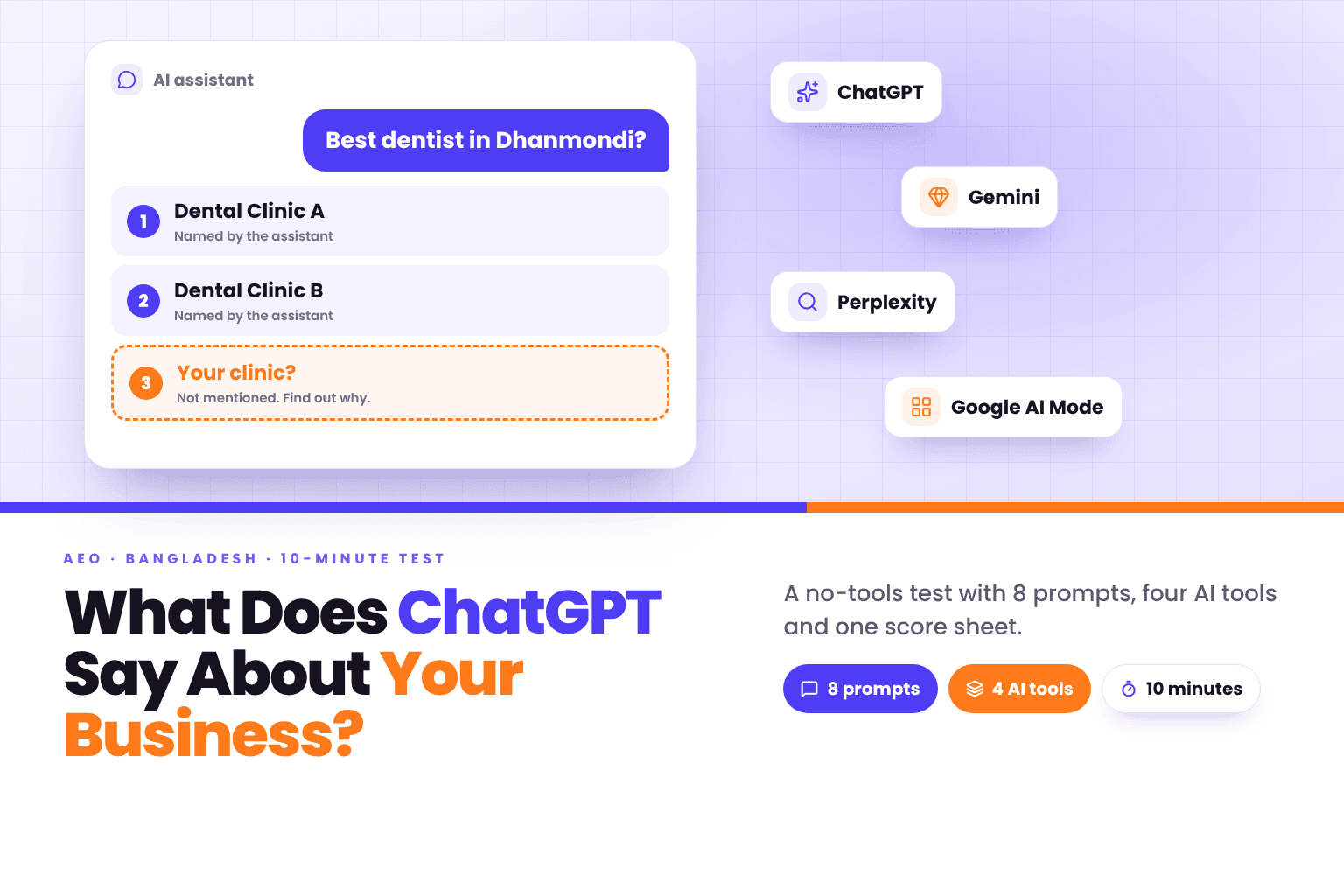
How Can I Check What ChatGPT Says About My Business?
Read article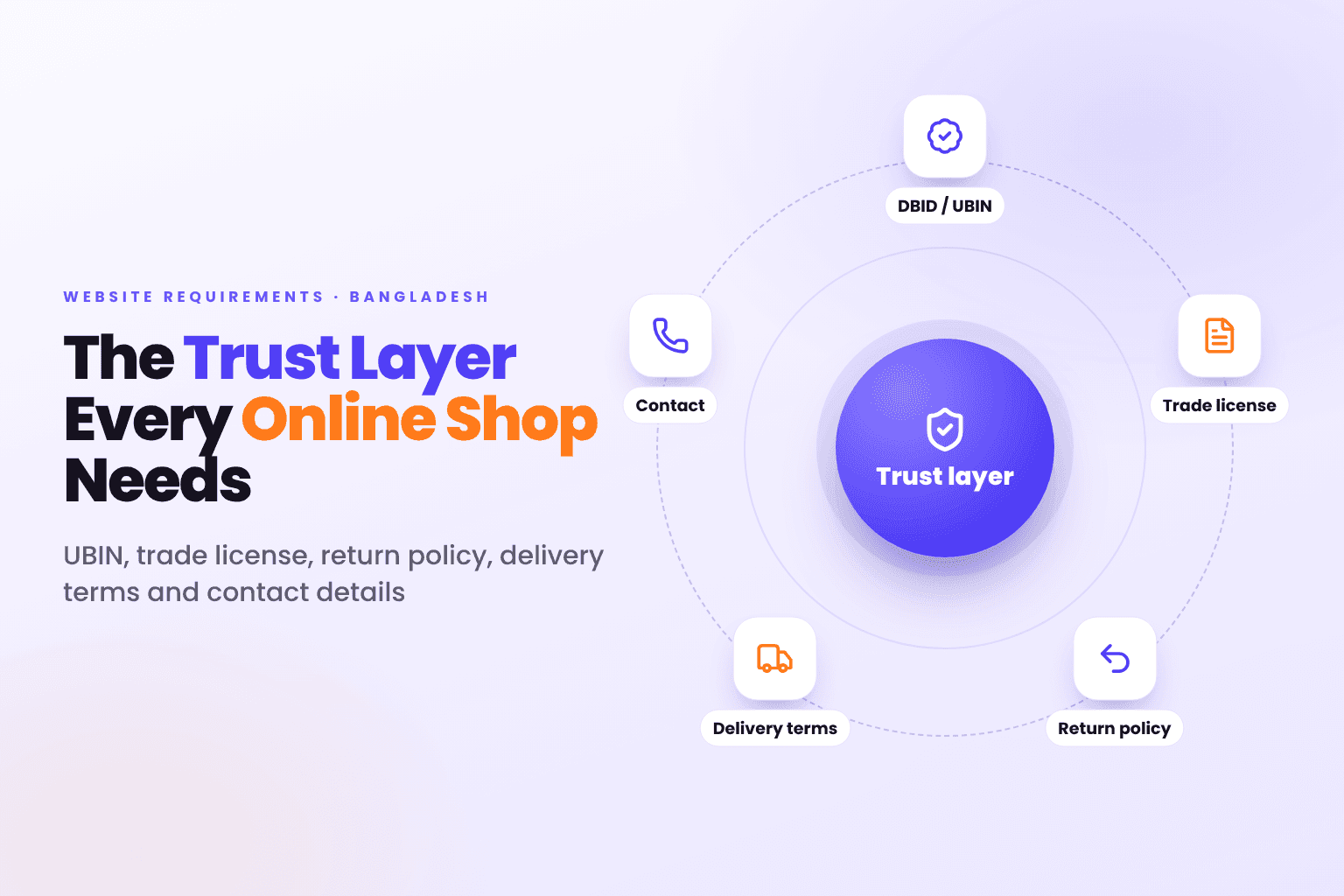
UBIN, Trade License and Return Policy: The Trust Layer Every Bangladeshi E-commerce Website Needs
Read article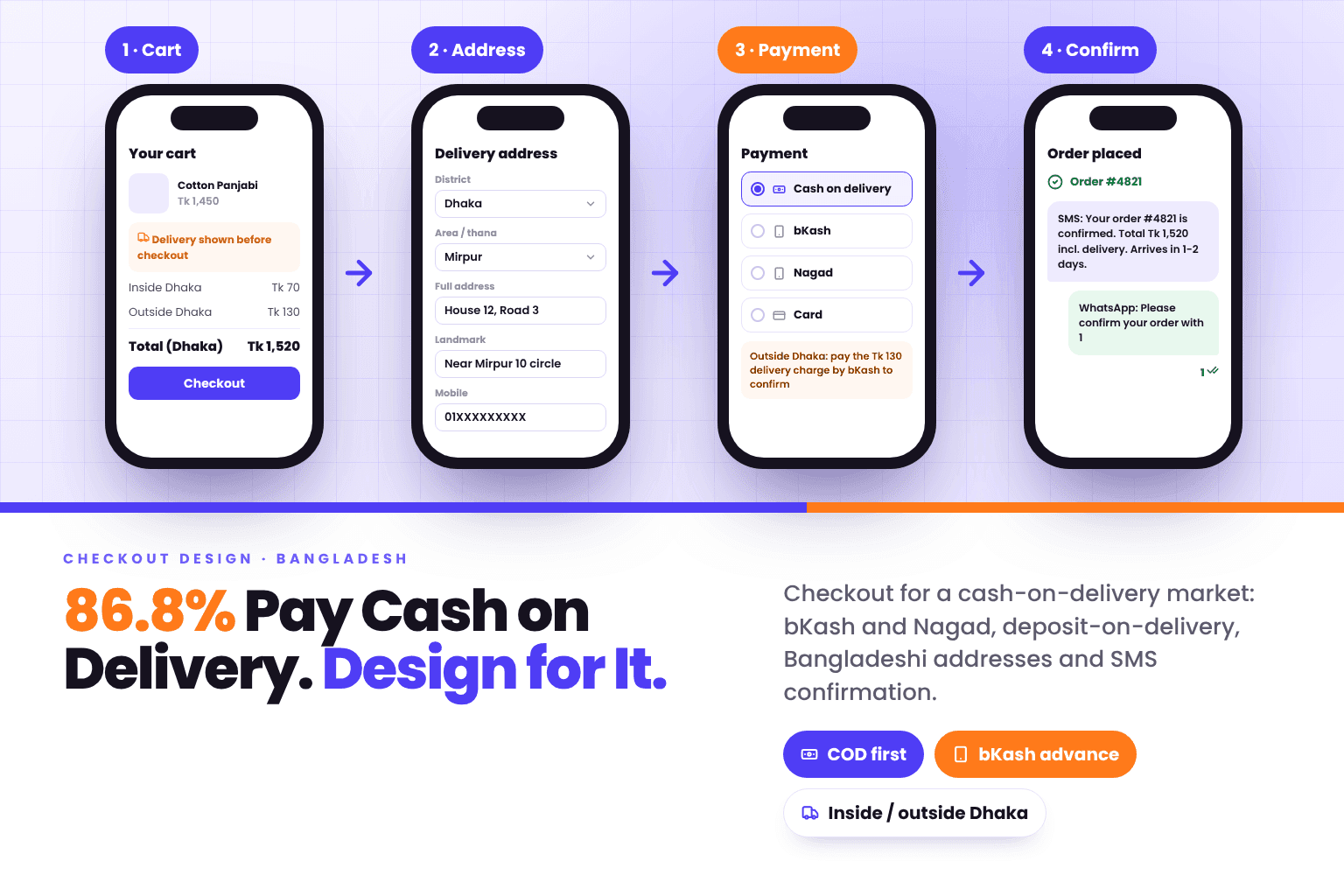
Comments
No comments yet. Be the first to share your thoughts.