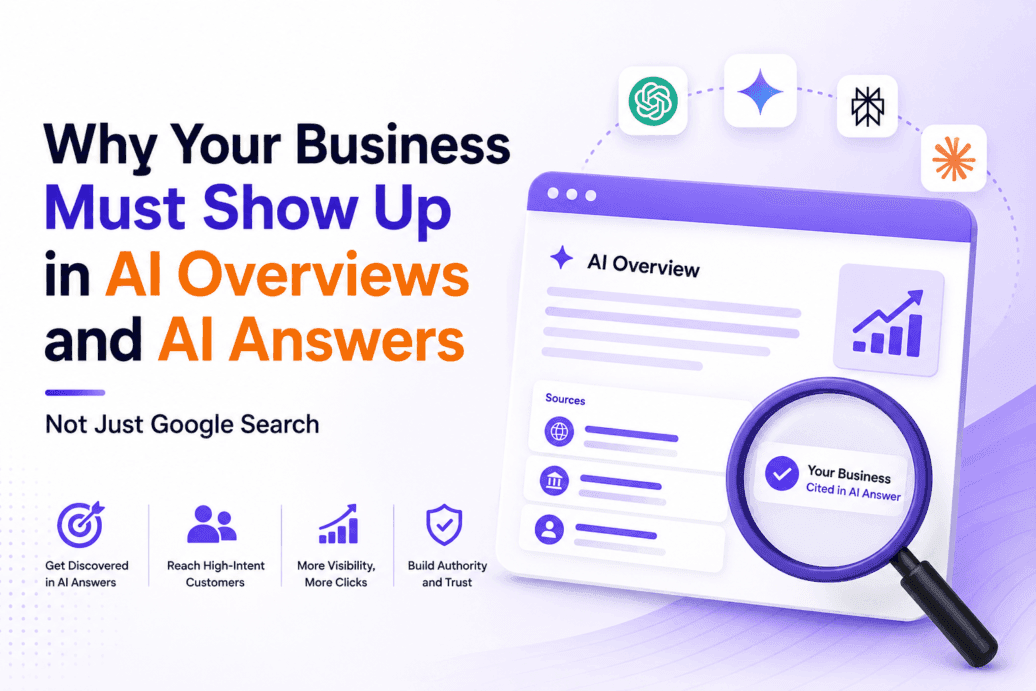
Why Your Business Must Show Up in AI Overviews and AI Answers (Not Just Google Search)
Pujan Kumar Saha · August 7, 2026 · 12 min read · Updated August 18, 2026
Key takeaways
- Ranking first on Google is no longer the finish line, because the searcher often gets an AI-written answer before reaching a single blue link.
- Visibility now spans more than Google, since AI assistants and answer engines have become discovery surfaces in their own right.
- Getting cited by AI depends on clear, verifiable, well-structured content that an answer engine can quote with confidence.
- Businesses that adapt now build an advantage that will be difficult for latecomers to close once these surfaces become competitive.
This isn’t a future problem. It’s already reshaping how businesses get found, and the businesses that adapt now are building an advantage that will be very hard for latecomers to close.
The Search Results Page Isn’t What It Used To Be
Two things are happening on Google at once, and both work against businesses that only optimize for traditional rankings.
First, AI Overviews are everywhere. According to Conductor’s analysis of 21.9 million queries, AI Overviews appeared in roughly 25% of Google searches by early 2026, up from just 13% a year earlier, and other large-scale studies using different methodologies put the figure closer to 48% of all queries. Whichever number you trust, the direction is the same: AI-generated summaries are becoming the default way Google answers a growing share of questions, not an occasional feature.
Second, when an AI Overview appears, people stop clicking. Pew Research Center tracked the actual browsing behavior of 900 US adults across nearly 69,000 real Google searches. When an AI summary appeared, users clicked a traditional search result in just 8% of visits, compared to 15% when no summary appeared, nearly double. Clicking on one of the actual source links cited inside the AI summary happened in only 1% of visits. Separately, Bain & Company’s research found that searches triggering an AI Overview end without any click 83% of the time, versus about 60% for ordinary searches.
Put together: your business can rank #1 in the traditional sense and still be functionally invisible, because the person searching never scrolls down to see you.
The Upside Nobody Talks About
Here’s the part that should change your strategy rather than just worry you: being cited inside the AI answer isn’t a consolation prize. It now outperforms the old #1 spot. Research compiled by BloggerIdeas found that brands cited inside an AI Overview earn 35% more organic clicks and 91% more paid clicks than a brand sitting in the traditional position-one slot below the AI answer. In other words, the AI answer isn’t purely stealing your traffic. It’s redistributing it toward whichever brand it decides to trust and quote. If that brand is you, you win disproportionately. If it isn’t, you’re now competing for scraps below a wall of text most people never read past.
This is exactly the shift Answer Engine Optimization exists to address. Where SEO is built to win a ranking position, Answer Engine Optimization (AEO) is built to win the citation itself, structuring your content, your data, and your authority signals so that when Google, ChatGPT, Perplexity, or Gemini generate an answer, your business is the source they pull from.
It’s Not Just Google Anymore
AI Overviews are only half the picture. A separate, fast-growing layer of search is happening entirely outside Google, inside ChatGPT, Gemini, Perplexity, Copilot, and Claude.
- ChatGPT alone had reached roughly 900 million weekly active users by February 2026, according to OpenAI’s own figures, more than double the ~400 million it had just a year earlier.
- Website traffic referred from AI platforms grew 16x between 2024 and 2026, per SE Ranking’s traffic study, with ChatGPT currently sending the largest share of that referral traffic, followed by a fast-rising Gemini and Perplexity.
- During the 2025 holiday shopping season, AI-referred traffic to US retail sites grew 693% year over year, according to Adobe Digital Insights, a strong signal that AI answers are increasingly where purchase research actually starts.
- The traffic that does arrive from AI platforms tends to be higher-intent: one industry benchmark found AI search traffic converting at roughly 14.2%, compared to about 2.8% for average organic Google traffic, nearly five times higher value per session, per Superlines’ compiled research.
None of this means Google stops mattering. It’s still by far the largest source of search traffic. It means the definition of “search visibility” has quietly expanded to include a handful of AI platforms that didn’t exist as consumer products five years ago, and your business needs a plan for all of them, not just one.
Why Ranking #1 on Google No Longer Guarantees You’re Findable
Here’s the uncomfortable truth for businesses that have invested years in traditional SEO: ranking position and AI citation are no longer the same contest. A business can hold the #1 organic spot on Google and be completely absent from ChatGPT’s answer to the exact same question, because these systems don’t simply mirror Google’s rankings. They evaluate content differently, and they don’t always agree on who the authoritative source is.
This is also not a “set it and forget it” win once you get cited. Research from DocDigitalSEM found that AI Overview content changes for the same query roughly 70% of the time, and when it updates, nearly half the citations get swapped out, only about 30% of brands manage to stay visible across back-to-back responses to the same question. Getting cited once is an accomplishment. Staying cited is an ongoing discipline, which is exactly why AEO has to be treated as a continuous practice, the same way SEO already is.
What Actually Gets a Business Cited by AI
AI answer engines are, at their core, pattern-matching for trustworthy, well-structured, easily extractable information. A few factors consistently show up across the research:
Clear, direct answers near the top of the page. AI systems favor content that states the answer plainly in the first few sentences, then supports it, the opposite of a long narrative buildup before the point.
Statistics, citations, and sourced claims. Content that includes real data points, studies, and quotable facts achieves 30–40% higher visibility in AI-generated responses, according to Superlines’ research, which is part of why a well-sourced blog post tends to outperform a vague opinion piece in AI answers.
Freshness. Pages updated within the last two months earn roughly 28% more citations than older, stagnant content, per the same research, a strong argument for maintaining and refreshing your best content rather than only publishing new pieces.
Structured data and schema markup. FAQ schema, HowTo schema, and clean heading structures make it far easier for both Google’s AI Overviews and third-party AI crawlers to lift and attribute your content accurately.
Established authority sources still dominate citations. DocDigitalSEM’s analysis found YouTube cited in 23% of AI Overviews, Wikipedia in 18%, and Google’s own properties in 16%, a reminder that video content, well-maintained knowledge bases, and a strong overall web presence all feed into whether an AI system trusts you enough to quote you.
This is precisely the groundwork we lay out in more detail in our guide to AEO strategies and the tools we recommend for tracking AI visibility, structuring content, implementing schema, and monitoring citation performance the way you’d already monitor keyword rankings.
Real Results: Getting Cited in AI Overviews and AI Mode
This isn’t theoretical. Here’s what it actually looks like when a business moves from invisible to cited inside Google’s AI Mode and AI Overviews.
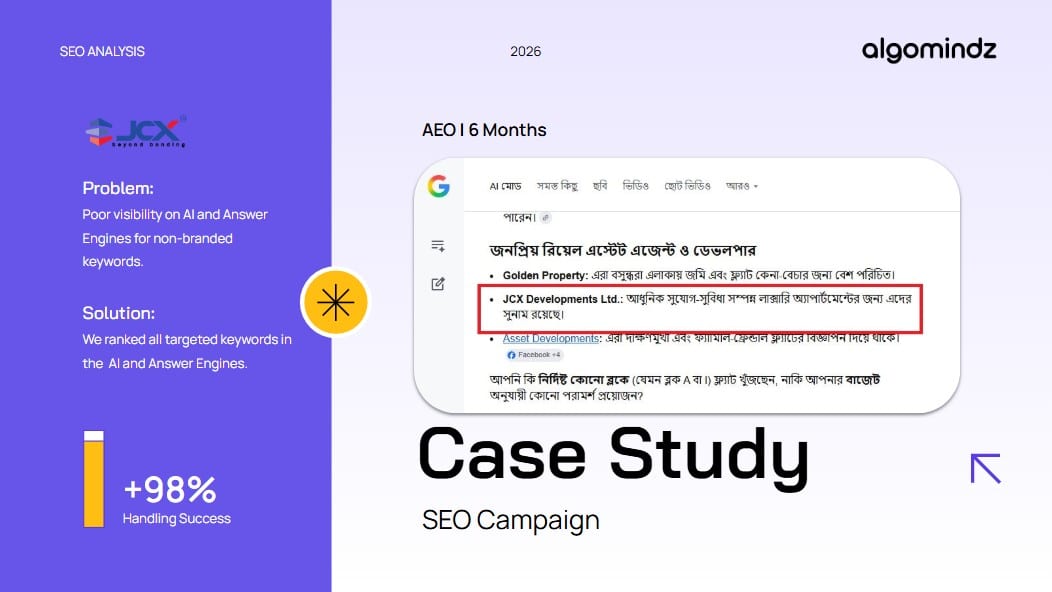
JCX Developments, 6-month AEO campaign. JCX Developments, a real estate developer, had poor visibility on AI and answer engines for non-branded keywords, the kind of generic “who are the best developers” searches that drive real buyer intent. Within six months of a targeted AEO campaign, we ranked all target keywords inside Google’s AI and answer engines. The screenshot below shows JCX Developments named directly alongside established competitors in Google’s AI Mode response to a query about popular real estate agents and developers, with the citation earning a 98% handling success rate across the engagement.
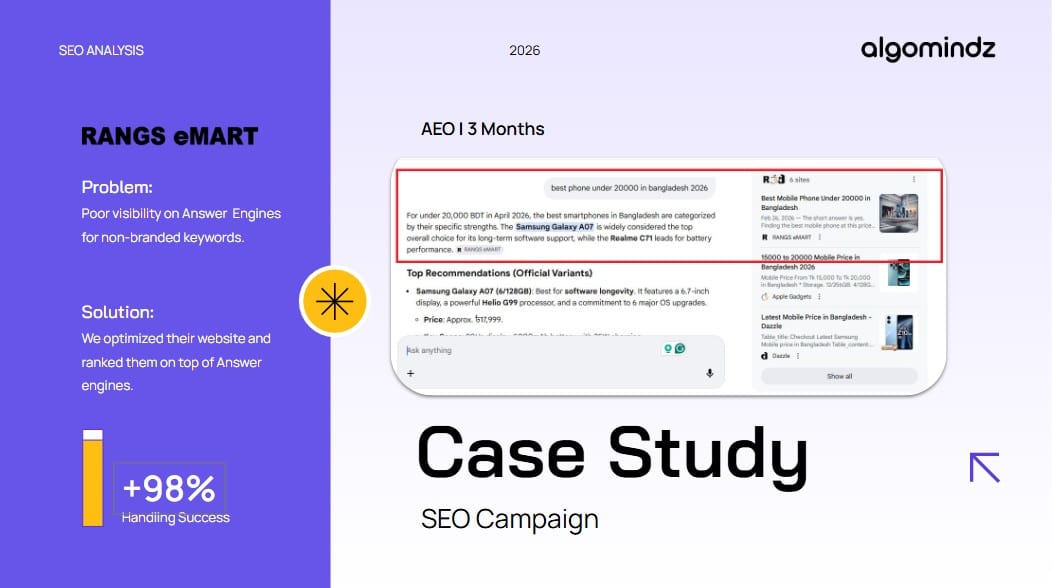
Rangs eMart, 3-month AEO campaign. Rangs eMart faced the same core problem: poor visibility on answer engines for non-branded keywords, meaning the business was effectively invisible to anyone using AI Mode to research a purchase rather than typing a branded search. We optimized their website and ranked them at the top of answer engine results in just three months. The result, shown below, is Rangs eMart appearing directly inside Google’s AI Mode as a top recommendation for “best phone under 20,000 in Bangladesh 2026”, exactly the kind of high-intent, comparison-driven query that AI Mode now answers before a user ever reaches a traditional search result.
Green Delta Insurance, 6-month AEO campaign. Green Delta Insurance didn’t have proper visibility on AI and answer engines at all. We optimized their content and overall website for both AI systems and human users, and the business now appears across most major AI and answer engines. The screenshot below shows Green Delta Insurance cited in a Google AI Overview response about non-life insurance in Bangladesh, named alongside other established insurers as one of the digitally innovative, travel-insurance-focused options in the market.
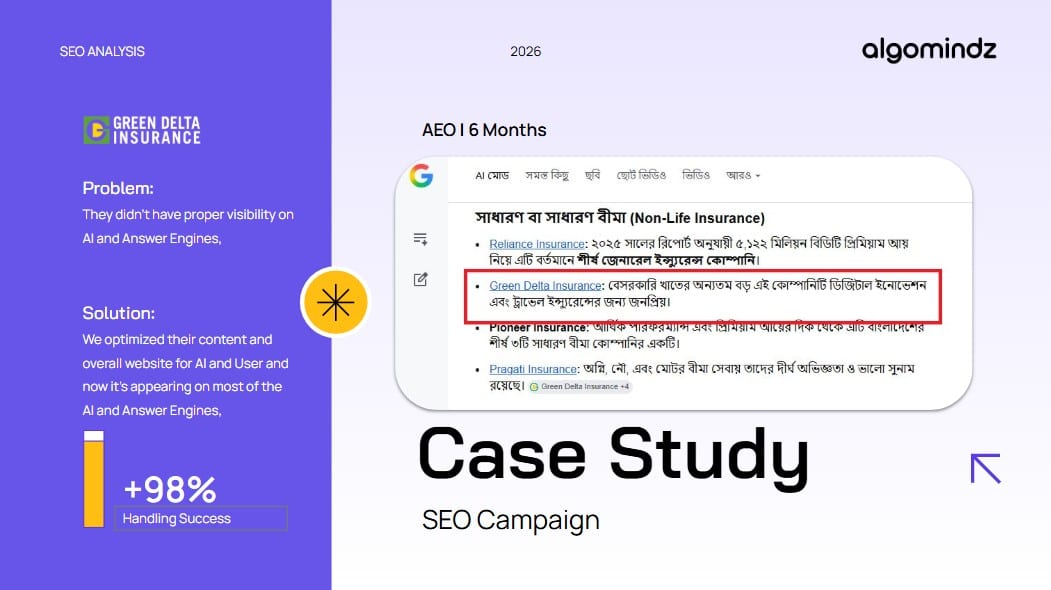
All three cases share the same starting point, real businesses with strong traditional SEO fundamentals that were still functionally invisible the moment a customer’s question got routed through an AI engine instead of a classic search. That’s the exact gap AEO is built to close, and it’s the same gap most competitors in any given industry still haven’t addressed yet.
Why This Matters Even More for Bangladeshi Businesses
Search behavior doesn’t shift at the same pace everywhere, and that gap is an opportunity if you move early. AI adoption is rising fastest in emerging and South and Southeast Asian markets right now, research compiled by Omnibound found AI tool adoption reaching 59% in India, among the highest rates globally, well ahead of many Western markets. As smartphone and mobile-data access continue expanding across Bangladesh, a market where, as we’ve covered in our piece on local SEO timelines, the majority of internet access already happens on mobile. It’s a reasonable bet that AI-assisted search and shopping research will follow a similarly steep adoption curve here.
The practical implication is the same pattern we’ve seen with SEO adoption locally: most Bangladeshi businesses haven’t structured their content for AI answer engines yet, which means the businesses that do it now have a real head start before the space gets competitive. Just as we’ve seen with local SEO and Google Business Profile optimization, being early to a low-competition channel tends to produce outsized results compared to entering once everyone else has caught on.
How to Start Showing Up in AI Overviews and AI Answers
You don’t need to abandon your existing SEO work, AEO builds directly on top of it. A few practical starting points:
- Audit how your business currently appears (or doesn’t) in AI answers. Search your core service queries in Google’s AI Overviews, ChatGPT, and Perplexity, and see who’s being cited instead of you.
- Restructure key pages to answer questions directly. Add a clear, concise answer in the first 2–3 sentences of important pages, followed by supporting detail, mirroring how featured snippets and AI summaries are extracted.
- Add FAQ and HowTo schema markup to service pages and blog content so AI crawlers can parse your content’s structure accurately.
- Publish content with real data, not just opinions. Original statistics, case studies, and cited sources make your content far more quotable to an AI system than generic advice.
- Refresh your best-performing content regularly rather than letting it go stale, recency is now a measurable citation factor, not just a ranking one.
- Strengthen your presence on high-citation platforms like YouTube and well-maintained knowledge resources, since AI systems lean heavily on a small set of trusted sources.
- Treat this as ongoing, not one-time. Since AI answers reshuffle citations roughly 70% of the time they update, staying visible requires the same continuous attention you’d give to keyword rankings.
If your current SEO strategy stops at “rank on page one,” it’s already behind where the market is heading. The businesses building visibility inside AI Overviews and AI answer platforms today are the ones that will still be the default answer when a customer asks, whether they’re asking Google, ChatGPT, or whatever comes next.
Want to know how your business currently shows up, or doesn’t, in AI Overviews and AI answer platforms? Talk to our AEO team for a free visibility audit, or explore how we pair it with SEO for full-funnel search visibility.
Want more of our work in your Google results?
Frequently asked questions
SEO focuses on ranking your pages in traditional search results. AEO focuses on getting your content selected and quoted as the direct answer inside AI Overviews, ChatGPT, Perplexity, and similar tools. They rely on overlapping fundamentals: quality content, technical health, and authority. But AEO adds structural and citation-focused elements SEO alone doesn’t cover.
Comments
No comments yet. Be the first to share your thoughts.