
How to Start an Online Business in Bangladesh: A Practical Guide
Pujan Kumar Saha · · 12 min read · Updated
Key takeaways
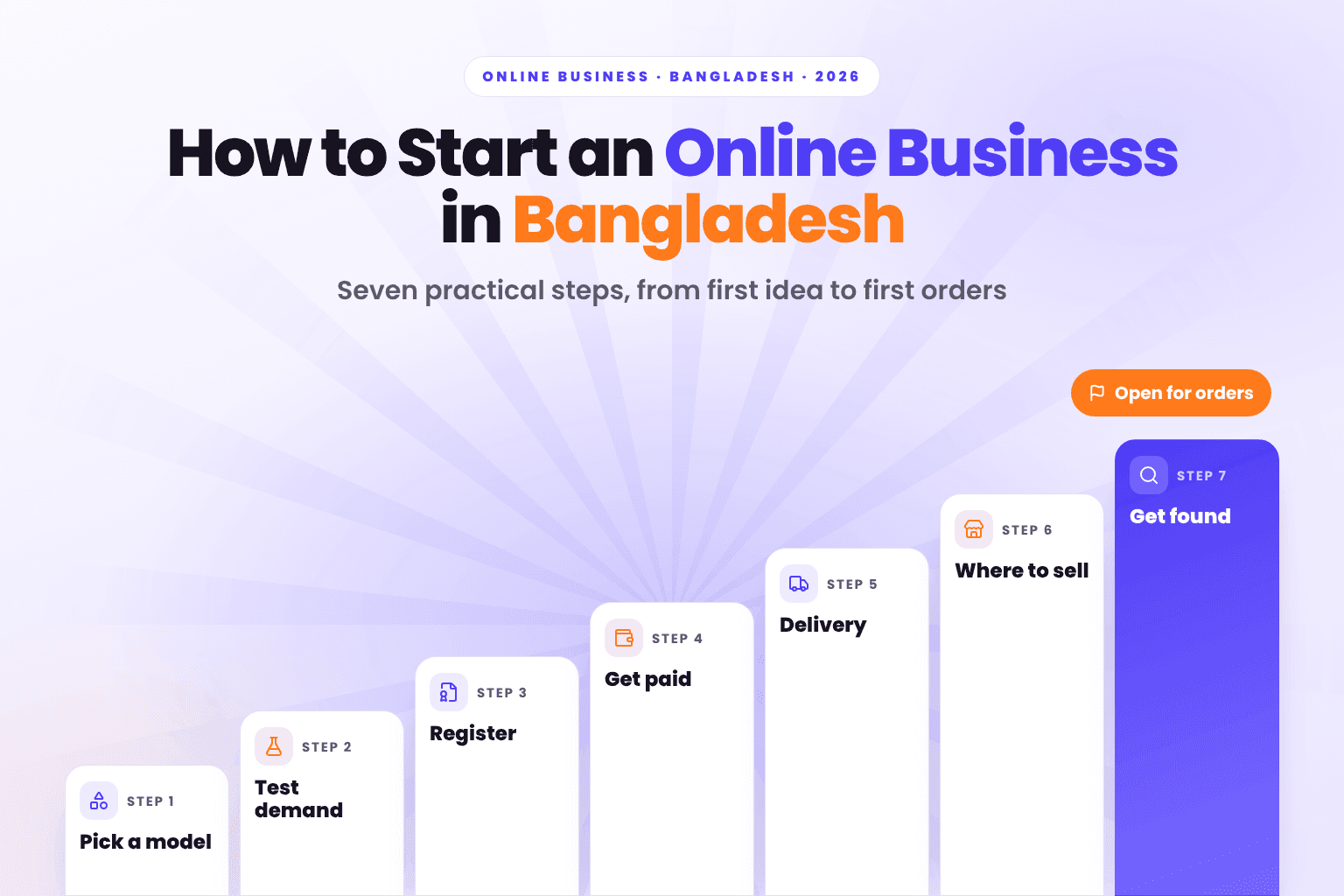
- Starting an online business in Bangladesh takes seven steps: pick a model, test demand, register, set up payments, choose a courier, decide where to sell and make sure customers can find you.
- Test demand for a week with Google Trends, Facebook groups, Daraz listings and pre-orders before buying any stock.
- Get an e-TIN, trade license and DBID early, because payment gateways such as SSLCommerz, banks and corporate buyers ask for them.
- Most shoppers still pay cash on delivery, so design for it first, add bKash or Nagad next, and build search presence early instead of relying on boosted posts.
Starting an online business in Bangladesh takes seven practical steps: pick a model that fits how Bangladeshis actually buy, test demand before you spend, get your trade license, e-TIN and DBID in order, set up bKash, Nagad or a payment gateway, choose a courier, decide where you'll sell, and build a way for customers to find you through search. None of these steps is expensive on its own. Most new sellers fail because they skip one, usually demand testing or legal registration, and pay for it later.
The timing is good. Bangladesh had 82.8 million internet users at the end of 2025, and card-based online spending alone ran at roughly Tk 22 billion a month through mid-2026. Yet most small sellers still run on a Facebook page with no website, no registration and no search presence, which leaves plenty of room for a business that does the basics properly.
Step 1: Pick a Business Model That Fits How Bangladesh Buys
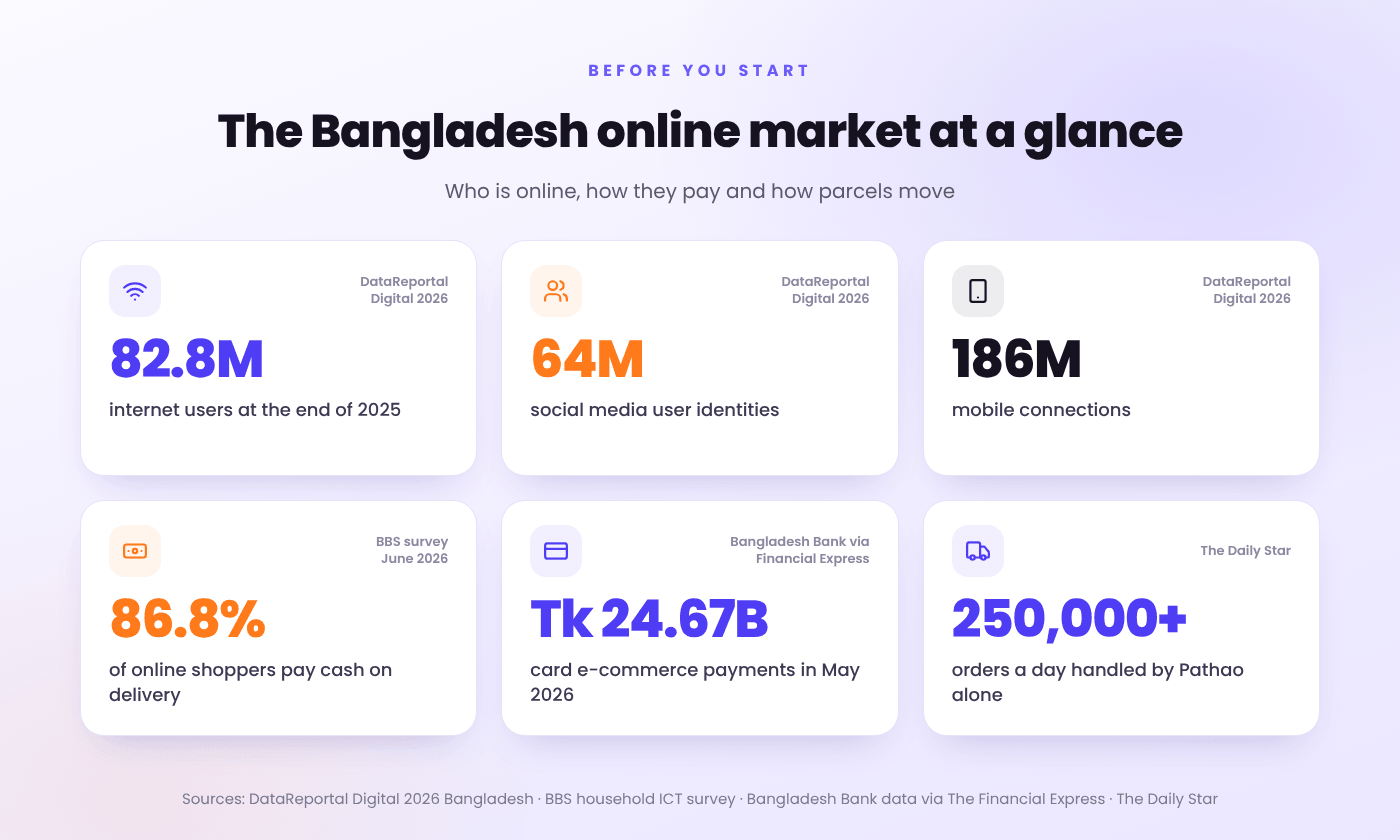
The right model depends less on what you want to sell and more on how your buyers behave. According to DataReportal's Digital 2026 Bangladesh report, the country had 82.8 million internet users and 64 million social media user identities in late 2025, against 186 million mobile connections. In plain terms: most buyers discover products on Facebook, and less than half the population is online at all. Don't build for phones only, though. StatCounter data shows desktop still drives about half of web traffic in Bangladesh, so your shop has to work well on both.
That shapes which models work. Here are the four most common ones for a first online business:
| Model | What you sell | Where it usually sells | Main risk |
|---|---|---|---|
| Reselling (sourced products) | Goods bought wholesale from Chawkbazar, Islampur or importers | Facebook page, marketplaces | Thin margins, easy to copy |
| Own brand | Clothing, handicrafts, cosmetics, food made or branded by you | Website plus Facebook and Instagram | Needs upfront stock and product photos |
| Services | Design, tutoring, repair, consulting, booking | Website, Google Business Profile, Facebook | Hard to scale beyond your own hours |
| Digital products | Courses, templates, software, e-books | Website, YouTube, Facebook groups | Needs trust before people pay in advance |
If you're starting with little capital, reselling or services gets you selling fastest. If you want something that grows in value over time, an own brand with its own website is the stronger long-term bet, because a brand name can rank in search and a reseller's listing usually can't.
The market is large enough for all four. Industry estimates quoted by The Financial Express put Bangladesh's e-commerce market at about US$7.5 billion in 2024, rising toward US$9.8 billion by 2028, though online still makes up only around 3% to 5% of total retail sales.
Step 2: Test Demand Before You Spend Money
The cheapest mistake to avoid is buying stock nobody wants. Before you order a single carton, spend a week checking whether people are already looking for what you plan to sell.
- Check search demand: Open Google Trends, set the country to Bangladesh, and type your product in both English and Bangla ("jamdani saree" and "জামদানি শাড়ি"). A steady or rising line is a good sign. A spike only around Eid tells you the product is seasonal.
- Read what buyers ask: Join three or four Facebook groups where your buyers hang out. Note the questions they repeat, the prices they complain about and the sellers they recommend. That's free market research.
- Study the marketplaces: Search your product on Daraz and look at how many sellers already list it, their prices and their review counts. Lots of sellers with few reviews means demand is thin. A few sellers with thousands of reviews means demand is real but the leaders are entrenched.
- Run a small pre-order test: Post five to ten product photos on a new page and take pre-orders or inquiries for a week before buying stock. Inquiries cost you nothing. Unsold inventory costs you everything you paid for it.
If the test fails, change the product, the price or the audience and test again. It's far cheaper to fail at this stage than after you've paid for stock, a website and a trade license.
Step 3: Register the Business Properly
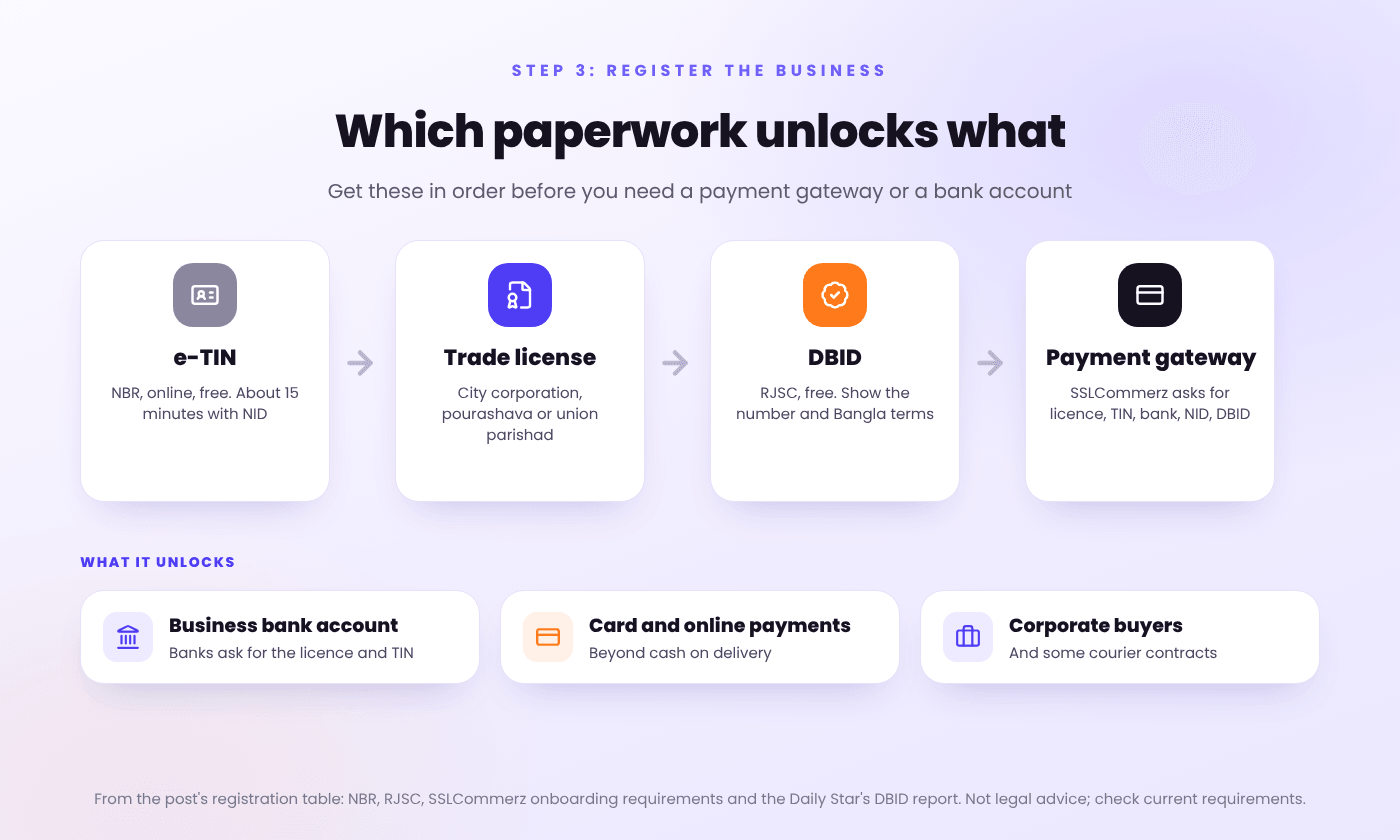
You can take orders on a Facebook page without any paperwork, and plenty of people do. The problem shows up later: payment gateways, banks and some courier contracts ask for documents you don't have, and you can't scale past cash on delivery without them. Get these four in order early.
| Registration | Issued by | Cost | Why you need it |
|---|---|---|---|
| Trade license | Your city corporation, pourashava or union parishad | Varies by business type and area, from about Tk 100 to over Tk 40,000 plus VAT | Legal right to operate; required by payment gateways and banks |
| e-TIN | National Board of Revenue (online) | Free | Needed for the trade license, bank accounts and gateway onboarding |
| DBID (Digital Business Identity) | RJSC, under the Ministry of Commerce | Free | Required by gateways such as SSLCommerz; proves you're a registered digital business |
| BIN (VAT registration) | National Board of Revenue | Free to register | Required for companies and partnerships, and for gateway onboarding in those cases |
Trade license: Apply to the local authority where your business operates. In Dhaka North, this is done online through the DNCC e-revenue portal. According to Jural Acuity's guide to trade license requirements, a sole proprietor typically needs their NID, photos, a rent agreement or proof of premises, a TIN certificate and a holding tax receipt. The license runs for one fiscal year, July to June, and must be renewed by 30 June.
e-TIN: This takes about 15 minutes online with your NID and a mobile number, as UNB's step-by-step e-TIN walkthrough explains. There's no fee and no office visit.
DBID: The Digital Business Identity was introduced so customers can trace who's behind an online shop. A Daily Star report on DBID rules says the owner's NID is enough to apply, and that you must show the DBID number on your website or page and publish your terms and conditions in Bangla. Approval has been slow: The Financial Express found that only about 13% of applications were accepted in the first year, mostly due to incomplete information or missing Bangla terms. Fill it in carefully the first time.
Once you're registered, you also have to follow the Digital Commerce Operation Guidelines 2021. The Daily Star's overview of the guidelines lists the main obligations: deliver within 5 days in the same city and 10 days elsewhere, publish clear purchase and return conditions, ask permission before collecting customer data, and keep business records for 6 years. Buyers look for these details too, so once you have them, display your trade license and return policy on your e-commerce website where people can see them before they order.
If you plan to raise investment or take on partners, register a private limited company with RJSC instead of a sole proprietorship. It costs more and takes longer, but it keeps your personal assets separate from the business.
Step 4: Set Up How You'll Get Paid
Most Bangladeshi shoppers still pay when the parcel arrives. A Bangladesh Bureau of Statistics survey reported in June 2026 found 86.8% of online shoppers pay cash on delivery, while only about 13.9% use bKash or Nagad. That's why it makes sense to design your checkout around cash on delivery first and treat digital payment as an extra option, not the main path.
You have three realistic options, and most growing shops end up using all three:
- Cash on delivery through your courier: The courier collects the cash and pays it to you, usually after deducting its charge. It's the easiest way to start, but you carry the risk of returns and refused parcels.
- A bKash or Nagad business account: For small and f-commerce sellers, the bKash Personal Retail Account needs only your NID and a fresh SIM registered to it. Receiving customer payments is free, and you can accept up to Tk 30,000 a day and Tk 500,000 a month. Asking for the delivery charge in advance on riskier orders, such as first orders from a new number or deliveries outside Dhaka, is the simplest way to cut fake orders. Keep that advance small, since larger prepayments bring escrow rules into play.
- A payment gateway on your website: Gateways such as SSLCommerz, aamarPay and shurjoPay let customers pay by card, mobile banking or internet banking at checkout. They ask for more paperwork. SSLCommerz's onboarding requirements for a sole proprietor include an updated trade license, TIN certificate, bank account, NID and a DBID, which is why Step 3 matters.
The shift is already happening. Card-based e-commerce payments reached Tk 24.67 billion in May 2026, the highest month in Bangladesh Bank's recent series, according to The Financial Express's analysis of card-based e-commerce spending.
Step 5: Sort Out Delivery Before Your First Order
Delivery is where most new online shops lose money in Bangladesh, mainly through returned cash-on-delivery parcels. Choose your courier before launch, not after the first order comes in.
The main e-commerce couriers are Pathao Courier, Steadfast, RedX and Paperfly, with Sundarban and SA Paribahan still common for district-level and bulk parcels. Scale varies a lot. The Daily Star reported that Pathao alone handles more than 250,000 orders a day with a delivery success rate above 95%.
When comparing couriers, ask each one the same five questions:
- What is the charge inside Dhaka, in sub-areas and outside Dhaka, and how does it change by weight?
- What is the cash-on-delivery collection fee?
- How quickly do they pay out collected cash, and to bKash or bank?
- What do they charge for a returned parcel?
- Do they offer pickup from your home or shop, and from what order volume?
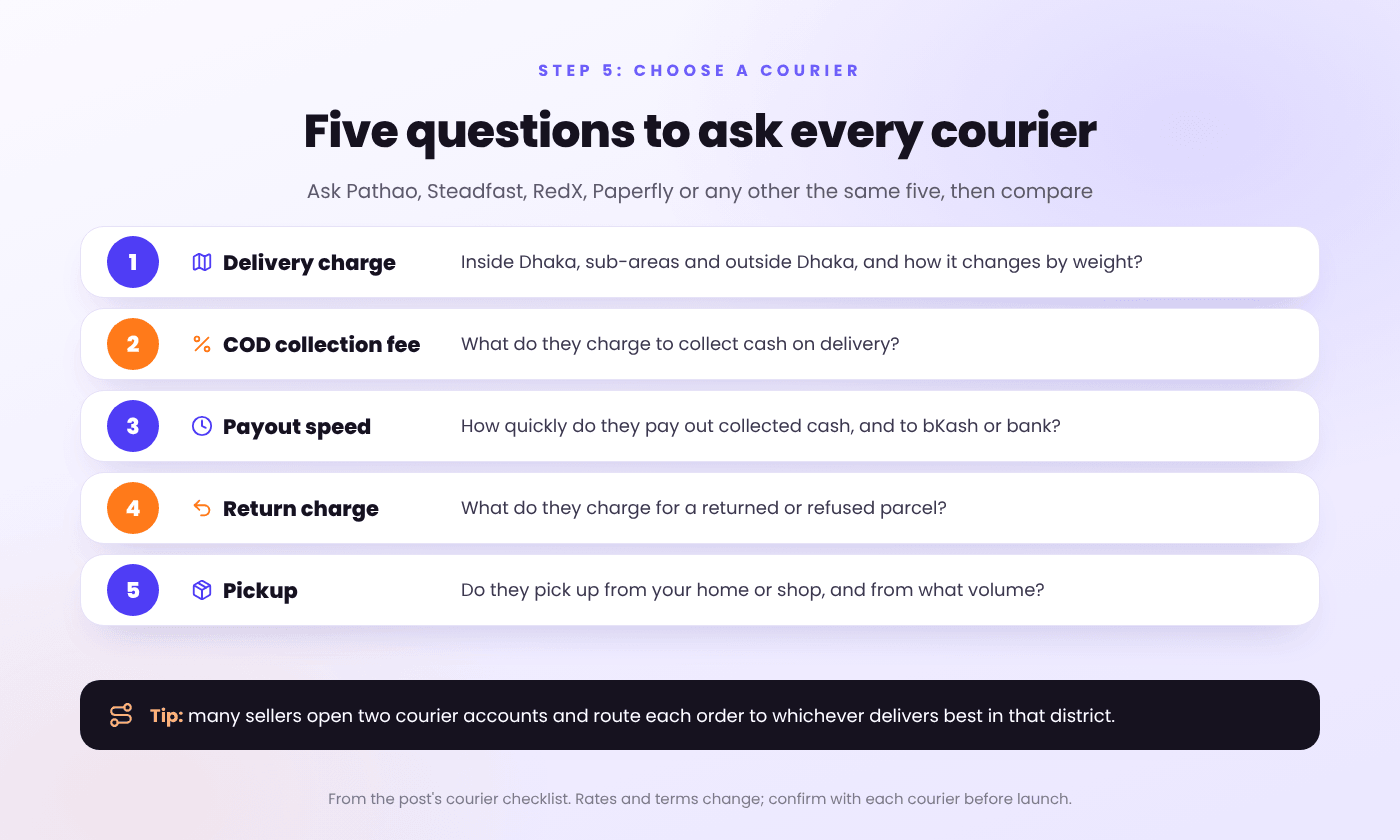
Many sellers open accounts with two couriers and route orders by area, using whichever has the better success rate in that district. Remember the legal deadline from Step 3 as well: 5 days for delivery in the same city and 10 days elsewhere.
Step 6: Decide Where You'll Sell
You don't have to pick just one channel, but you do have to pick where you start. Each one trades cost against control.
| Channel | Upfront cost | Who owns the customer | Best for |
|---|---|---|---|
| Facebook page and Instagram | Free to open; boosting costs extra | Meta does | Testing products and early sales |
| Marketplace (Daraz and similar) | Free to list; commission per sale | The marketplace does | Reaching buyers who already shop there |
| Your own website | Domain, hosting and build cost | You do | Search traffic, trust, repeat buyers |
For most first-time sellers, the sensible path is to start on Facebook while you test products, then build a website once you have repeat buyers, a bigger catalogue or people searching Google for what you sell. Over a full year, the real cost of running a Facebook page versus a website in Bangladesh often surprises sellers, because boosting posts keeps costing money while a basic site keeps working after the ad budget stops.
When you do build a site, keep it simple: a fast-loading product catalogue, clear prices, a visible return policy, cash on delivery at checkout, and your trade license and DBID in the footer. Register your domain early, even before the site is ready, so nobody else takes your brand name. If you'd rather not build it yourself, shortlist from the web design and development companies in Bangladesh that build online stores, and pick one that can set up the catalogue, payments and courier integration in one go.
Ready to move from a Facebook page to your own store?
Tell us what you sell and roughly how many products you have. We will suggest the simplest store setup for your stage: catalogue, cash on delivery, bKash and courier integration, with your trade license and DBID in the footer.
Step 7: Make Sure Customers Can Find You
A Facebook post reaches people for a day or two. A page that ranks on Google keeps bringing buyers for months, without paying for every click. This is where most small Bangladeshi online shops are weakest, and where a new business can overtake older competitors fastest.
Start with four things, in this order:
- Claim your Google Business Profile: It's free, and it puts your shop on Google Maps and in local results. Even a home-based business can list itself as a service-area business without showing the address.
- Get listed in the right places: Add consistent name, phone and address details by listing your shop on the business directories Bangladeshi buyers actually use, starting with the largest few rather than all of them.
- Build pages that answer real searches: Each product and category page should target what people type, in English and in Bangla transliteration, with real photos, prices and delivery details. Good e-commerce SEO for a Bangladeshi online store is mostly this: clear pages that prove you'll deliver.
- Check how AI tools describe you: More buyers now ask ChatGPT or Google's AI Mode for recommendations. Take ten minutes to see how ChatGPT and Google AI Mode describe your business, and fix wrong or missing details at the source.
If you need sales while search traffic builds, run a small-budget Google Ads campaign for your Bangladeshi business on your best-selling products only. And once the store is earning, a properly planned SEO campaign for an online store in Bangladesh is what turns those first rankings into a steady stream of orders you don't pay for one click at a time.
Want your shop found on Google from day one?
Our free website audit checks your store or page for speed, mobile, Google Business Profile and search basics, and shows the first three fixes we would make. Free, no obligation.
Common Mistakes New Online Sellers Make
Most failed online shops in Bangladesh don't fail because of the product. They fail on the basics around it.
- Buying stock before testing demand: A week of pre-orders tells you more than any amount of guessing, and costs nothing.
- Pricing without counting delivery and returns: Courier charges, cash-on-delivery fees and refused parcels come out of your margin. Price for them from the first order.
- Running without registration: It works until you need a payment gateway, a bank account or a corporate buyer. Then it stops you completely.
- Hiding who's behind the shop: Buyers in Bangladesh have been burned by e-commerce scams, so they look hard at how to tell whether an online business in Bangladesh is legitimate before they order. A real address, phone number, trade license and return policy remove that doubt.
- Depending on boosted posts forever: Paid reach stops the day the budget does. Search rankings and a customer list keep working.
- Missing the delivery deadline: The 5-day and 10-day limits under the Digital Commerce Operation Guidelines apply to small sellers too, and late parcels are the fastest way to collect bad reviews.
Launching soon? Get a second pair of eyes first.
Send us your launch plan, your website or your Facebook page. We will point out what is missing before your first orders: registration details, policies, checkout or search setup.
The Bottom Line
Starting an online business in Bangladesh is cheaper than ever, but the shops that last are the ones that get the unglamorous parts right: they test demand before buying stock, register properly, plan for cash on delivery, pick a reliable courier, and build a presence buyers can find on Google rather than relying on boosted posts alone. Do those seven steps in order and you'll be ahead of most online sellers in the country before you've spent much at all.
Planning to launch an online store and want it found on Google from day one? Talk to our team about building search into your launch plan, or see how other Bangladeshi brands grew in our case studies.
Want more of our work in your Google results?
Frequently asked questions
You can start taking orders on Facebook without one, and many sellers do. But payment gateways such as SSLCommerz, business bank accounts and many corporate buyers require a trade license, so you'll need one as soon as you want to grow beyond cash on delivery.
Comments
No comments yet. Be the first to share your thoughts.