
How to Grow an Online Business in Bangladesh
Pujan Kumar Saha · · 13 min read · Updated
Key takeaways
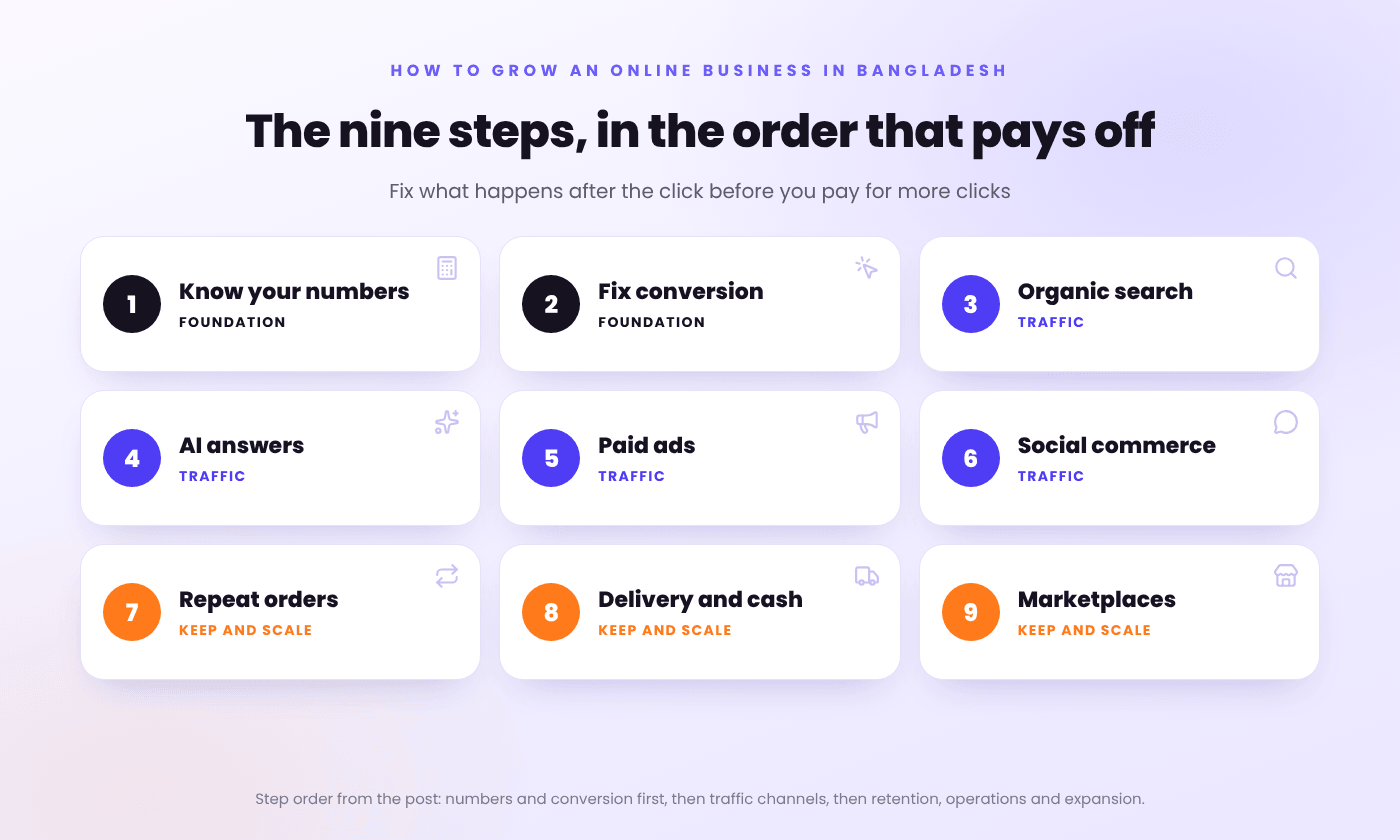
- Grow in the order that pays off: know your numbers, fix conversion, then add organic search, AI answers, paid ads and social commerce, then retention, operations and marketplaces.
- Measure every channel per delivered order, because cash-on-delivery refusals make the ad dashboard look better than the money you actually keep.
- Google handles almost all search in Bangladesh, and consistent mentions across directories and other sites help a store appear in AI answers.
- Repeat buyers, a courier scorecard and order confirmation before dispatch protect margin as order volume grows.
You grow an online business in Bangladesh by fixing what happens after the click before you pay for more clicks: a fast mobile store, a cash-on-delivery checkout people trust, and a delivery record that keeps orders from coming back. Once those hold, you add traffic from search, AI answers, Meta ads and social commerce, then earn repeat orders from customers you already paid to acquire.
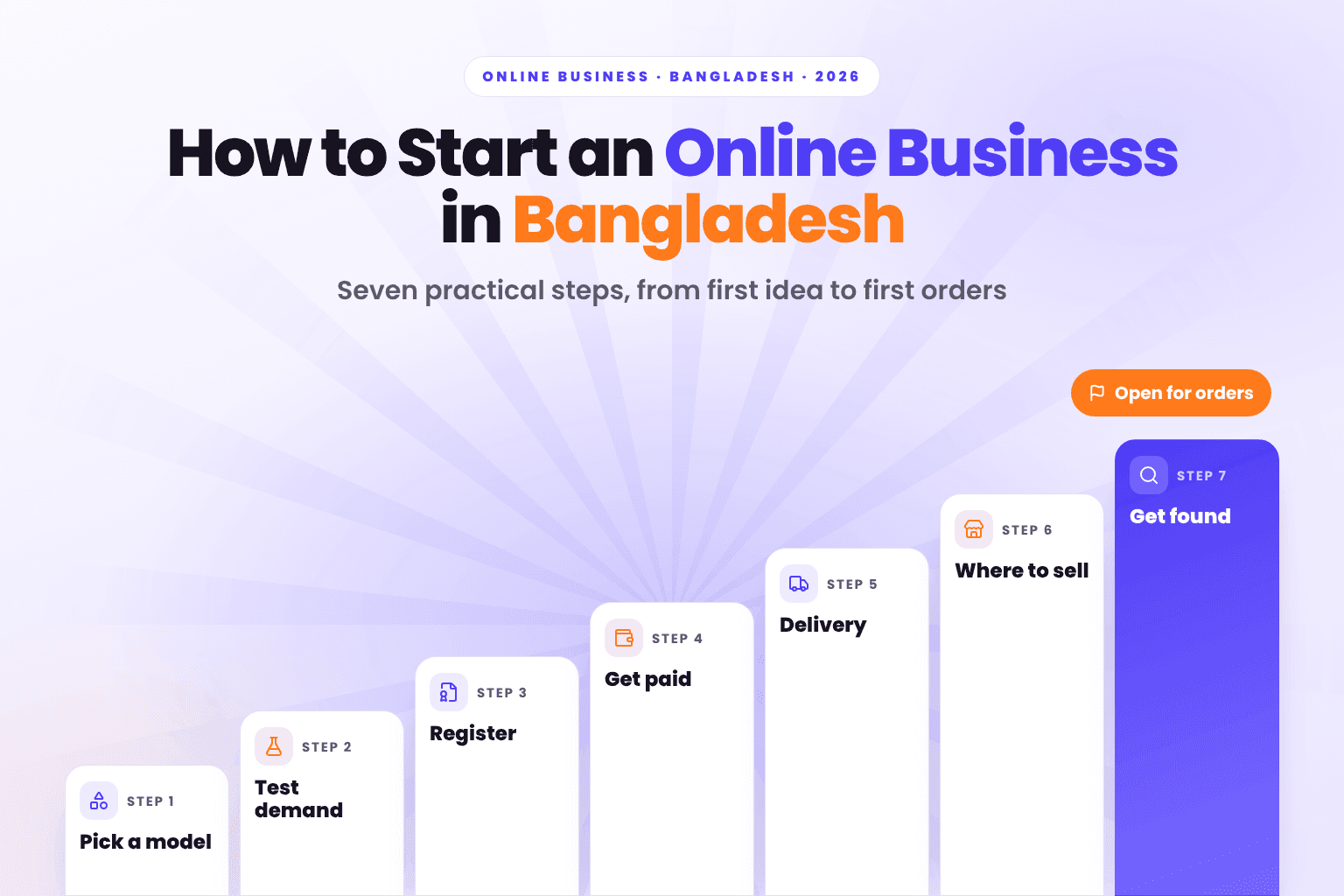
This guide assumes you have already launched. If you have not, work through the legal and setup steps to start an online business in Bangladesh the right way first, then come back. The nine steps below follow the order that usually pays off: numbers, conversion, search, AI answers, ads, social, retention, operations, and marketplaces.
Step 1: Know Your Numbers Before You Spend More
Growth that looks good on the ad dashboard often loses money at the doorstep. A Bangladeshi store pays for every order placed but only earns on orders that are delivered and accepted, so measure everything per delivered order.
| Number | How to work it out | What to watch for |
|---|---|---|
| Delivered rate | Delivered orders ÷ orders placed | Fake, duplicate and changed-mind COD orders pull it down. A falling rate calls for better order confirmation, not more ads. |
| Cost per delivered order | Ad and sales cost ÷ delivered orders | Always higher than cost per order placed. |
| Contribution margin per delivered order | Price − product cost − packaging − courier and COD fees − payment fees | The ceiling your cost per delivered order must stay under. |
| Conversion rate by channel | Orders ÷ sessions, split by source and device | Facebook in-app traffic, mobile search and desktop search convert differently. |
| 90-day repeat rate | Customers who order again within 90 days ÷ new customers | Decides how much you can afford to pay for a first order. |
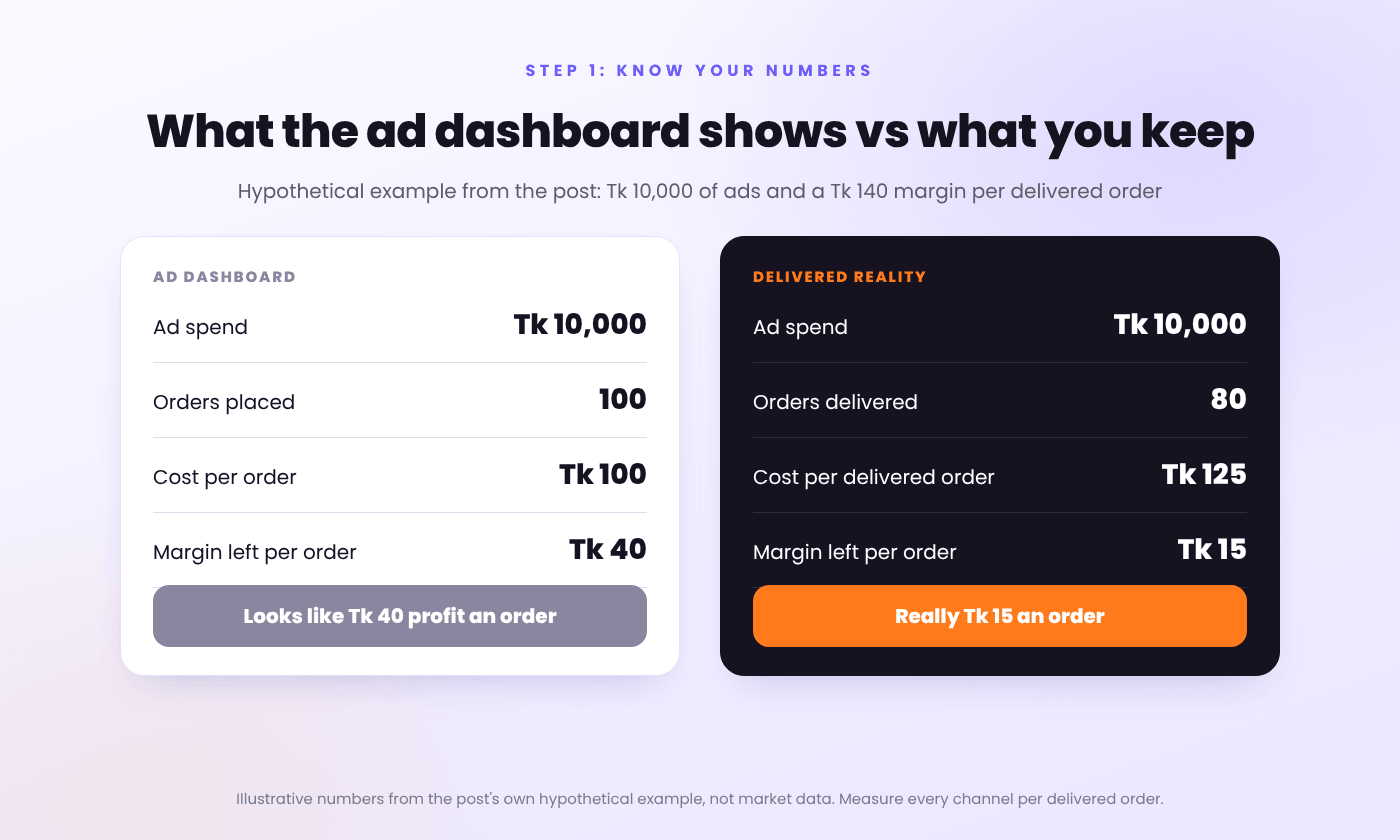
Here is a hypothetical example. You spend Tk 10,000 on ads and receive 100 orders, so the dashboard shows Tk 100 per order. Only 80 are delivered, so each delivered order really cost Tk 125. If your contribution margin is Tk 140 per delivered order, you keep Tk 15, not the Tk 40 the dashboard implies.
A spreadsheet with one row per week for each channel is enough to start. Fill it from your order system and courier reports, not from ad-platform screens.
Step 2: Fix Conversion Before You Buy More Traffic
Moving conversion from 1% to 2% doubles your orders without adding a taka of traffic cost, so audit the store before you scale spend. Most Bangladeshi shoppers still pay in cash at the door, which means hesitation, not payment friction, is usually what loses the sale.
- Check the store on a mid-range Android phone over mobile data, then on a desktop. Searchers here still split between the two, as the data on how desktop and mobile search behave in Bangladesh shows.
- Build the order form around cash on delivery. Ask for name, phone and full address only, and show the total with delivery charge before the buyer commits. A checkout built around cash on delivery in Bangladesh also needs a confirmation step that filters out fake orders.
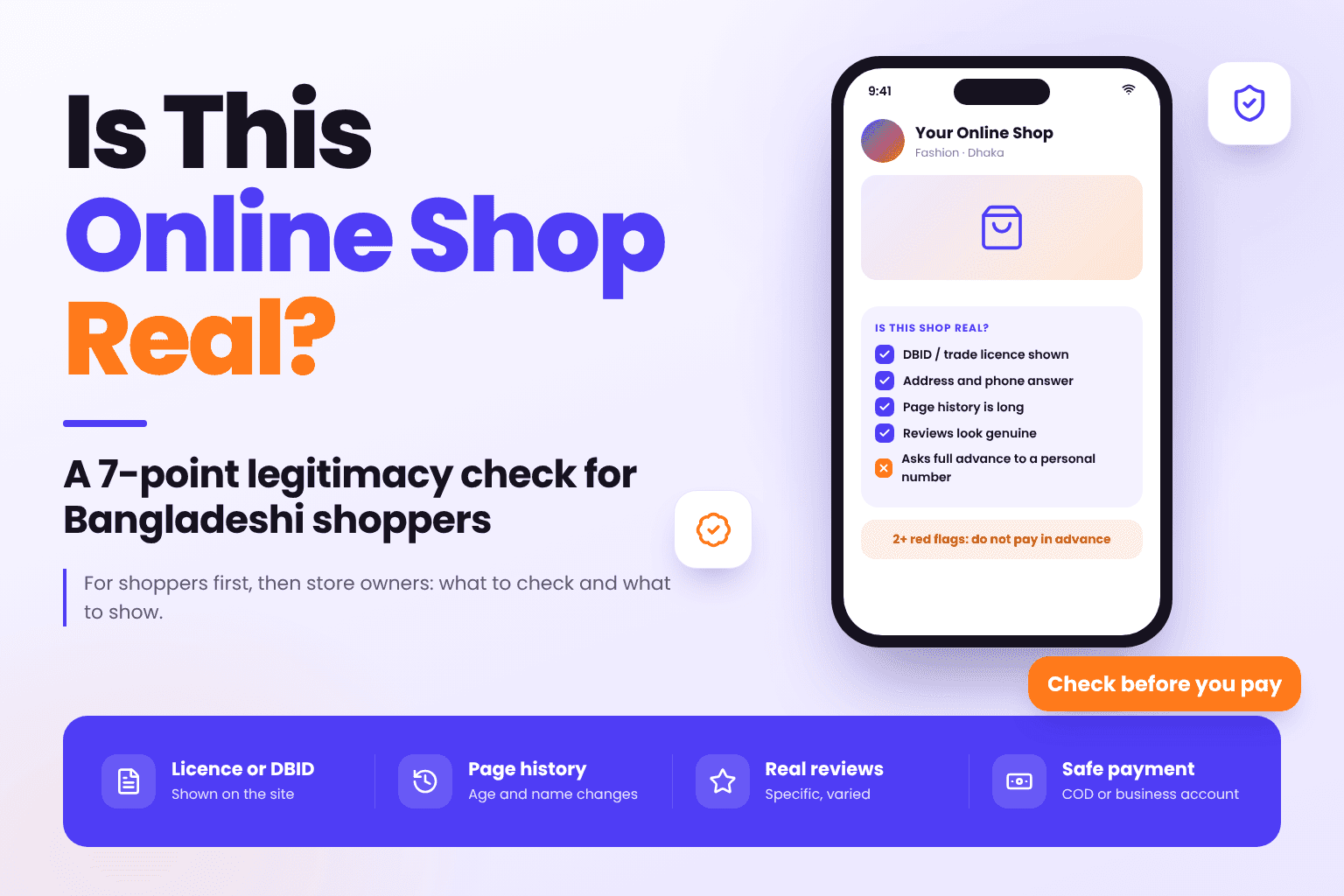
- Put proof next to the buy button: a working phone number, a physical address, your trade license number, a clear return policy and photos from real customers. The trust signals Bangladeshi shoppers look for before paying matter most on a first order from an unknown store.
- Offer bKash or Nagad beside cash on delivery, and test a small discount for paying in advance. Prepaid orders rarely get refused at the door.
- Confirm every order by call, SMS or WhatsApp before dispatch. A two-minute call costs less than a courier round trip for a refused parcel.
Change one thing at a time and give each change a week of orders before judging it.
Not sure where your store loses orders?
Our free audit checks your store on mobile and desktop: speed, checkout, trust details and search basics, and shows the first three fixes we would make before you spend more on ads. Free, no obligation.
Step 3: Grow Organic Search Traffic
Google handled 98.46% of searches in Bangladesh in October 2026 (StatCounter), so organic growth here means growth on Google. It is also the one channel where cost per order tends to fall as the store ages, because a ranking page keeps sending buyers after you stop paying for it.
- Match pages to what buyers type. Give every product category its own page and check the phrasing people use, including Bangla and mixed Bangla-English searches such as "panjabi price in Bangladesh" (an illustrative query, so confirm the real ones in Google Search Console).
- Make product pages worth ranking. Write unique descriptions, show the price in Tk, state stock, delivery areas and delivery time, and add real photos. Manufacturer copy pasted from a supplier ranks nowhere.
- Add the technical basics: Product schema with price in BDT and availability, clean URLs, an XML sitemap, and noindex on filter and sort URLs that create duplicates. Page speed on mobile data matters as much as any of it.
- Publish buying guides for the questions that come before a purchase, and link each guide to the category it leads to. The e-commerce SEO strategies that suit smaller Bangladeshi online stores cover this structure in more depth.
- Keep your business details identical everywhere they appear. Claim your listings on the business directories in Bangladesh that carry real traffic, and set up a Google Business Profile if you have a shop or pickup point.
Search results take months to build, so judge this channel on a quarterly trend, not a weekly one. If you would rather not run it in-house, a steady SEO campaign built around a Bangladeshi online store is the usual way to keep it consistent.
Step 4: Get Found in AI Answers
Shoppers now ask ChatGPT, Gemini and Google's AI Mode where to buy things, and those tools name a handful of stores instead of listing ten blue links. In Whitespark's 2026 local search survey, three of the top five AI search visibility factors were citation factors, and its author summarised the shift as "mentions are the new link." For a store, that means other sites describing you consistently matters as much as your own pages.
- Test first. Ask the major AI tools the questions a buyer would ask, such as "where can I buy [your product] in Dhaka?", and record which stores they name and which pages they cite. You can ask ChatGPT what it says about your business and compare the answer with your own listings to find the gaps.
- Lead key pages with a direct answer. A category page should state in its first two sentences what you sell, where you deliver, the price range in Tk and your return rule.
- Earn mentions off your own site. Directory listings, marketplace profiles, local blogs, review pages and "best of" roundups all count, and each should repeat the same name, address, phone number and product claims.
- Fix inconsistencies. Research compiled by Visionary Marketing, drawing on Semrush data, found that 74% of businesses with mismatched name, address and phone details across three or more sources were left out of Google AI Mode's local answers.
- Answer real questions on the page. Add an FAQ with the questions customers actually send you, and mark it up with FAQ schema only if the visible text matches.
Nobody can promise a place in an AI answer, so treat this as a visibility habit and re-run your test prompts every month. Teams that want it handled can look at answer engine optimization work for an online store.
Do Google and AI tools recommend your store?
Tell us your store and your best-selling products. We will check how you appear in Google and in AI answers such as ChatGPT and Google AI Mode, and what is missing.
Step 5: Run Paid Ads on a Small Budget
Paid ads are the fastest lever you have, and the easiest way to burn cash. Meta's tools reached about 64.0 million Facebook users in Bangladesh in late 2025 (DataReportal), so audience size is never your constraint. Your constraint is the margin each delivered order leaves you, which you worked out in Step 1.
- Start with one product that already sells organically or through your page. Run two or three creatives in Bangla, showing the product in use, the price in Tk and cash on delivery.
- Pick one objective per campaign: website orders if your store converts well, or click-to-message if most of your sales close in Messenger or WhatsApp.
- Set a daily budget you can afford to lose for a week, and avoid editing the campaign during that time so the platform can learn.
- Judge results on cost per delivered order, not on the cost per purchase that the ad dashboard shows.
- Retarget people who viewed a product, started checkout or bought before. These audiences are small but usually the cheapest orders you will get.
- Add Google Search for people already looking to buy. Brand and high-intent product queries are the place to begin, and the same logic applies to running Google Ads on a small budget in Bangladesh: few keywords, tight match types and a daily review of search terms.
Raise a campaign's budget in modest steps, around 20% at a time (a common rule of thumb, not a platform rule), and only while cost per delivered order stays below your margin.
Step 6: Use Social Commerce Without Living on It
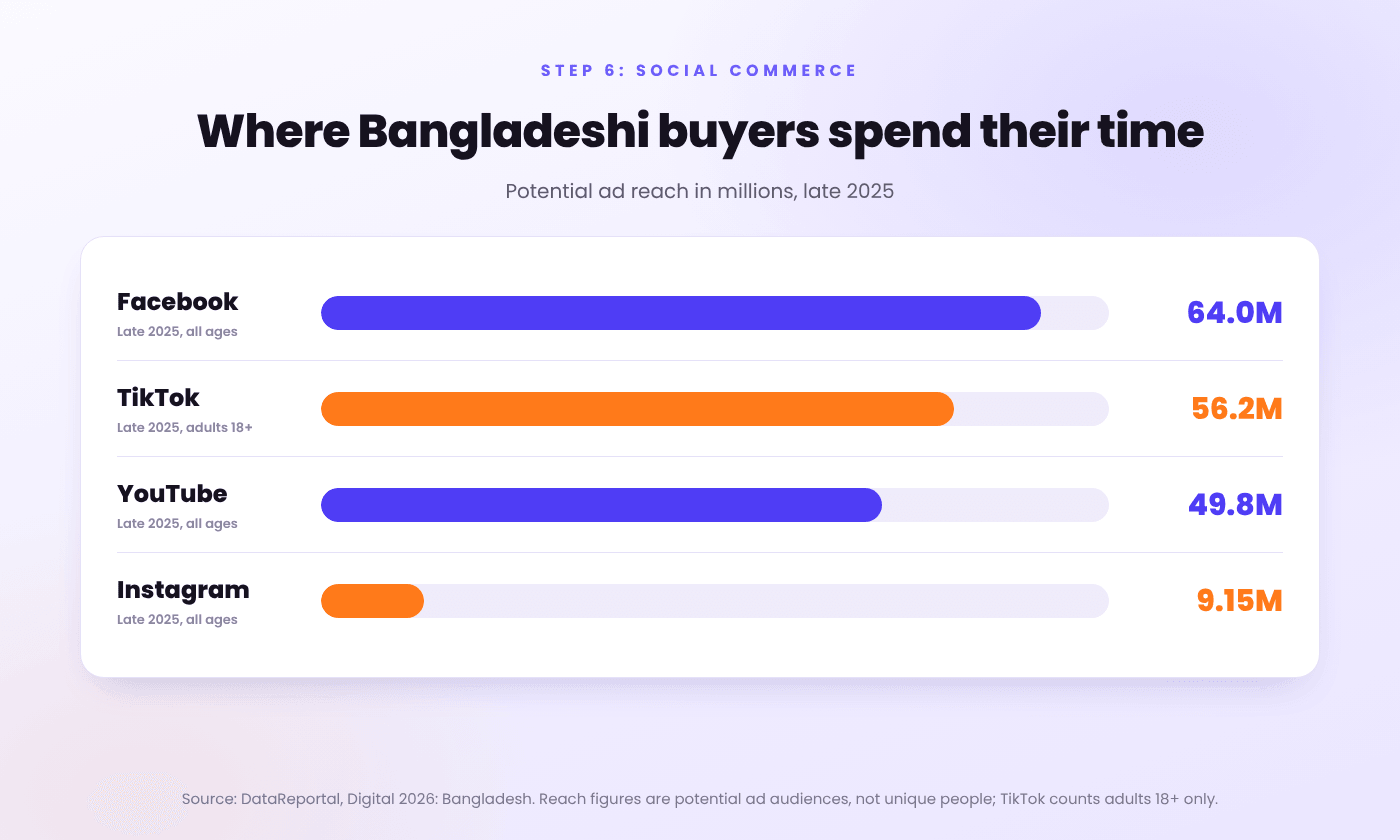
Facebook, TikTok, YouTube and Instagram are where Bangladeshi buyers spend their time, and many small stores sell almost entirely through a Facebook page and Messenger. DataReportal's late-2025 figures show how the audiences compare.
| Platform | Ad reach in Bangladesh | Period and basis |
|---|---|---|
| 64.0 million | Late 2025, all ages | |
| TikTok | 56.2 million | Late 2025, adults 18+ |
| YouTube | 49.8 million | Late 2025, all ages |
| 9.15 million | Late 2025, all ages |
Source: DataReportal, Digital 2026: Bangladesh. Reach figures are potential ad audiences, not unique people, and Meta has revised its audience data.
Turn that attention into orders with a few habits:
- Post product videos that show size, texture and use, since buyers who cannot touch the item want proof. TikTok and Reels suit this best.
- Answer Messenger and WhatsApp messages quickly, with saved replies for price, delivery time and return policy.
- Send every social buyer to one place that records the order, whether that is your website or a simple order sheet, so you can track repeat customers.
- Treat the page as a channel, not an asset. Platform rules, reach and account access can change without notice, so collect phone numbers and emails you own.
If you are deciding where the store should live, the trade-offs are worked through in the post on whether a Facebook page is enough or a website is worth building for a Bangladeshi online business.
Step 7: Earn Repeat Orders and Reviews
A customer who has already received a parcel from you and found it matched the photo is the cheapest buyer you will ever reach. Retention work is mostly small follow-ups done on time.
- Message every buyer after delivery. A short SMS or WhatsApp note asking whether the product arrived as expected catches problems before they become bad reviews.
- Ask for a review when the buyer is happy, with a direct link to the place you want it: your Google Business Profile, your product page or your Facebook page.
- Reply to every review, including the negative ones, with a specific fix. Prospective buyers read the replies as closely as the ratings.
- Bring buyers back with reasons that fit the product: a refill reminder, a matching item, early access to a new batch, or a festival offer ahead of Eid or Pohela Boishakh.
- Keep a customer list with name, phone, last order date and product. Even a spreadsheet lets you message the right people about the right item.
- Offer a small reward for referrals, such as a discount on the next order for both people.
Track the 90-day repeat rate from Step 1. If it sits near zero, look at product quality and delivery experience before you add more ad spend.
Step 8: Tighten Delivery, Returns and Cash Flow
Every extra order you win puts more weight on couriers, packing and cash collection. Operations decide whether growth makes money, because a refused parcel costs you the product's trip out, its trip back and the ad spend that sold it.
| Area | What to do | What it protects |
|---|---|---|
| Courier scorecard | Record delivered rate, return rate, damage and days to remit COD cash for each courier, by district | Your delivered rate and your cash |
| Courier mix | Use two couriers and route each district to whichever performs better there | Against one partner's bad week |
| Refusal control | Call before dispatch, keep a list of phone numbers that repeatedly refuse, and ask for advance payment on risky orders | Cost per delivered order |
| Packing | Protect fragile items, add an invoice and a card with your page and phone number | Reviews and repeat orders |
| Returns | Publish a short rule, inspect returns the day they arrive and restock sellable items | Trust and inventory |
| Stock | Set a reorder point for your best sellers before you raise ad budgets | Ad spend wasted on sold-out items |
| Cash flow | Plan for the days between delivery and COD remittance when you order stock | Your ability to keep buying inventory |
When daily orders outgrow a spreadsheet, move to an order management tool that prints courier labels and tracks status. Do it before the backlog starts producing wrong parcels, not after.
Step 9: Add Marketplaces and Expand Carefully
Once your own store has stable numbers, add a second sales channel or a wider product range, one at a time and with a margin test before you commit stock.
- Test a marketplace such as Daraz with your best three products. Marketplaces bring ready buyers, but they also bring price comparison, platform fees and customer data you do not own, so check that the margin survives before you list your whole range.
- Use the marketplace as a discovery channel. Put your brand name on the packaging and invite buyers to your own page or store for the next order.
- Expand the range through what existing buyers already ask for in messages and reviews, not through what looks trendy.
- Open new districts by adding couriers with good coverage there, and check your delivered rate for the new area after the first two weeks.
- Look at wholesale or B2B orders if your product suits them. Order sizes are larger and refusals are rarer, though payment terms need care.
- Be realistic about cross-border selling. Capital controls limit it, as the U.S. International Trade Administration's Bangladesh e-commerce guide notes, so confirm the payment route before you promise international delivery.
When the store itself starts limiting growth, whether through slow pages, weak catalogue tools or messy checkout, rebuild it deliberately. A shortlist of web design and development companies in Bangladesh that rebuild online stores for growth is a fair place to start.
Common Growth Mistakes
- Scaling ads while the delivered rate is falling. More orders placed can mean less money earned.
- Judging every channel by last-click orders. Search and social often work together, so compare cost per delivered order across a month, not a day.
- Discounting to win orders without checking margin after courier and COD fees.
- Running everything through a Facebook page with no list of customer phone numbers or emails you own.
- Ignoring doubts about legitimacy. Buyers regularly ask whether an online business in Bangladesh is legit, so show your registration, address and return rules on the page before they ask.
- Changing five things at once, so you cannot tell which one worked.
- Adding a marketplace, a new product line and a second courier in the same month.
Want a growth plan built around your own numbers?
Send us your monthly orders, delivered rate and channels. We will suggest which of the nine steps to do first for your store, and what to leave for later.
The Bottom Line
Growth in Bangladesh comes from the order that reaches the customer and stays sold, so measure delivered orders, fix the store and checkout, then add search, AI visibility, ads and social in that order. Repeat buyers and tight operations keep each new channel profitable.
Want a second pair of eyes on your numbers and channels? Talk to our team about a growth plan for your online store, or browse the results we have delivered for Bangladeshi businesses.
Want more of our work in your Google results?
Frequently asked questions
Fix conversion and order confirmation first, then run small paid campaigns on Meta and Google while search and AI visibility build in the background. Paid ads move fastest, but they only pay off once your delivered rate and margin per delivered order are known.

Comments
No comments yet. Be the first to share your thoughts.