
Is AEO Replacing SEO? Separating Hype from Reality in the Bangladeshi Market {Infographic}
Pujan Kumar Saha · August 8, 2026 · 10 min read · Updated August 18, 2026
Key takeaways
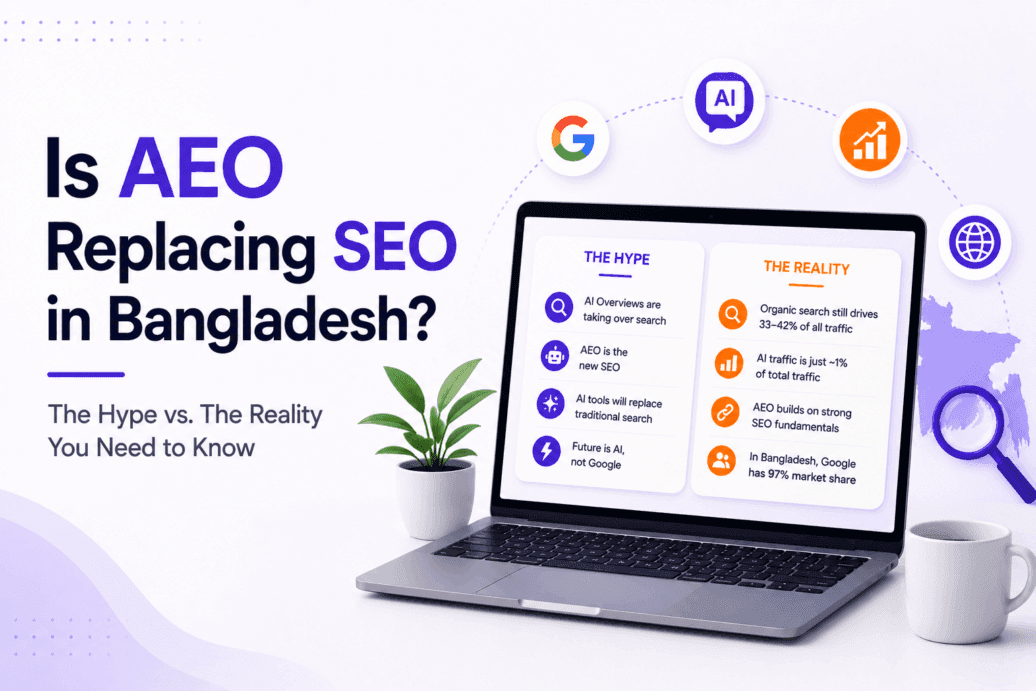
- "SEO is dead" and "AEO is the new SEO" are marketing claims, not conclusions the underlying data actually supports.
- The hype is even more overstated in Bangladesh, where Google's dominance is more extreme than the global average that most of this commentary is built on.
- Standalone AI chat adoption in Bangladesh is real but still concentrated in a narrow slice of the population, so it cannot yet carry a business's visibility on its own.
- AEO cannot skip past SEO locally, because most Bangladeshi businesses have not completed the SEO foundations that answer engines draw on in the first place.
This piece is the reality check: what’s genuinely true about AEO, what’s overstated, and what it specifically means if you’re running a business here rather than in a market where AI chat apps are already a daily habit for the mass market.
The Hype: Why Everyone’s Saying SEO Is Dying
The hype isn’t baseless. It’s built on real numbers.
- AI Overviews now appear in roughly a quarter to nearly half of all Google searches, depending on the study, and when one shows up, Pew Research Center’s tracking of actual browsing behavior found that users click a traditional search result in just 8% of visits, compared to 15% when no AI summary is present.
- ChatGPT alone was processing roughly 2.5 billion messages a day by late 2025, with more than 700 million weekly users, about 10% of the world’s adult population, according to reporting picked up by the Asia News Network.
- Referral traffic from AI platforms to websites grew a real, measurable 16x between 2024 and 2026, according to SE Ranking’s traffic study.
- Visitors who do arrive from AI platforms convert dramatically better. One large benchmark from Conductor, covering 13,770 enterprise domains and 3.3 billion sessions, found AI-referred visitors converting at multiples of the standard organic rate, and spending significantly more time on-site once they land.
Read only these numbers and “SEO is over” sounds reasonable. It isn’t, and the same research that produced these headlines also contains the correction.
The Reality Check: What the Same Data Actually Shows
Here’s what usually gets left out of the hype: AI referral traffic, for all its growth, is still a very small slice of the total traffic pie.
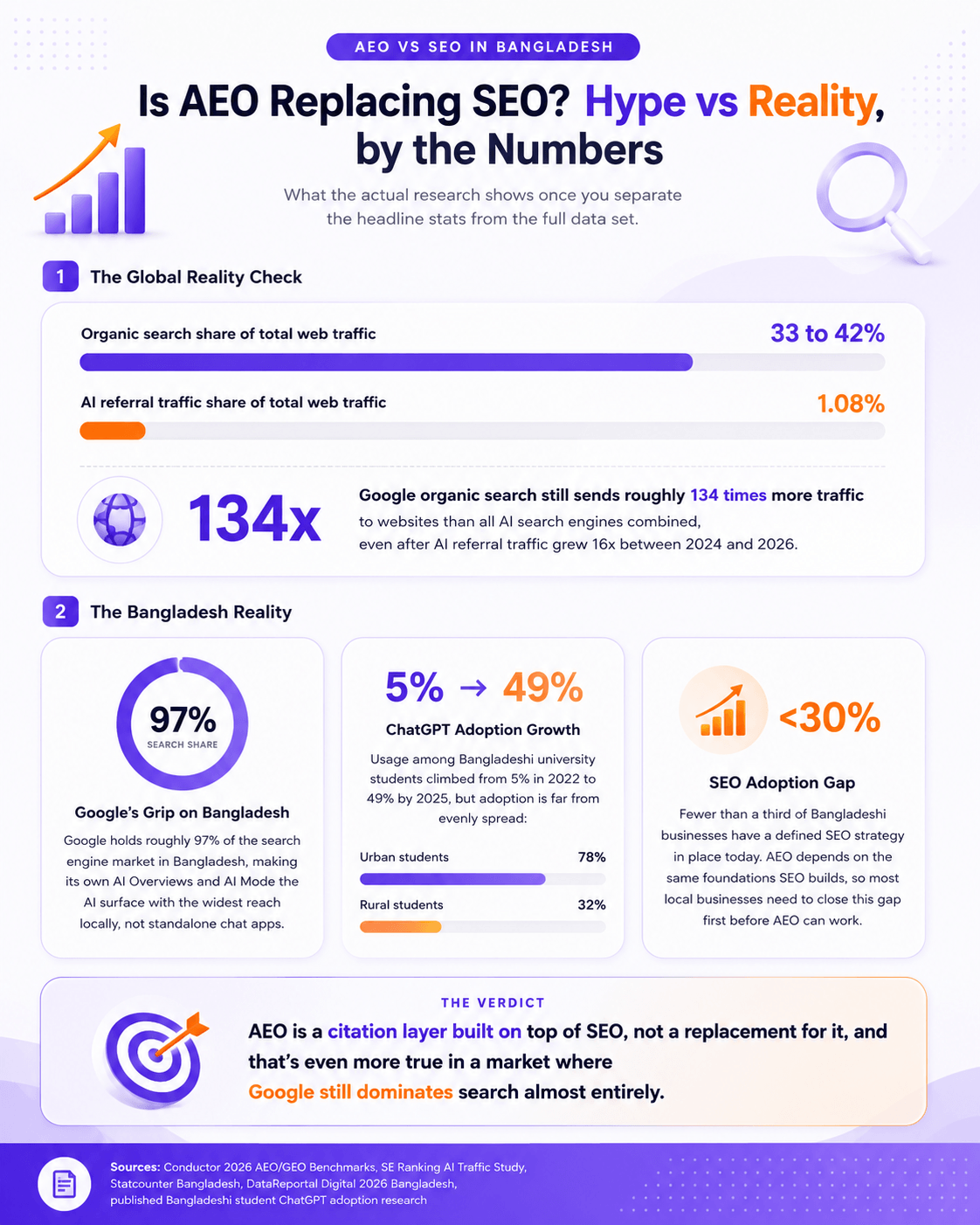
That same Conductor benchmark, the one showing the 16x growth, also found AI referral traffic sitting at just 1.08% of total website traffic on average, while organic search still accounted for 33% to 42% of visits across the industries studied. SE Ranking’s independent analysis puts it even more plainly: Google organic search still sends roughly 134 times more traffic to websites than all AI search engines combined, down from a 300x gap at the start of 2025, but still an enormous distance from “replacement.”
Perhaps the clearest summary of the actual research consensus comes from Analyze.ai’s read of the same benchmark data: AI hasn’t replaced anything, it has shown up as a new, fast-growing channel sitting alongside email, social, and paid search, not in place of organic search. The pages that perform well inside AI answers tend to be the same buyer-intent pages that already perform well on Google, just structured slightly differently for how AI systems extract information.
This is the actual relationship: AEO is a layer built on top of strong SEO fundamentals (technical health, authoritative content, structured data), not a separate discipline competing for the same budget. A business that abandons its SEO program to “chase AI” is optimizing for roughly 1% of its potential traffic while neglecting the channel still responsible for a third or more of it.
Why the Hype Is Even More Overstated in Bangladesh
If the global numbers already show AEO as additive rather than a replacement, the picture shifts further once you apply it to Bangladesh specifically, for three concrete, local reasons.
1. Google’s dominance in Bangladesh is even more extreme than the global average
Globally, Google faces some competition from Bing and regional search engines. In Bangladesh, it barely does. Google holds roughly 97% of the search engine market share here, a near-monopoly that means the “AI layer” most likely to matter for a Bangladeshi business in the near term isn’t a standalone chat app at all. It’s Google’s own AI Overviews and AI Mode, which ride directly on top of the search engine 97% of the country already uses, rather than requiring anyone to adopt a separate app.
2. Standalone AI chat adoption is real, but still concentrated in a narrow slice of the population
The growth of ChatGPT usage in Bangladesh is genuinely striking: one study tracking Bangladeshi university students found usage climbing from just 5% in 2022 to 49% by 2025. But that same research is explicit about who’s driving it: adoption splits sharply between 78% among urban students versus 32% among rural students, according to the published study. Layer that against DataReportal’s Digital 2026 Bangladesh figures, roughly 82.8 million internet users out of a population of over 170 million, with internet penetration still around 47%, and the honest picture is that today’s active ChatGPT-style AI user in Bangladesh skews young, urban, and already internet-connected. It’s a real and fast-growing audience, but it isn’t yet the mass-market audience that Google search already reaches.
3. SEO adoption among local businesses hasn’t caught up yet, so AEO can’t skip past it
By most industry estimates, fewer than a third of Bangladeshi businesses have a defined SEO strategy in place at all. That matters directly here: AEO doesn’t work as a shortcut around SEO, it depends on the same foundations (indexable, well-structured, authoritative content) that most local businesses haven’t built yet. Telling a Bangladeshi business to “focus on AEO instead of SEO” when their site may not even be properly indexed yet isn’t forward-thinking advice. It’s skipping a step that hasn’t been completed.
None of this means AEO doesn’t matter in Bangladesh. It means the opportunity here looks different from the US/UK narrative: it’s less “abandon Google rankings for ChatGPT visibility” and more “make sure you’re structured to be cited inside Google’s own AI Overviews and AI Mode,” since that’s the AI surface already reaching the audience your business can actually access today.
Where SEO and AEO Genuinely Overlap: Proof From Our Own Campaigns
The most convincing argument against “AEO replaces SEO” isn’t theoretical; it’s that the same underlying work produces both outcomes. Every AEO win we’ve delivered for a Bangladeshi client has come from strengthening the same fundamentals that also drive traditional rankings, not from a separate playbook.
JCX Developments needed stronger visibility and keyword rankings through standard SEO work, and that same optimized, well-structured content is what got them ranked inside Google’s AI Mode for real estate developer queries within a 6-month AEO campaign, the identical content strategy powering both outcomes.
Rangs eMart had poor visibility on non-branded keywords in traditional search. Once we optimized their website with the technical and content fundamentals that any solid SEO campaign requires, they moved into the top of both classic rankings and Google’s AI Mode answer for “best phone under 20,000 in Bangladesh 2026” within 3 months.
Green Delta Insurance lacked proper visibility across the board, not just in AI answers, but generally. Optimizing their content and site structure for both human users and AI systems together is what got them cited in Google’s AI Overview for non-life insurance queries within 6 months.
Seraphic Associates, meanwhile, is a case built entirely on traditional SEO fundamentals: technical fixes, content strategy, and a cleaned-up backlink profile, and it produced a 73% increase in organic traffic and 60+ keywords ranked. That’s the foundation. AEO builds the citation layer on top of exactly that kind of foundation; it doesn’t substitute for it.
In every one of these cases, there was no “SEO budget” and a separate “AEO budget” competing against each other. It was one strategy, structured to win visibility wherever the customer’s question gets answered: Google’s classic results, Google’s AI Overview, or Google’s AI Mode.
What Bangladeshi Businesses Should Actually Do
Given all this, the practical framework isn’t “switch to AEO.” It’s “build SEO properly, then layer AEO on top of it,” in roughly this order:
- Get the SEO foundation right first. Technical health, indexability, mobile performance, and local SEO fundamentals still matter more than anything else, especially since most local competitors haven’t done this yet.
- Structure content to be extractable, not just readable. Clear, direct answers near the top of key pages help both classic snippets and AI-generated summaries pull from your content accurately.
- Prioritize being cited inside Google’s AI Overviews and AI Mode over chasing ChatGPT specifically. For now, that’s the AI surface actually reaching the audience your business can realistically access in Bangladesh, since it sits inside the search engine 97% of the country already uses.
- Add schema markup and keep content fresh. These are the same signals that help both traditional rankings and AI citation eligibility. There’s no separate technical checklist for one versus the other.
- Watch, but don’t over-invest in, standalone AI chat visibility yet. Track it, understand it, and start building for it, particularly if you serve a younger, urban, English-comfortable audience, but don’t redirect your core SEO budget toward it while the addressable audience is still a fraction of your total market.
- Treat AEO as an addition to your reporting, not a replacement metric. If you’re only tracking rankings and organic sessions, add AI citation visibility as a new line item, not a swap for the metrics that still represent the overwhelming majority of your traffic.
The Verdict
AEO isn’t hype in the sense of being fake. The shift in how people get answers is real, measurable, and accelerating. But “AEO is replacing SEO” is the overstated part. The data, both globally and specifically in Bangladesh, points to the same conclusion: AEO is a citation layer built on top of solid SEO, not a rival discipline pulling budget away from it. In a market where Google still commands the search landscape almost entirely and most competitors haven’t finished the SEO fundamentals yet, the businesses that will actually benefit from the AI-search shift are the ones treating it as an extension of their existing strategy, not a replacement for it.
Not sure whether your business needs to start with SEO fundamentals or is ready to layer on AEO? Talk to our team for a free assessment, or see how we’ve combined both in our full portfolio of case studies.
Want more of our work in your Google results?
Frequently asked questions
No. Industry benchmarks show AI referral traffic still accounts for roughly 1% of total website traffic globally, compared to 33-42% from organic search. AEO builds on SEO fundamentals rather than substituting for them.
Comments
No comments yet. Be the first to share your thoughts.